

Picking Your Perfect Tractor Buddy: A Super Simple Guide
Imagine you're getting a new best friend to help you with all the heavy lifting on your farm. That friend is a tractor! But just like picking the right pair of shoes, you need to choose a tractor that fits your land and your chores. This guide will walk you through everything, step by step, like we're chatting in a treehouse. Plus, hidden along the way are six Science Corners that will teach you cool things about how tractors really work. Let's dive in!
We'll use their machines to give you real examples throughout this guide—because the best way to understand tractor choices is to see them on real models!
Step 1: Get to Know Your Land – How Big Is It, Really?
Before you even look at a tractor, you need to measure your playground—um, I mean your land. Think of your land as a giant pizza: a small slice, a medium slice, or a huge party pizza? Here's the rule of thumb:
Small slice (less than 10 acres): Like a big backyard or a tiny farm. You need a compact or sub-compact tractor—think of it as a zippy little go-kart. It can mow grass, pull a tiny plow, and carry light stuff. Easy to turn around in tight spots.
Medium slice (10 to 50 acres): Now we're talking a real farm! You need a utility tractor—like a sturdy pickup truck. More muscles (that's horsepower), stronger lifting arms. It can handle big mowing, plowing, and hauling heavy things all day.
Large slice (over 50 acres): This is a BIG operation. You need a full-size, powerful tractor—like a monster truck or a tank. Huge horsepower, giant wheels, and fancy features for planting, watering, and towing super-heavy gear.
If you're looking at Haichuan's lineup for a small slice (under 10 acres), their 28HP or 32HP models are a great fit—nimble enough to zip around tight corners, yet strong enough to handle basic tilling and hauling around a smaller property.
? SCIENCE CORNER ①: Why Are Tractor Rear Wheels So Big?
Have you noticed that many tractors have rear wheels much larger than the front ones, with deep, chunky treads? That's because most of the tractor's work—like plowing—requires the rear wheels to push. The rear wheels are the "drive wheels." Bigger rear wheels grip more soil and provide better traction so the tractor doesn't spin out. The front wheels are mainly for steering, so being smaller makes them more nimble. As for those deep treads, they act like the teeth on your hiking boots, biting into mud and dirt to prevent slipping. Next time you jump in a muddy puddle, check your footprints—they look a lot like tractor tire tracks, don't they?
Step 2: What Chores Will Your Tractor Do? (Make a Chore Chart!)
Your tractor is like a Swiss Army knife—it can do many jobs, but you need to know which attachments (extra tools) you'll want. Let's list common chores:
Plowing & tilling: Flipping soil like a giant spoon stirring soup. You need a tractor with a strong PTO (Power Take-Off). What's PTO? Imagine a spinning power outlet on the back of the tractor—it sends power to spinning tools like tillers. Without PTO, a plow just sits there.
Mowing: Cutting grass or hay. For small yards, a little mower deck underneath works great. For big fields, you need a rotary cutter—like a helicopter blade on wheels.
Hauling & towing: Moving hay bales, pulling a trailer of rocks, or dragging logs. You need a tractor with a three-point hitch (a fancy triangle-shaped hook in the back) and strong hydraulics. Hydraulics are like your muscles but made of oil and pipes—they push and pull super hard.
Planting & harvesting: For big farms, you need special planters and harvesters. That's for the big monster tractors.
Haichuan's 45HP utility tractor is a perfect mid-range example for the medium-slice farm: it can handle all of the above—plowing, mowing, hauling—with a reliable four-cylinder engine and a smooth 8F + 2R gearbox. One less thing to worry about.
? SCIENCE CORNER ②: Why Is Hydraulics So Powerful?
Have you ever squeezed a syringe with your finger blocking the tip? You can't push it in, can you? That's hydraulics in action! A hydraulic system is filled with special oil that acts like an extremely thick syringe. When a part called the "hydraulic pump" (driven by the engine) spins, it pushes hard on the oil. That oil travels through metal pipes to a "hydraulic cylinder"—a steel tube containing a piston—and pushes it. Oil can barely be compressed (unlike air, which squishes easily), so nearly all the pushing force gets transmitted. Plus, because the cylinder is wide, the force gets multiplied many times over. A compact tractor's hydraulic system can easily lift hundreds of kilograms—stronger than any human!
Step 3: Engine Power – How Many Ponies Are Under the Hood?
We measure engine power in horsepower (HP). Think of it like this: 1 HP is the strength of one workhorse. So a 30 HP tractor is like having 30 strong ponies pulling at once. But ponies eat fuel (aka, gas), so more ponies also means more money.
Under 30 HP (little ponies): Great for mowing lawns, light hauling. Very fuel-efficient. Easy to park in a small shed.
30–70 HP (medium ponies): The sweet spot for most medium farms. Can plow, till, mow, haul—a real all-rounder.
Over 70 HP (big, strong draft horses): For heavy farming. These tractors are huge, thirsty for fuel, but they can pull almost anything.
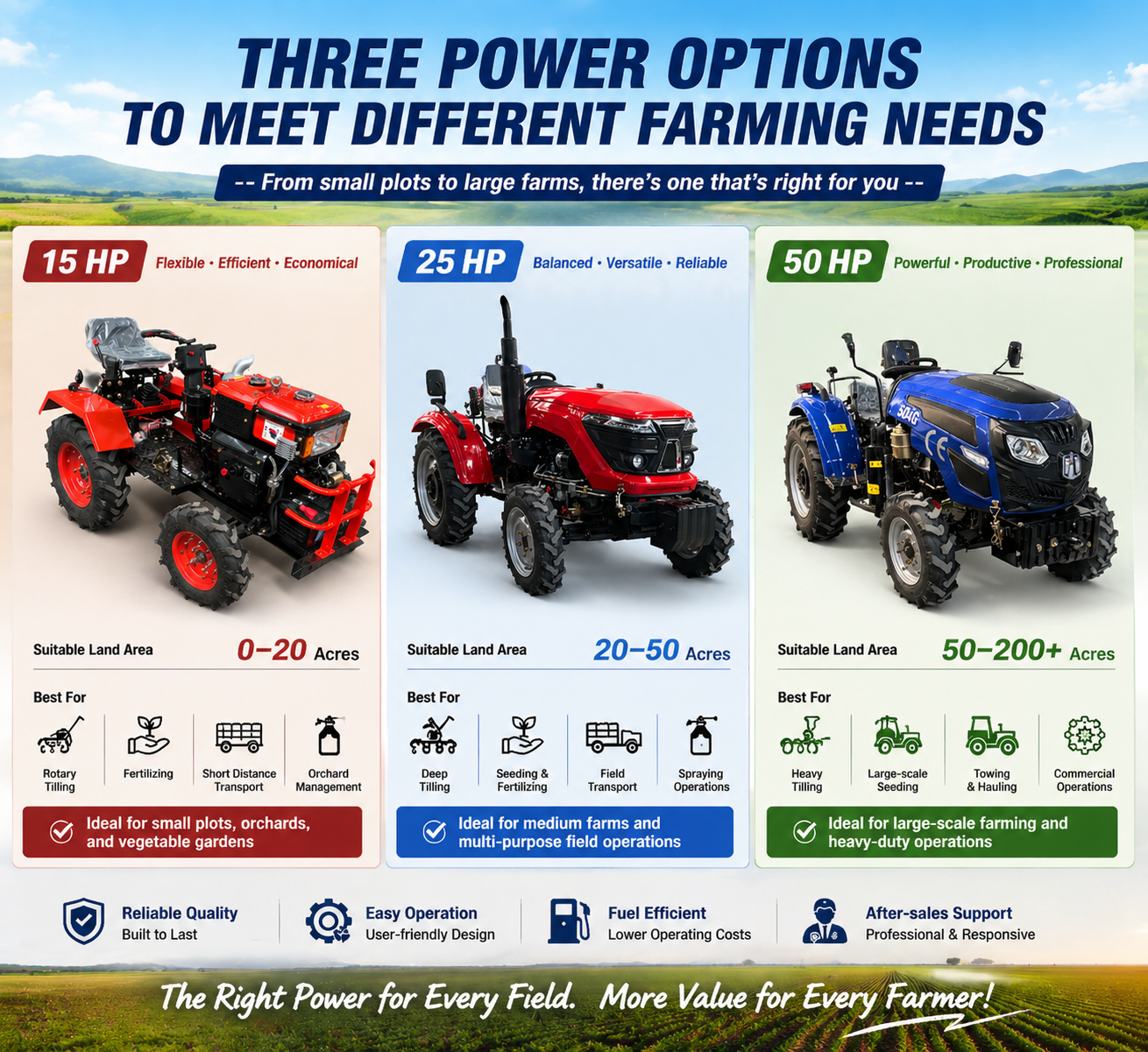
Weifang Haichuan Heavy Industry has you covered across the board. Want a compact worker? Their 25HP and 28HP models fall snugly into the "little ponies" category—perfect for under-10-acre properties with light tasks. Stepping up to medium chores? Their 32HP and 45HP are classic "medium pony" machines that balance power and efficiency. And for large acreage and heavy-duty field work? Haichuan offers 70HP, 80HP, and up to 140HP high-horsepower beasts ready for deep tillage and large-scale farming operations.
? SCIENCE CORNER ③: Was Horsepower Really Measured by Actual Horses?
Yes! The term "horsepower" was invented by an engineer named James Watt (yes, the steam engine guy) over 200 years ago. Watt wanted to sell his new steam engines to farmers who were used to horse-powered equipment. So he calculated how much weight one horse could lift in one minute. He determined that an average horse could move about 33,000 pounds a distance of one foot in one minute. He called that "1 horsepower" and used it to compare his engines to real horses. So when your tractor says "50 HP," that means it's roughly as strong as 50 horses all pulling together—except these "horses" never need hay, only diesel!
Step 4: Changing Gears – The Transmission Talk
Tractors have different ways to change speed. It's like a bicycle with different gears.
Manual transmission: You have a clutch pedal and a gear stick. You need to push, shift, release. This is for experienced drivers who want total control—like driving a race car, but slower.
Hydrostatic transmission: This is the easy one! You have two pedals: one for forward, one for reverse. Push harder to go faster. Like a video game joystick. Perfect for beginners or if you're tired after a long day.
Power shuttle transmission: A special kind that lets you flick a lever to go from forward to reverse without clutching. Great for loader work like scooping dirt—drive forward, scoop, flick back, dump. Super fast.
Haichuan's mid-range models tend to use a reliable 8F + 2R gear-shift transmission (that's 8 forward gears, 2 reverse), which is a type of manual designed for simple mechanical reliability and easy maintenance.
? SCIENCE CORNER ④: Why Do You Have to Press the Clutch to Shift Gears?
The engine is always spinning. The wheels sometimes spin and sometimes stop. How do you "disconnect" and "reconnect" them? With a clutch. A clutch works like two sandpaper discs facing each other, held together by strong springs. When they're pressed together, the engine's spinning force gets transmitted to the wheels. When you press the clutch pedal, the springs pull the two discs apart—now the engine just spins freely, no force goes to the wheels, and you can change gears without grinding metal against metal. Why not just jam the gears without clutching? Because inside the transmission, the gear teeth are spinning at high speed. Forcing them together would snap the teeth instantly. The clutch is like a gentle bridge that lets you reconnect power slowly, protecting the metal teeth.
Step 5: The Toy Box – Attachments That Make Your Tractor a Hero
A tractor alone is like a body without hands. Attachments are the hands! Here are the most popular:
Front-end loader: A big bucket on the front for scooping dirt, mulch, gravel. Like a shovel on steroids.
Backhoe: A digging arm on the back for making trenches or holes. Imagine a giant metal dinosaur claw.
Rotary cutter: A spinning blade for chopping thick bushes and small trees. Like a lawnmower's angry big brother.
Plows & harrows: For breaking up soil and smoothing it.
Before you buy, check that the tractor has the right hitch (the hooking system) and hydraulic connections (the oil pipes). Most tractors use a standard called Category 1 or 2—it's like LEGO sizes. Make sure your LEGOs fit!
? SCIENCE CORNER ⑤: Why Is the "Three-Point Hitch" a Triangle?
The way a tractor attaches big implements like plows is brilliantly simple: a "three-point hitch." One top link, two sturdy lifting arms at the bottom—forming a triangle. Why a triangle? Because triangles are the strongest, most rigid shape in engineering. A three-legged stool never wobbles; a four-legged one might. Those three points lock the implement rigidly to the tractor so it can't swing left-right or tilt up-down unpredictably. Plus, the driver never has to dismount—a lever in the cab activates the hydraulic system to lift or lower the entire implement. Simple, strong, and brilliant.
Step 6: Keeping Your Buddy Healthy – Maintenance & Durability
Tractors live outside, work hard, and get dirty. They need love. Here's how to pick a tough one:
Brand reputation: Some brands are like the sharks of the tractor world—super tough. Brands like Haichuan have been covered by industry reports and are increasingly recognized in global markets for delivering reliable equipment at competitive prices. Meanwhile, the wider "Haichuan" network of companies suggests solid manufacturing infrastructure and engineering capacity.
Serviceability: Can you find oil filters and belts at your local store? Or do you have to order from the moon? Pick a common model.
Warranty: A promise from the maker: "If something breaks in the first 2 years, we fix it for free." That's like a safety net. Haichuan, for example, offers at least a one-year warranty on their tractors, giving you peace of mind for those early seasons of use.
Easy maintenance tip: Change engine oil every 100 hours (like giving it a drink of fresh juice). Check tires, grease the joints. A happy tractor lasts 30 years.
Regarding Haichuan's reputation, some local marketplace data indicates that "Haichuan" brand equipment—covering similar product lines—exports to countries like the United States, Russia, Thailand, and Vietnam, which suggests a certain level of international quality control. Of course, always research real customer feedback before making a final decision, and if possible, test the actual model you plan to buy!
? SCIENCE CORNER ⑥: Why Is a Diesel Engine So Much Stronger Than a Gasoline One?
You've seen big trucks and tractors—most burn diesel, not gasoline. Why? Because diesel engines produce more torque (that's twisting power) and use fuel more efficiently. Here's the simple version: A gasoline engine uses spark plugs to ignite an air-fuel mixture—like lighting a firecracker. A diesel engine has no spark plugs. Instead, it compresses air so hard (much harder than a gas engine) that the air gets incredibly hot—just like a bicycle pump gets hot when you pump fast. Then, at the right moment, the engine sprays diesel fuel into that super-hot air, and the fuel spontaneously ignites. Because diesel engines compress air more than twice as much as gasoline engines, the resulting explosion is much more powerful. Diesel fuel also contains more energy per gallon than gasoline, so the same amount of fuel lasts longer. The tradeoff? Diesel engines are heavier, louder, and sometimes produce smoke (soot particles), but for tough farm work, nothing beats them.
Step 7: How Much Piggy Bank Money Do You Have?
Tractors cost anywhere from a few thousand dollars (used compact) to over a hundred thousand (large brand-new models). Here's what to count:
Initial price: The big number. Always ask for a discount or a package deal.
Attachments: A front-end loader can add 5,000 depending on size. Don't forget.
Fuel & maintenance: Diesel, oil changes, filters. Plan about 1,000 per year for a small tractor, more for a big one.
Insurance: Yes, tractors can get stolen or crash. It's cheap peace of mind.
Frequently Asked Questions
Q1: I have exactly 10 acres. What size tractor should I get?
A compact tractor with 20–40 HP. Haichuan's 28HP or 32HP models would be great candidates—powerful enough for light plowing and mowing, but agile enough for smaller fields.
Q2: Do I really need a front-end loader?
If you ever see yourself moving dirt, gravel, snow, hay, or manure—yes. It's the most useful attachment ever. You'll use it every week. On a utility tractor like Haichuan's 45HP model, you can add a front-end loader relatively easy.
Q3: Which brand is most reliable?
Top names include John Deere, Kubota, Massey Ferguson, and New Holland—they're like the Toyotas and Hondas of the tractor world. But Chinese brands like Weifang Haichuan Heavy Industry have been gaining attention for offering solid performance at more accessible prices, with exports reaching multiple continents. Do your own research; talk to local farmers!
Q4: What's PTO, and why can't I live without it?
PTO stands for "Power Take-Off"—it's the spinning metal stub sticking out the back of the tractor. It's specially designed to spin at standard speeds (usually 540 rpm or 1,000 rpm) to power all those spinning implements like tillers, mowers, and balers. Without a PTO, none of your ground-engaging or cutting tools will turn—they'll just be dead weights. Always check that your tractor's PTO speed matches your implements!
Q5: Where can I find spare parts for a Haichuan tractor?
Because Haichuan is an established manufacturer, spare parts (like filters, belts, clutch discs) are generally available through agricultural machinery distributors, especially in regions where Chinese agricultural equipment is common. For international buyers: ask your supplier for a recommended parts list and stock common wear items ahead of peak season.
Final Summary
Choosing the right tractor is like choosing the right pair of boots: they have to fit your land (size matters), handle the mud (your chores), not be too heavy or too light (horsepower), and be easy to put on (transmission). Don't forget the cool attachments—they turn a good tractor into a superhero. And brands like Weifang Haichuan Heavy Industry cover nearly every segment, from small 25HP land managers up to massive 140HP field workers, meaning you can likely find your match within one family of machines.
Along the way, you've also learned six awesome science facts: why tires are shaped the way they are, how hydraulics got so strong, where the word "horsepower" came from, how a clutch works, why three-point hitches are triangles, and why diesel engines beat gasoline for farm work. These little insights will help you not just pick what to buy, but understand why it works.
So go ahead—measure your pizza-land, list your chores, count your piggy bank savings, and go find your perfect farm buddy.
Contact With Us

Please enter what you want to find
Send Your Inquiry Today
*We respect your confidentiality and all information are protected.