

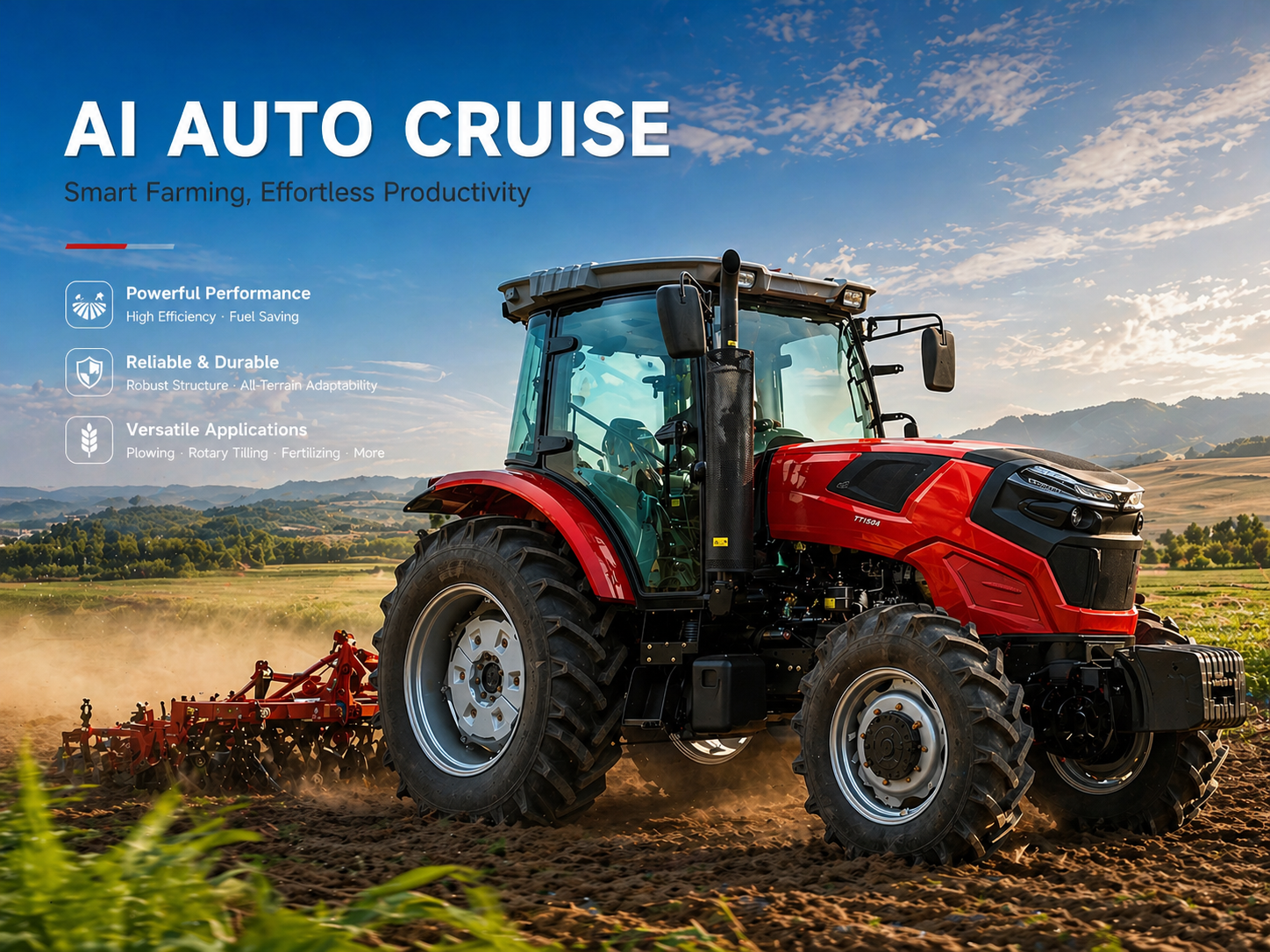
Revolutionizing the Fields: How Weifang Haichuan Heavy Industry is Embedding AI into Farm Machinery for a Sustainable Future
At the engineering centers of Weifang Haichuan Heavy Industry, a quiet but profound shift is underway. The company, long known for rugged agricultural machinery, is now weaving artificial intelligence into the very fabric of its tractors and implements. The goal is not simply to build smarter machines, but to fundamentally redefine the relationship between the farmer, the land, and the tools that connect them. Through a series of carefully integrated AI technologies, Haichuan is turning its equipment into perceptive, adaptive partners capable of making split‑second decisions that elevate both productivity and environmental stewardship.
On‑Machine Intelligence: The Reflex Arc of the Modern Tractor
One of Haichuan's foundational innovations is the deployment of Edge AI directly on the tractor. A useful analogy is the human reflex arc: when you touch a hot surface, your spinal cord orders your hand to withdraw before your brain even registers the pain. Similarly, Haichuan's tractors no longer need to transmit every camera frame to a distant cloud server and wait for instructions. Instead, high‑performance processors embedded in the vehicle analyze sensor data on the spot, recognising objects and making decisions in milliseconds. This local intelligence is critical in the field, where connectivity is often patchy and a delay of even half a second could mean the difference between nurturing a crop and accidentally damaging it. Edge AI gives the machine the autonomy to act instantly, just as a skilled operator would react without hesitation.
Autonomous Navigation: From Pre‑Programmed Paths to Real‑Time Adaptation
Building on this on‑board brain, Haichuan has developed autonomous driving capabilities that go far beyond simple GPS guidance. Think of the tractor's navigation system as a seasoned taxi driver who not only follows a map but also reads the street—avoiding a pothole here, yielding to a pedestrian there. Using a fusion of satellite positioning, lidar, and visual odometry, the machine constructs a live, high‑definition map of its surroundings and plans the most efficient route while respecting soil conditions and crop rows. This ability to replan on the fly reduces soil compaction, minimises overlap, and allows the tractor to operate safely around the clock, addressing labor shortages without compromising precision.
The Surgical Sprayer: Vision‑Guided Precision Application
Perhaps the most vivid example of Haichuan's AI‑driven philosophy is its smart spraying system. Traditional spraying can be compared to painting an entire wall just to cover a few hairline cracks. Haichuan's technology, by contrast, behaves like a micro‑surgeon armed with a high‑speed vision system. As the boom passes over the field, cameras capture a continuous stream of images. The onboard neural network performs real‑time semantic segmentation—distinguishing crop from weed, stem from soil—much the way facial recognition software identifies a specific person in a crowd. The moment a weed is detected, a targeted nozzle delivers a precise droplet, often less than a square centimetre, directly onto the intruder. The result is a reduction in herbicide use of up to 90% in some cases. This protects waterways from runoff, preserves beneficial organisms in the soil, and lowers input costs dramatically.
The Digital Twin: Stress‑Testing Decisions in a Virtual World
Before any real action takes place, Haichuan's engineers can now rehearse an entire season in a Digital Twin. In the same way that airline pilots train for emergencies in full‑motion simulators before ever leaving the ground, farmers and agronomists can use a virtual replica of their field to test countless scenarios: “What if we delay planting by one week? What if a dry spell hits during tasseling?” The digital twin is fed with historical weather data, soil maps, and machine parameters. An AI model then simulates outcomes, allowing Haichuan's system to prescribe an optimised plan—selecting the ideal seed population, nutrient timing, and harvest window. Once validated in the virtual environment, the plan is uploaded to the real tractor, which executes it with the same fidelity. This closes the loop between prediction and practice, greatly reducing the risk of costly real‑world mistakes.
Hyper‑Local Climate Awareness: The Micro‑Weather Brain
Haichuan's AI stack extends to what could be called a micro‑weather intelligence layer. Instead of relying on regional forecasts that treat a whole county as a single data point, the system integrates on‑machine sensors, local weather stations, and even soil moisture probes to understand the climate bubble around a specific part of the field. The analogy here is a personal weather map that knows which side of a hill will catch the morning dew and which corner is prone to frost. The tractor’s control logic can then irrigate only the zones that actually need water, vary planting depth according to soil temperature, or delay a spraying pass until the wind speed drops below a safe threshold. This granularity turns water conservation and chemical stewardship from good intentions into measurable, daily actions.
Predictive Maintenance: Giving the Machine a Proprioceptive Sense
A machine that works in dust, mud, and extreme temperatures is bound to wear. Haichuan addresses this by embedding a predictive maintenance system that functions much like the human body's proprioception—the innate ability to sense the position and condition of one's own limbs. Vibration sensors, oil quality monitors, and hydraulic pressure transducers continuously feed data into an anomaly‑detection model. The AI learns the normal “heartbeat” of each component and flags deviations subtle enough to be imperceptible to the human ear or eye. Weeks before a bearing begins to fail, the system can nudge the fleet manager to schedule a 30‑minute service, preventing a two‑day breakdown during the narrow harvest window. It transforms maintenance from a reactive scramble into a strategic, quiet preparation.
Collaborative Robotics: Drones as Aerial Scouts, Small Ground Robots as Weed‑Pulling Assistants
Haichuan views the tractor not as a solitary powerhouse but as the hub of a coordinated robot team. Above the canopy, drones equipped with multispectral cameras fly pre‑programmed survey routes. They capture reflectance data beyond the visible spectrum, generating Normalized Difference Vegetation Index (NDVI) maps that reveal plant stress from disease or nutrient deficiency long before any yellowing of the leaves appears. This is analogous to a medical scan that detects a problem at the cellular stage, rather than waiting for external symptoms. Meanwhile, lightweight ground robots, acting like precision weeding assistants, can be deployed in the tractor's wake to mechanically remove any remaining weeds without disturbing the crop row. All these platforms communicate via a shared mesh network, orchestrated by Haichuan's central AI framework, turning a fleet into a single, harmonious organism.
The Data‑to‑Decision Pipeline: Aggregating Insight into a Living Playbook
Every pass of a Haichuan machine generates a stream of geo‑tagged data points—soil electrical conductivity, organic matter estimates, crop biomass. This information flows into a cloud‑based analytics engine that aggregates it across seasons, fields, and even cooperating farms. The engine then identifies patterns invisible to any individual farmer: “Fields with this particular soil type consistently under‑perform in wet El Niño years unless planted two weeks earlier.” By transforming raw data into a constantly updated, evidence‑based playbook, Haichuan’s system allows farmers to make decisions less on intuition and more on statistically validated agronomic science. It is the evolution from farming by the almanac to farming by a living, learning model of one’s own land.
A Sustainable Equation, Written in Silicon and Steel
The environmental arithmetic behind Haichuan's AI‑integrated machinery is compelling. Precision water application slashes consumption; targeted spraying slashes chemical loads; optimised route planning cuts fuel use and CO₂ emissions; and reduced soil compaction from fewer unnecessary passes preserves soil structure and microbial life. These gains are not theoretical—they are quantifiable and scalable. In a world where agriculture must simultaneously increase output and drastically reduce its footprint, Haichuan’s machines represent a practical path forward, turning vague sustainability pledges into hard, operational facts.
The Road Ahead: Partnership, Not Replacement
Weifang Haichuan Heavy Industry’s vision does not end with a driverless tractor. It extends to a collaborative ecosystem where human expertise and artificial intelligence form a feedback loop of continuous improvement. The farmer remains the strategist and the steward, while the AI handles the millisecond‑by‑millisecond execution and the processing of vast data streams. As Haichuan refines its edge inference chips, improves its digital twin fidelity, and integrates ever‑more autonomous swarm capabilities, it is laying the foundation for an agriculture that is not only more productive and profitable, but fundamentally more respectful of the natural systems on which we all depend. The fields of tomorrow are being written today, line by line, by the quiet intelligence humming inside a tractor built in Weifang.
Contact With Us

Please enter what you want to find
Send Your Inquiry Today
*We respect your confidentiality and all information are protected.