

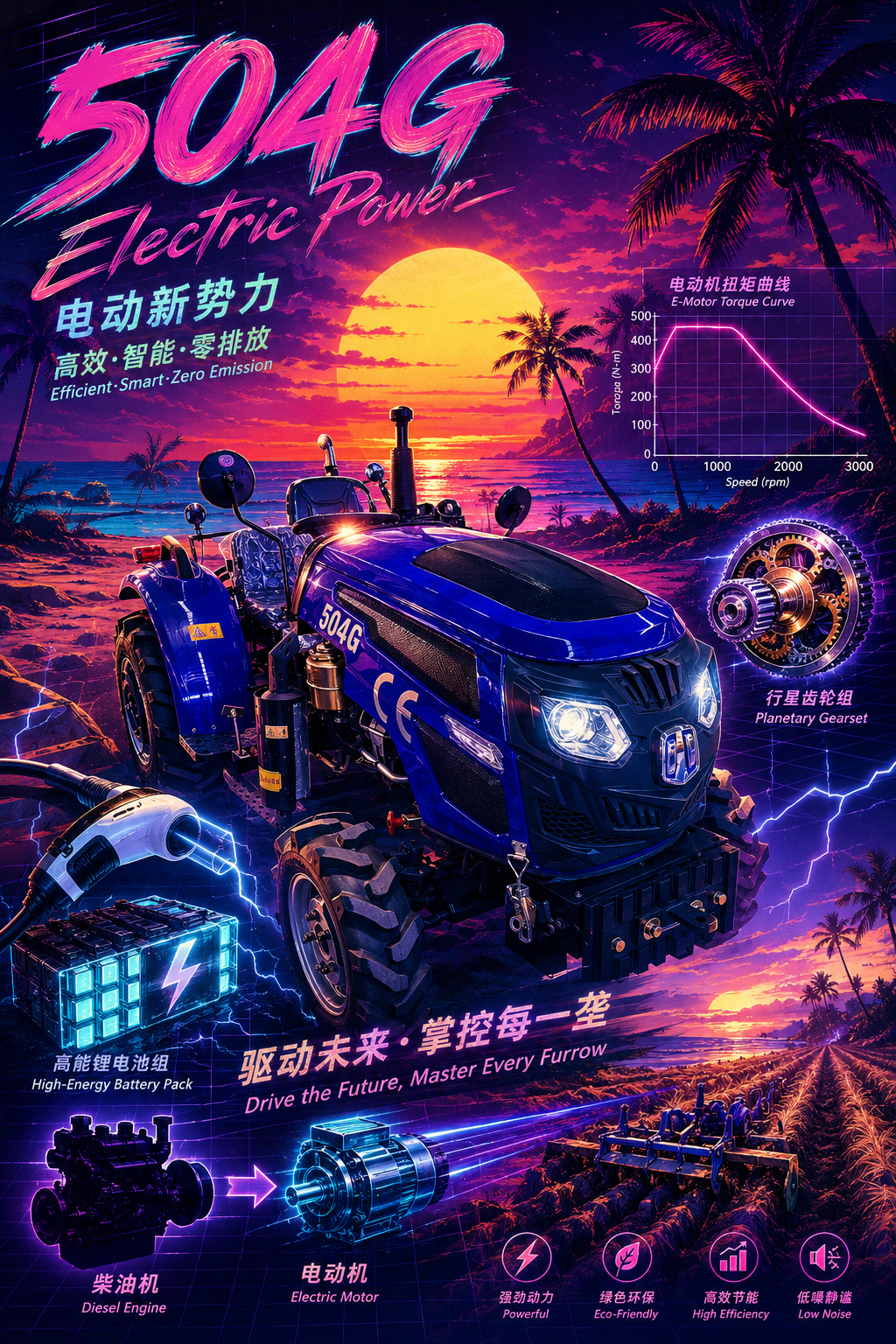
Real quick recap: our tractor started as a naked iron lump that could barely putt‑putt. Now she's a full‑blown beast—chassis locked, brakes grippin', steerin' sharp, transmission slick, hydraulic arms liftin' heavy, PTO spinnin' power out to every tool you hang off her. She runs, she stops, she hauls, she plows, she plants. A straight‑up universal iron bull.
But the story ain't over, not by a long shot. Diesel ruled these fields for over a hundred years. Now? Batteries and silicon chips are bangin' on the farm gate. This chapter, we steppin' outta gears and hydraulic oil to look at the tractor's future heartbeat—electrification. This ain't just yankin' the fuel tank and droppin' in a battery. Nah, this is a full gut‑renovation from where the energy comes to how it gets to the ground.
6.1.1 The Diesel's Ceiling – Three Bullet Holes in a Hundred‑Year Workhorse
Listen, that diesel engine is a war hero. But she got three fatal flaws nobody can fix, and that's what's pushin' the whole ag world to hunt for a new path.
Flaw One: Efficiency slammed against a physics wall. A diesel's thermal efficiency at its one sweet spot can hit maybe 45%. Sounds decent, right? But in real fieldwork, that engine is always coastin' at low load—turnin' at the headland, waitin' for the grain cart, light transport. In those moments, efficiency drops under 20%. You put a tank of fuel in, and only two, maybe three tenths of it actually become useful work at the wheels. The rest? Poof. Heat and smoke, gone with the wind. It's like hirin' ten workers and only two are sweatin' while the other eight stand around gaspin' for air. Bad business, man.
And think about the curve—diesel efficiency looks like a sharp teepee. You gotta be right at the peak or you fallin' off fast. A tractor in a real field might spend less than a third of its day on that peak.
Flaw Two: Emissions won't quit, and the aftertreatment keeps gettin' more expensive. EU Stage V, US Tier 4 Final—every year the rope gets tighter. To pass, you gotta bolt on a DPF to catch soot, SCR that sprays urea into the exhaust to kill NOx, and EGR to recirculate gas. You know the headache? That DPF clogs up and needs a "regen" cycle to burn the trapped soot clean. If the regen ain't controlled right, raw diesel slips past the rings into the oil pan and thins out your engine oil—kiss your bearings goodbye. SCR means you're buyin' and haulin' diesel exhaust fluid, and on a big tractor that's another real cost every season. And the dirtiest moment for diesel emissions ain't at full throttle—it's low speed, high load: exactly when you're startin' a pull, deep plowin', or crawlin' up a hill. That's the tractor's main job. So the rules get tighter, the exhaust hardware gets pricier, and the whole game gets less worth playin'.
Flaw Three: Control is way too crude. A diesel spits out mechanical torque. You gotta run it through a whole parade—clutch, gearbox, driveshaft—just to manage speed and load. You got more gears? Still steps. First gear 2.8:1, second gear 1.9:1—you always stuck somewhere between the steps you actually need. Clutch can be smooth? It's still slippin' and wearin' every time you launch, a little bit of its life scraped off. And response? You stomp the throttle, fuel sprays, burns, pushes the piston, torque travels through flywheel, clutch, gearbox, driveshaft to the wheels—hundreds of milliseconds of lag. When you need centimeter‑level precision for precision seeding or variable‑rate fertilizing, that lag makes tight control real hard.
These three bullet holes together forced the whole industry's hand. But electrifyin' a tractor ain't like slappin' a big battery in a car. A tractor faces brutal, long‑hour, heavy‑load work in the dirt—completely different weight class than a passenger car. So ag electrification takes a step‑by‑step, scene‑by‑scene path.
6.1.2 Hybrid Power – Diesel and Electric Motor Shacked Up
Since pure electric can't yet wrestle the real heavy fieldwork, let the diesel and electric motor shack up together. That's your hybrid tractor.
Core logic in one line: Let the diesel do only what it's good at—steady output and high‑speed cruise. Everything it sucks at—launch, speed change, low‑speed high‑torque—throw all that to the electric motor. Three basic setups. Let's hit the real differences, and break down the physics on each.
Parallel Hybrid: Diesel and electric motor can drive the wheels solo or together. The key mechanical piece is a power‑split device—usually a planetary gearset. Diesel hooks to one input, motor/generator to another, wheels to the output. The physics is exactly the planetary gears from our transmission chapter: sun gear, planet carrier, ring gear. Lock different pieces, get different ratios. But here it ain't for shiftin'—it's for blendin' two power sources.
Run the modes: launch, where diesel is pitiful, the motor pushes alone and the diesel can nap or just spin a generator. Accelerate or climb, both diesel and motor punch together through the power‑split. Highway cruise, diesel direct‑drive—pure mechanical gears, no electric conversion loss, peak efficiency. Braking or slowing, the motor flips into generator mode and sucks kinetic energy back into the battery.
Upside is each covers the other's weakness, and you keep diesel's efficient direct‑drive cruise—that's non‑negotiable for tractors that also haul on roads. Downside is the control brain is complicated: when to use oil, when to use spark, when to blend, and exactly what ratio—all that needs a heavy control strategy. Plus the planetary gears themselves have some mechanical drag. Parallel is the most mature hybrid tractor setup because it's closest to the traditional drivetrain, smallest change.
Series‑Parallel Hybrid (Power‑Split): Adds another generator so the diesel can fully decouple—engine RPM and wheel RPM completely unshackled. The diesel just locks at its peak thermal efficiency RPM and hums there, strictly makin' electricity. Wheels are driven purely by electric motor. This is basically CVT philosophy baked into the powertrain's DNA: engine sits at its sweet spot, vehicle speed changes all handled by the electric side—same goal as a CVT, but using electrons and planetary gears instead of cones and a steel belt.
But there's a physics cost you can't dodge: energy goes diesel → mechanical → generator → electrical → maybe battery → motor → mechanical. Two full conversions. Generator around 95%, motor around 95%, multiply 'em you're around 90%. Add battery charge/discharge losses, you're lookin' at 10‑15% total conversion tax. A parallel setup at highway direct‑drive has none of that. So series‑parallel shines where you're constantly starting, stopping, varying speed—diesel stays efficient the whole time—but on long steady cruises it's actually thirstier than parallel. In cars this is mature—Toyota's THS is classic series‑parallel—but in a tractor where load jumps wild (plow hits a hard spot, then soft, then rocks), the control strategy is way nastier than in a car.
Series Hybrid (Range‑Extender): Simplest of the three. Diesel never touches the wheels. Its only job is to spin a generator, electricity goes to battery or straight to the drive motor. Layout is flexible—you can stuff the diesel‑generator anywhere there's room, no mechanical shaft path needed. Downside is heaviest conversion tax: burn fuel → spin shaft → make electricity → maybe store in battery → pull from battery → spin motor → spin wheels. Every arrow is a little energy bite taken out. Total efficiency under heavy load can't match parallel or series‑parallel. But for steady‑load fieldwork—constant‑speed tilling, constant‑speed seeding—the control simplicity is actually a strength. No complex power‑split brain required; the diesel just sits there dronin' at its happy RPM makin' juice. Another hidden win: zero mechanical link between diesel and wheels, so theoretically you can delete the whole conventional drivetrain—clutch, gearbox, U‑joint driveshafts—chop mechanical complexity and maintenance way down.
Right now, parallel and series‑parallel rule the hybrid tractor world, series stays with smaller specialty machines. Fendt's e100 Vario prototype leans series‑hybrid, with a small diesel just generatin' while electric motors do all the drivin'. John Deere's SESAM concept explored both pure electric and hybrid paths early.
One line for your export customer: "Hybrid means the diesel does steady generator duty or direct highway cruise—all the dirty jobs, launch, speed change, low‑speed grunt, get thrown to the electric motor."
6.1.3 Pure Electric Tractor – Ditchin' the Diesel Completely
If hybrid is shacking up, pure electric is a clean break—rip out the diesel, gearbox, clutch, the whole parade, and drop in batteries, inverters, and electric motors. This is the most hyped path and the most brutal challenge. Let's crawl inside a pure electric tractor and crack open its heart, its blood, its temper, and its bottlenecks one by one.
The Heart – Electric Motor: A Beast Right From Zero RPM
We spent a whole chapter on the diesel's "attitude"—only strong in that narrow high‑RPM alley, soft as noodles below it, so you need a complex gearbox to translate. An electric motor don't got that problem at all.
The torque curve on an electric motor is the stuff engineers dream about: from the very instant it hits zero RPM, it can dump out max torque, and hold that torque all the way into mid‑high speeds. No idle needed. No half‑clutch slippin' to launch. No shifting. You press the pedal deeper, it pushes harder—linear, precise, millisecond response.
The physics tells you why: a diesel relies on burning fuel to push a piston; at low RPM the burn time is long, heat loss is high, torque suffers. An electric motor runs on magnetic fields—stator coils get AC current, create a spinning magnetic field, and the rotor with permanent magnets or induced current gets dragged along. How strong the field, how strong the torque—independent of speed. So at zero RPM you already got max torque locked and loaded, held steady through the "constant torque region," then into the "constant power region" where torque drops some but power stays flat. The whole curve is smooth like an ironed bedsheet.
Plain talk: a diesel is an ox that has to get runnin' before it can pull. An electric motor is a cheetah that launches full force the second its paw twitches. Every situation a diesel hates—dead‑stop launch, heavy climb, low‑speed deep plowin'—that's exactly where the electric motor eats for breakfast. The first time a diesel driver steps into an electric tractor and hits the pedal, what shocks 'em most ain't the quiet—it's that immediate "foot down, tractor moves, no waitin'" directness. That diesel lag—stomp, wait half a beat, torque finally builds—just gone.
Real numbers: Case IH's Farmall 75C Electric, rated 74 horsepower, can punch out instant peak torque of 320 Newton‑meters. That's more peak twist than a lot of same‑size diesels can only manage when they're screamin' at their peak RPM—and the motor don't need to "hunt" for it. It's right there at 0 RPM. When that Farmall 75C hooks to a heavy mower in muddy ground and launches from a dead stop, it's almost silent, smooth as silk, zero jerk. Driver barely feels a thing.
The Blood – Battery: The Heaviest, Priciest Piece of the Whole Machine
Motor's amazing, but it can't make its own food. Its food is the battery. That battery decides how heavy your tractor can work, how long it runs, and what the price tag says.
Which Battery? – LFP vs. NMC
Same as electric cars, lithium‑ion is king, but two roads split hard. Ag cares most about safety—a battery fire in a dry field full of straw or oil is a nightmare—so nearly all pure electric tractors run lithium iron phosphate (LFP). The physics: LFP's crystal structure is super stable. You can puncture it, crush it, it barely heats up. Thermal runaway temperature is over 270°C. NMC (nickel manganese cobalt) packs more energy density but its thermal stability is worse—runaway around 200°C. Trade‑off: LFP's energy density is 150‑180 watt‑hours per kilo; NMC can hit 200‑260. Ag takes the safety trade every time.
Almost every electric tractor on the market is LFP. Over in China, Weifang Haichuan Heavy Industry is pushin' hard into pure electric, and they're deep in the LFP game. Their electric tractor lineup runs LFP battery packs with IP67 sealing, engineered for zero‑below cold starts and high‑temp field days, with a dual‑motor setup that splits drive and PTO power so each runs at its own best efficiency. They're attackin' mid‑range fieldwork—orchards, pastures, greenhouses—with a whole product ladder from compact 25‑horse models up through bigger 50‑horse electric rigs that can act as mobile power stations in the field, chargin' drones and handheld electric tools right off the tractor's battery. Haichuan's play is the same core logic as the big names: use the motor's instant torque to make the machine feel alive, strip complexity out of the drivetrain, and let the battery double as a jobsite energy hub.
Out in the West, John Deere's SESAM concept and E‑Power prototype carry high‑capacity lithium packs from Kreisel, with SESAM packin' around 150 kWh—LFP‑based but still in prototype stage.
What Does a Battery Pack Actually Look Like? – Not a Brick, a Whole System
Folks picture a battery as one big steel brick where the engine used to sit. Reality is way more layers:
Cell: The smallest unit. Multiple cells get bundled into a module.
Module: Cells plus structural frame and cooling plates.
Battery Pack: Multiple modules sealed inside a dust‑tight, waterproof shell. Haichuan's packs hit IP67—total dust protection, can sit a meter underwater for half an hour and stay dry. That means a sudden thunderstorm or workin' in flooded mud won't kill your pack.
Battery Management System (BMS): The brain. Watches every single cell's voltage, temperature, and current in real time, blocks overcharge, over‑discharge, overheating. When a pack catches fire, nine times out of ten the BMS failed its job.
Thermal management is just as critical. Batteries heat up when they discharge—current pushin' through internal resistance turns some energy straight to heat. LFP likes 15‑35°C. Freezin' winter morning, the electrolyte gets sludgy, lithium ions move slow, and your usable capacity tanks. Blazin' summer noon, the battery ages faster and risks thermal runaway. So you need active thermal management. Haichuan's electric tractors are built to run stable in ‑20°C cold, which means they got battery heaters and cooling loops keepin' the pack in its happy zone year‑round.
The Core Fight – Energy Density: Diesel Is Still in a Different League
Batteries keep improvin', but one physics fact still stands: diesel's energy density is around 12 kWh/kg. The best LFP today is 0.15‑0.18 kWh/kg. That's a 70‑80x gap. The energy stored in carbon‑hydrogen chemical bonds is just fundamentally denser than the energy stored by lithium ions shuttlin' in and out of a crystal lattice.
A 100‑horsepower tractor deep‑plowin' burns about 80‑90 kWh of axle power per hour. Eight to ten hours a day means 640‑900 kWh total. Diesel: a 200‑liter tank (around 2000 kWh of energy) gets you through 6‑8 hours easy. Battery: at 160 Wh/kg, a 640‑900 kWh pack weighs 4 to 5.6 metric tons. That's already the weight of the whole tractor itself. And that 5 tons of battery is crushin' your soil—soil compaction is the silent yield killer, blockin' air and water from roots. Plus, draggin' all that extra weight around burns more energy just to move the tractor, which means you need even more battery. It's a nasty loop.
So for now, pure electric tractors cluster between 25 and 130 horsepower. Heavy deep‑tillage electrification is waitin' on solid‑state batteries to maybe break the 400‑500 Wh/kg barrier, but that's still 5‑10 years from showroom floors.
Refueling – 3‑Minute Fill vs. Hour‑Long Charge
Diesel fills up in three minutes. Batteries take hours. The physics again: fillin' a tank is just movin' liquid—energy already packed in chemical bonds, pump does the work. Chargin' is an electrochemical reaction—lithium ions gotta physically shuttle through electrolyte and intercalate into the anode. Rush it too hard, the battery heats up, plates lithium metal, or catches fire.
Typical pure electric tractor fast‑charges from 20% to 80% in around 40‑45 minutes. But in the middle of a field, there ain't no fast charger, and the rural grid usually can't push the 50‑100 kW those chargers pull.
Workarounds in play: battery swap (Deere's SESAM had a quick‑swap system, but you need standardized packs across brands); machine‑to‑machine charging (Haichuan's electric tractors can act as mobile power banks, chargin' drones and electric shears right in the field, makin' a whole electric work chain); solar self‑generation (Fendt talks about farms makin' their own green power via rooftop solar to charge the tractor, closin' the carbon loop). All still niche, none at scale yet.
Pure Electric Platforms Rewrite the Whole Machine's Design Logic
We spent five whole modules on clutches, gearboxes, differentials—the beautiful precision of the mechanical age. On a pure electric platform, the whole picture shifts:
Gearbox gets massively simplified or just deleted. The motor's speed range is huge and it makes max torque at zero. No need for six, twelve gears to translate a narrow diesel band. A simple two‑speed AMT or no gearbox at all is plenty.
Clutch basically vanishes. No half‑clutch slippin' needed. Pedal controls torque directly, naturally smooth.
Differential can be replaced by electronic diff. Put a separate hub motor on each wheel, run an algorithm, and you get millisecond‑level speed difference control—no physical differential gears needed.
PTO gets its own independent motor. Traditional PTO power snakes all the way from the engine through clutch, gearbox, shafts—long path, big losses. Pure electric just puts a dedicated motor on the PTO. Spins when you want, stops when you want, totally decoupled from the drive motor.
The whole tractor becomes a mobile power station. A diesel tractor makes mechanical power—shafts and gears. Hard to use for anything else. An electric tractor makes electrical power—not only drives the wheels and PTO, but can directly feed electricity to drones, electric shears, water pumps, lights. It's a rolling jobsite energy hub.
This is why pure electric ain't just "swap engine for motor." It's a ground‑up rebuild of the whole power architecture.
6.1.4 Hydrogen Fuel Cells – Another Kind of "Electric"
Hydrogen fuel cells are still an electric drive at heart, just without the heavy battery. Simple chemistry: hydrogen gas meets oxygen from air inside the fuel cell stack, electrochemical reaction makes electricity and water. Electricity runs the motor, water is the only tailpipe emission. You get the drive quality and zero emissions of pure electric, plus way higher energy density than a battery, and refuelin' as fast as diesel.
But farm use hits three walls. One, hydrogen is expensive. The cheapest "grey hydrogen" comes from natural gas—still pumps out carbon, misses the clean point. True zero‑carbon "green hydrogen" from renewable electrolysis costs 3‑5 times more. Two, storing hydrogen is a pain. Hydrogen at room temp is a super‑light gas; to store useful amounts on a machine, you gotta compress it to 700 bar (700 times atmospheric pressure). The tanks are big, heavy, and pricey. Three, zero fueling stations. Building out hydrogen production, transport, storage, and pumps in rural areas is a money pit with no bottom.
New Holland's T6 Methane Power tractor burns biomethane captured from ag waste—combustion, not fuel cells—a practical bridge that uses existing engine tech. Hydrogen fuel cells in ag are still in the test phase. Heavy trucks might get there first.
6.1.5 Wrap‑Up: Three Electric Roads, One Direction
So let's park on the field bank and run this down.
Diesel's got three bullet holes—efficiency capped by physics, exhaust cleanup gettin' too expensive, and control way too crude for what modern ag demands. Three electric roads are open, and each has picked its lane.
Hybrid lets diesel and electric motor share the load. Parallel and series‑parallel lead the way, keepin' diesel's energy density and highway efficiency while dumpin' the jobs diesel hates onto the motor. It's the most practical bridge for heavy fieldwork right now.
Pure electric throws the diesel and the whole drivetrain out the window. Torque behavior is naturally superior, the drive feel is silk, maintenance drops hard, and it's born ready for smart controls. But battery energy density and charge speed are still the iron gate—for now it lives in mid‑size pastures, orchards, greenhouses, and light municipal work. When solid‑state or next‑gen batteries break through, pure electric walkin' from small horses to big horses is just a matter of time.
Hydrogen looks perfect on paper—dense energy, fast refill, clean exhaust—but hydrogen cost and the near‑zero refueling infrastructure keep it in the lab for ag. Burnin' biomethane in a regular engine might be the smarter first step
Contact With Us

Please enter what you want to find
Send Your Inquiry Today
*We respect your confidentiality and all information are protected.