

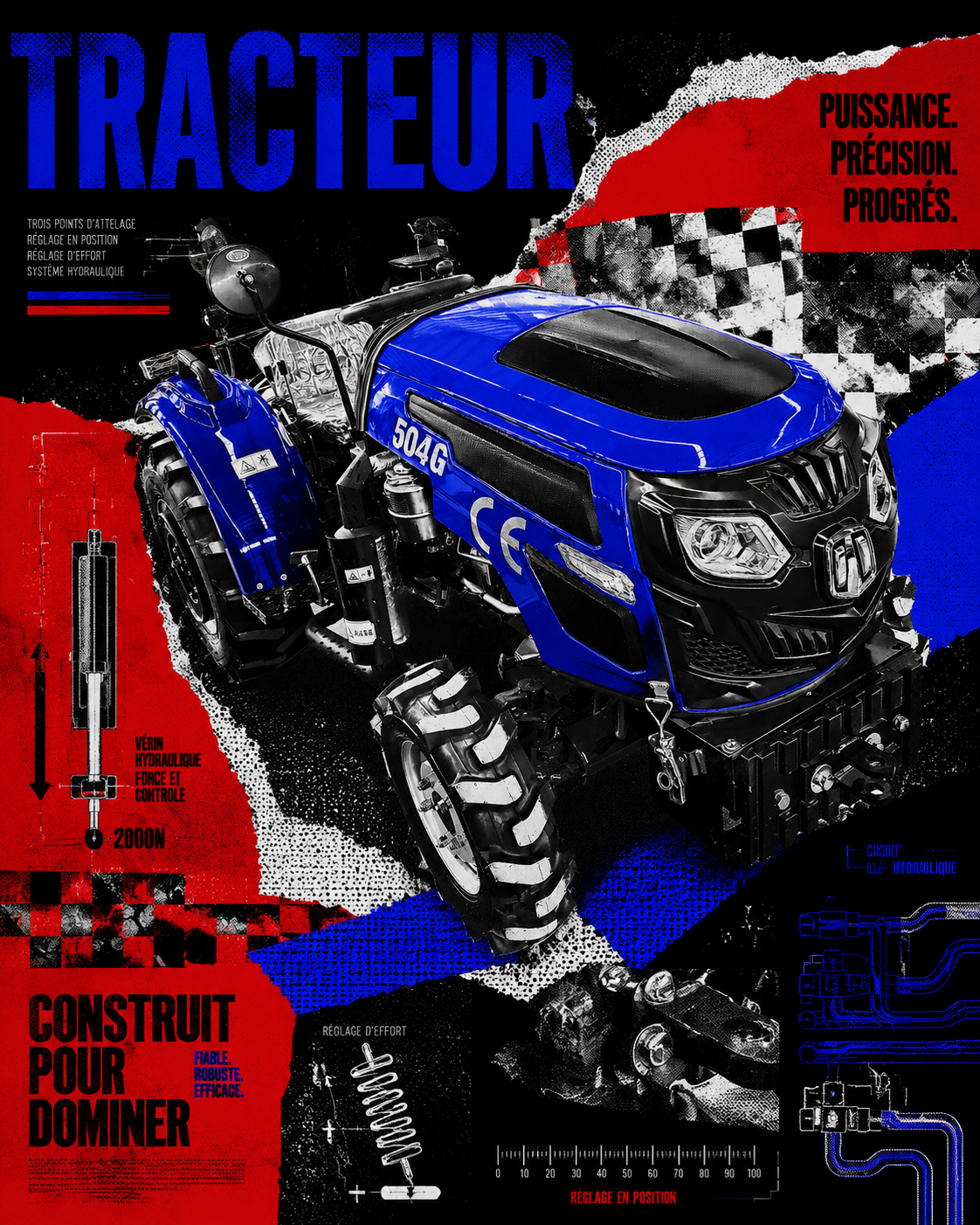
The Iron Bull's Mighty Arm
Yo, chief engineer! We done built the whole runnin' gear—chassis, brakes, steerin', transmission. This tractor can roll, turn, stop on a dime. But right now? She's a naked bull. Can't do no fieldwork. We gotta make her carry the heavy stuff—plows, harrows, tillers, seeders—strapped to her back or dragged behind, and she gotta lift 'em, drop 'em, finesse 'em like you usin' your own arm.
That's where the tractor's one‑of‑a‑kind magic comes in: the hydraulic hitch system. Today we crackin' it wide open, see how this iron bull grows muscles and smart hands.
5.1.1 Why Not Just Drag It With a Rope? – Implements Ain't Dead Weight
You might be like, "Man, why don't you just tie a rope to the plow and pull it?" Bruh, if it was that easy, granddaddy woulda never needed a mule. Haulin' a plow through dirt is a whole different beast from pullin' a wagon.
First, diggin' in and liftin' out: The plow gotta bite into the ground, and it gotta pull out clean. At the end of the row, you gotta hoist that whole rig up in the air just to turn around. If you don't, you draggin' a heavy steel blade sideways through the soil, carvin' a trench you didn't ask for.
Second, keepin' the depth steady: Under that dirt, it ain't all the same. Hit a hard patch, the plow rides up like it's hittin' a speed bump—too shallow. Hit a soft sand pocket, the plow nose‑dives like it's fallin' through a trapdoor—too deep, and the engine chokes. You need somethin' that feels that change instantly and adjusts on the fly.
Third, you need brute strength: A moldboard plow bitin' through soil can grab over a hundred kilos of resistance. You think a driver's arm gonna lift that? That's like a toddler tryin' to bench‑press a fridge. You need a hidden giant hand that tosses heavy implements around like toys.
A rope and a couple strong farmhands can't handle that mess. But a good hydraulic hitch? With a few iron rods and some oil, it does the job so smooth it's like a magic trick.
5.1.2 Hydraulic Power – Pascal's Law Pulls Another Shift
Remember Pascal's Law from the brake chapter? Sealed fluid, pressure same everywhere, small force turns into big force. The hydraulic hitch uses the same "oil‑powered muscle."
This muscle crew got three main homies:
Hydraulic Pump: Engine spins it, it sucks oil from the tank, pressurizes it, and shoves it out. Think of it as the heart, or better yet, a bicycle pump—but instead of air, it's pushin' oil, and it just keeps pumpin' and pumpin'.
Hydraulic Cylinder: This right here is the actual arm. A thick steel tube with a big piston inside, and a rod stickin' out. When that high‑pressure oil rushes in, the piston gets shoved out smooth and strong—liftin' thousands of pounds like it's nothin'. Picture a giant syringe: you push water in the back, the plunger slides forward. Except this syringe is the size of your leg and strong enough to lift a truck.
Control Valve: This is the brain and the switch. It decides where that high‑pressure oil goes—send it to the cylinder to lift the implement, let it drain back so the implement drops by gravity, or lock the oil path so the implement hangs there in the air, frozen. It's just like your shower faucet: twist left for hot, twist right for cold, shut it off in the middle. The valve routes the oil.
These three workin' together, the driver just flicks a little lever with one finger. The valve shifts, high‑pressure oil screams into the cylinder, and that heavy plow floats up in the air light as a feather—easier than pickin' up a pair of chopsticks.
5.1.3 Three‑Point Hitch – It Ain't Just Tied On, It's Hung Smart
Hydraulics is the muscle, but how you gonna hang the implement so it's stable and clever? That's the three‑point hitch. This is the most classic tractor design ever—simple like usin' three fingers to pinch and hold a tool steady.
Walk around to the back of the tractor, you'll see two thick iron arms (the lower links) stickin' out from both sides of the rear axle, and a third arm in the middle up top (the top link). These three points form an upside‑down triangle:
Two lower links: Hook to the implement's left and right bottom. They handle the pullin' and the liftin'. The hydraulic cylinder pushes right on these arms to raise 'em or lower 'em.
One top link: Hooks to the very top of the implement, length adjustable. Its job? Keep the implement's posture steady—no rockin' back and forth, no floppin' around.
Once you lock those three points, the implement is strapped to the tractor like it grew there. No wigglin' side to side, no flippin' over. And that triangle shape? Super stable. You ever seen a camera tripod? Three legs spread out, the camera don't move a hair. Three‑point hitch is the same deal.
Even slicker: the three‑point hitch shoves the weight of the implement and the plowin' resistance right onto the tractor's rear wheels. That's like free extra weight pushin' them tires down for more grip. It's like when you push a heavy wheelbarrow—you lean forward, plant your body weight on the handles, and suddenly you got traction. So when the plow's on, the rear tires bite harder into the dirt, and slippin' becomes way less of a problem.
5.1.4 The Soul of Plowin' – Draft Control and Position Control
Now we got strength, we got a solid hookup. The hardest job left: how you control the depth of the plow?
Say you gotta plow a field at 30 centimeters deep. If the ground was flat as a table, you'd just drop the implement to 30 cm, lock the height, and cruise. But real dirt got roots, rocks, hard clay, sand pockets. The implement's height gotta follow the ground and the resistance second by second, or it'll either pop out of the ground or dive in and choke the engine.
The soul of the hydraulic hitch lives in two completely different kinds of smart: Draft Control and Position Control. Let's use a couple everyday scenes to nail it down.
Draft Control – The Wisdom of Feel
Draft control cares about resistance. It don't care what height the implement is at—it only cares how much muscle that implement is eatin' up in the dirt.
Picture this: you pushin' a walk‑behind lawnmower across the grass. When the grass is short, it's light and easy. Suddenly you hit a thick, tall patch, and the mower bogs down—you feel it pushin' back hard. What's your gut reaction? You instinctively lift the mower just a little, so the blade takes a smaller bite and you can keep movin'. Once you're past the thick spot and it gets light again, you ease it back down.
That's exactly what draft control does. A sensor "feels" the resistance on the implement. When the plow hits hard dirt, resistance spikes—that signal races to the control valve, and the system lifts the plow a tiny bit (shallowin' the cut) so the engine don't overload and stall. Once you're past the hard patch and resistance drops, the system lowers the plow right back down to keep your target depth.
The whole time, the driver's hand ain't movin'. The hydraulics act like an arm with a sense of touch, micro‑adjustin' up and down based on the "feel" in the dirt. You'll hear the engine hummin' steady, and the field comes out even—depth might dance a centimeter or two, but overall it's consistent, and the machine stays protected.
One line to lock it in your head: Draft control works by muscle. Resistance goes up, I lift a bit. Resistance drops, I press a bit.
Position Control – The Stubborn Ruler
Position control cares about height. It don't care if the dirt's soft or hard—all it cares is exactly how high the implement is, and it locks it there like a pit bull.
Think of an elevator. You press the button for the 3rd floor, that elevator parks at the 3rd floor. Don't matter if ten people step in (more weight, more resistance)—it stays glued to that spot. You press 1, it goes to 1. The height is absolute.
Out in the field, say you ain't pullin' a plow—you got a rotary tiller on the back. The tiller blades spin fast and slice the soil; you don't need resistance feel, but you gotta keep the cuttin' depth exact, so every pass the soil is tilled the same thickness. You just set a height on the panel (say, drop 15 centimeters), the system lowers the tiller to that exact spot, and locks the oil. Hard dirt, soft dirt, don't matter—that tiller hangs at that exact height and chews through it. The upside is precision. The downside? It don't protect the engine like draft control—hit a super hard spot, the tiller just plows through and might overload.
One line: Position control works by the ruler. I said 15 centimeters, you get 15 centimeters, no matter what.
Mixed Control – Smart Brain and Hand Together
Nowadays, high‑end tractors ain't makin' you choose. Electronic Hydraulic Control (EHR) blends both together: you set a target depth, and you set a max resistance limit. Normally, it runs precise position control. But if resistance jumps past your red line, the computer instantly switches into draft control mode, lifts the implement just a hair to save the engine. Once resistance drops, it slides right back to precision position mode. It's like hirin' an old‑timer farmer who watches the plow and the ox at the same time.
For example, John Deere's EHR system shows you slip rate, depth, and resistance right on the screen in real time, and the driver tweaks it with a dial next to the armrest. And over in Weifang, Haichuan Heavy Industry puts electro‑hydraulic lift systems on some of their bigger tractors—force‑and‑position combined control, set depth and sensitivity by pushin' buttons. For you folks in export, when you're demo‑in' to a customer, you don't gotta yank mechanical levers and explain complex feedback. One screen does all the talkin'.
5.1.5 Wrap‑Up: The Iron Bull's Arm, Gettin' the Job Done Beautiful
Aight, chief engineer, let's squat at the edge of the field and run this back.
The tractor can carry heavy implements and do real farm work not by brute force, but by hydraulic finesse and that three‑point hitch stability. The muscle team—pump, valve, cylinder—lets the driver lift a thousand pounds with one finger. The three‑point hitch hugs the implement tight and shoves extra weight onto the rear wheels for grip. And draft control and position control? One works by feel, dodgin' trouble and savin' the engine; the other works by the ruler, holdin' depth exact for clean work. Together they give the iron bull smarts and strength.
One little lever, a few iron arms, a belly full of hydraulic oil—and this machine grows a powerful arm with touch, judgment, and explosive lift.
Next chapter, we gonna plug in an "external power outlet" for this iron bull—the Power Take‑Off (PTO). While she's carryin' implements, she'll also spin their blades, chains, and fans with her own heartbeat. We're makin' the whole machine come alive! Keep walkin' that field bank with me!
Contact With Us

Please enter what you want to find
Send Your Inquiry Today
*We respect your confidentiality and all information are protected.