

How Gears Ghost You
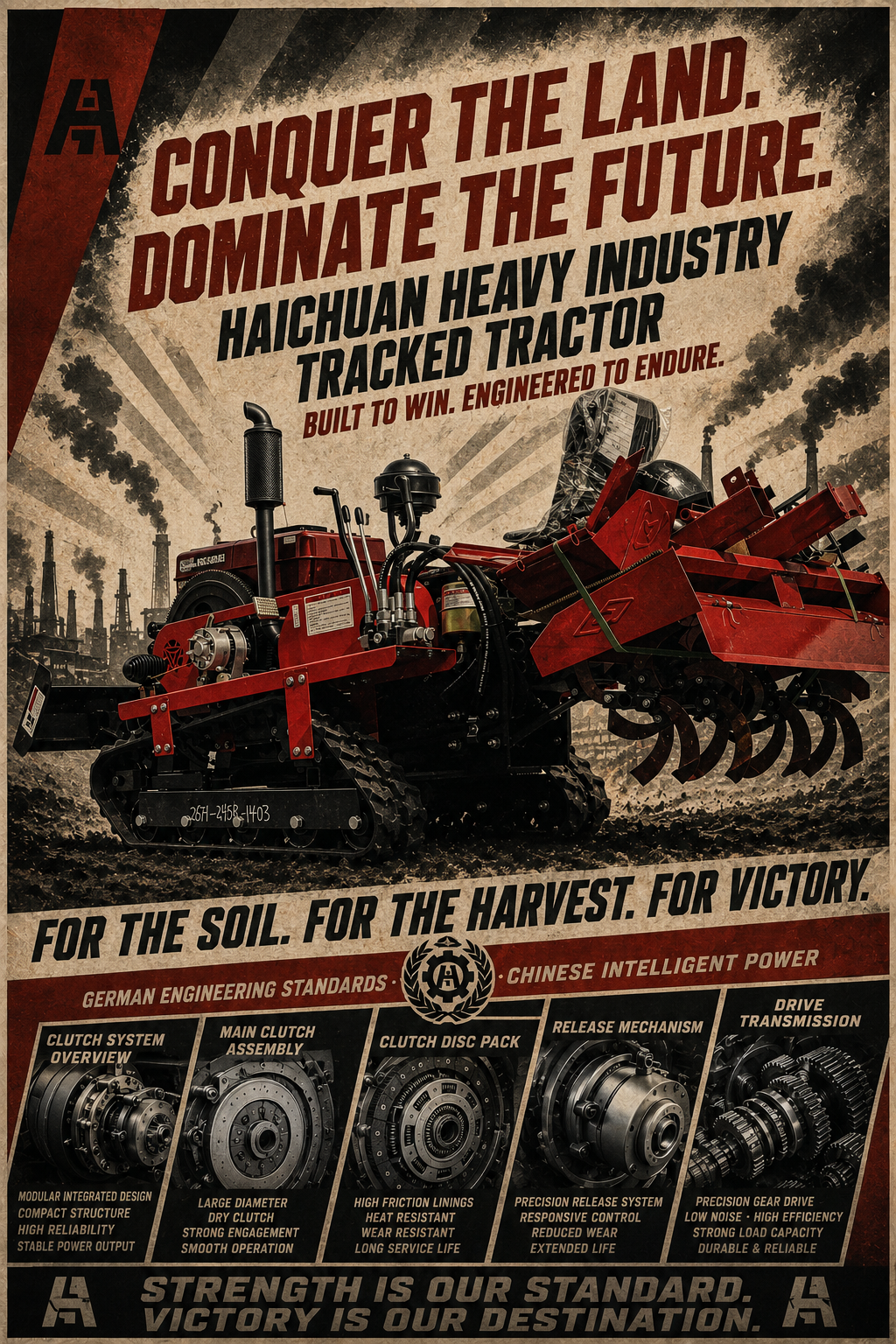
Aight, so check it—last time we had that clutch figured out. Iron handshake slidin' you off the line, oil fan pushin' power without even touchin'. Smooth. Now that power's knockin' at the transmission door, and this right here? This is where the real wizardry jumps off.
The transmission is the slickest hustler in the whole drivetrain, man. One job: bend the rules. That crankshaft only knows one speed—fast—and its torque comes with an attitude problem. The transmission says, "Nah, we ain't doin' that." It turns that one‑trick pony into a drive shaft that'll crawl slow and strong or sprint light and quick. Your tractor gonna creep through the mud draggin' a plow one minute, then fly down the road the next. Same engine. Whole different personality. That ain't just engineering, that's straight‑up sorcery.
Why That Engine Can't Work Solo – The Whole Point of a Gearbox
Let's be real—even the meanest diesel got a built‑in flaw. Its happy zone? Narrow. Real narrow. Drop below a certain RPM, it turns into wet spaghetti. Push it too high, it screams bloody murder and drinks fuel like it's chuggin' forty‑ounces. Meanwhile, the tractor got jobs to do:
Deep plowin': Draggin' steel through hard dirt, man. Speed? Three, four kilometers an hour, that's all. But you need torque so nasty it flips the earth inside out.
Rotary tillin': That PTO shaft spinnin' blades fast, and the engine better sit locked at its favorite RPM while the wheels creep slow so them blades slice even. Can't be jerkin' around.
Road haulin': Empty on the open road, don't need much muscle, but them wheels gotta turn fast. Twenty, thirty miles an hour, easy.
You see the problem, right? It's like one dude tryin' to tighten every screw in the world with his bare fingers. Some screws need slow and heavy, some need fast and light. His wrist can't cover all that. The transmission is the toolbox, baby. Every socket, every driver head. One power source, infinite moves.
Manual Transmission: The Old‑School Hustler Stackin' Gears Like Dominoes
The manual box is the OG—oldest, toughest, cheapest player in the game. Its whole philosophy? Four words: gear ratio pairin', baby.
Big Gear, Small Gear – The Slow‑Down, Muscle‑Up Remix
Two gears mesh, small one drives big one. Small spins five times, big turns once. That's reduction. And while it's doin' that, the twistin' force at the big gear multiplies like crazy. Flip it—big drives small—that's speed‑up and torque‑down. Inside a manual box, you got a whole collection of these different‑size pairs. Pick a pair, that's a "gear." Simple.
Most manual boxes run two shafts. The input shaft hooks to the clutch, carries fixed gears spinnin' with it. The output shaft points to the driveshaft, got gears slidin' or spinnin' on it. Shifting? You just pick which pair meshes. Small‑to‑big: low gear, crawlin' slow, strong as an ox. Big‑to‑small: high gear, wheels flyin', engine barely breakin' a sweat.
From Teeth‑Grindin' Hell to Smooth Criminal Moves: Synchromesh
Now, the oldest tractor boxes? They used sliding gear shiftin', and let me tell you—it was violent. Gears just got shoved along splined shafts, and when you shifted, two gears at different speeds crashed face‑first into each other. GRRAUNCH. Sparks flyin' like the Fourth of July. Old‑timer drivers had to learn that foot dance—double‑clutchin'. Clutch in, pull neutral, clutch out and blip the throttle so the gears match speeds, clutch in again, slot it home. Even then, grindin' happened. You'd find little chipped teeth in the bottom of that oil pan like broken dreams.
Then synchromesh rolled up and saved everything.
The secret weapon is a brass synchronizer ring—conical inside, sittin' against a matching cone on the gear. When you go to shift, the fork shoves that ring against the gear first. Cone hits cone, starts friction‑grabbin' like a mini clutch. It forces that gear's speed to match the shaft's speed—fast. Once they're singin' the same tune, the toothed sleeve slides over and locks 'em together smooth and silent. No crash, no grind, no drama.
What you gotta understand: synchromesh don't force things together—it sweet‑talks 'em into sync first, then locks the deal. That brass ring's softer than the gear teeth, so it wears down sacrificially. It don't carry the power, just plays peacemaker before the engagement. Lasts way longer than a clutch disc, too.
A real common tractor setup is the 12F+12R synchromesh box—twelve forward gears, twelve reverse. Forwards use different gear‑pair combos for different ratios. Reverse? You throw an extra idler gear into the train to flip the output shaft the other way. Low gears give massive reduction—deep plowin', hill climbin', wheels barely turnin' but torque through the roof. High gears get close to 1:1 or even overdrive for roadin'—engine just hummin', wheels eatin' up the miles.
The Dream: Shift Without Ever Droppin' Power – Power Shift
Synchromesh is beautiful, but you still gotta clutch in and cut the power. For a tractor buried in a heavy plow, the second that power cuts, the tractor slows, the plow snags, and now you gotta burn up the clutch all over again just to get rollin'. And on a hill? Power cuts, tractor rolls back, driver's heart jumps out his chest.
Enter power shift.
Inside a power‑shift box, they don't use simple dog clutches. Nah, they use stacks of wet multi‑disc clutches—friction plates and steel plates layered up, swimmin' in oil, squeezed by hydraulic pressure. The shift magic is "the next gear grabs while the last gear lets go." One clutch pack eases off, slippin' while the other pack eases on, grabbin'. For a split second, both are partially engaged so torque never hits zero. Driver don't touch no clutch pedal. Just push the lever, tap a button, and the hydraulic brain plus an ECU swaps gears in milliseconds.
The real trick ain't even the clutches—it's the control logic. When exactly to start grabbin' the next gear? When to let the last one go? How many milliseconds of overlap? What pressure curve? Get it right, the shift is silk. Get it wrong, the tractor bucks like a rodeo bull. Early systems used mechanical valves and trial‑and‑error; now it's electro‑hydraulic proportional valves and a computer that never misses.
Concrete example: Haichuan Heavy Industry runs wet multi‑disc clutches with electro‑hydraulic proportional valve control on some of their higher‑spec machines—power‑shift and power‑shuttle without droppin' torque. From entry 8F+2R sliding gear, to mid‑level synchromesh, to high‑end wet multi‑disc power shift. One clean tech ladder from budget to boss.
When you talkin' to a customer about manual transmissions, three questions cut through the noise: "That dirt sticky? Y'all plowin' more or haulin' more? The man on the seat a veteran or a rookie?" Heavy clay, deep plowin', hills—power shift is a lifesaver. Flat ground, mostly haulin'—synchromesh got you. Rookie drivers everywhere—keep 'em away from sliding gear unless you want that gearbox dead before harvest.
Automatic Transmission: Planetary Gears Pullin' the Invisible Sleight‑of‑Hand
Manual box is gear‑to‑gear—want six speeds, you stack six gear pairs. The automatic box says, "Hold my beer." It uses the planetary gearset—one set of gears spittin' out multiple ratios. That's what makes people's heads spin when they first look inside: how you got four, five speeds from just a handful of gears?
Sun, Planets, and Ring – The Universe in a Gearbox
Picture a mini solar system made of steel:
Sun gear: Center, small, boss of the operation.
Planet gears: Three or four little gears circlin' the sun, mounted on a planet carrier. They orbit the sun AND spin on their own pins—just like Earth doin' its cosmic dance.
Ring gear: Big hoop with teeth on the inside, wrappin' the whole crew. Planets roll along them internal teeth.
Three players: sun gear, planet carrier, ring gear. Here's the genius: you can lock any one of 'em to the case, or lock any two together, and every combination spits out a different gear ratio. Let's run the combos:
Hold the ring still, power in through sun, out through carrier. Sun spins, planets walk around inside the locked ring, draggin' the carrier slow. Big torque, low speed. That's your crawler gear.
Hold the sun still, power in through ring, out through carrier. Ring turns, planets orbit around the frozen sun. Different ratio, another forward gear.
Hold the carrier still, power in through sun, out through ring. Planets locked in place turn into idlers, ring spins backwards. That's reverse, baby. No extra shaft needed.
Lock any two together—say, sun to carrier. Whole gearset spins as one solid block. Direct drive, 1:1, zero gear loss. That's your efficient cruise gear.
That's ONE planetary set givin' you low, medium, direct, and reverse. Now chain two or three of these together with a fistful of wet multi‑disc clutches and brake bands, add a hydraulic brain to pick which combo when, and you got four to twelve forward speeds with no driver sweat.
Hydraulic Auto: Torque Converter + Planetary Gears = Hit the Gas and Go
We already broke down the torque converter—it's the oil fan that launches you smooth and multiplies torque on takeoff. Pair that with a planetary gearbox, and you got the classic hydraulic automatic transmission—the "AT."
Driver's job? Put it in D, lift off the brake, press the gas. That's it. Converter handles the launch, planetary box swaps ratios automatically under hydraulic command. You just steer and manage speed. In ag, ZF's TORQUE series and their TPT power‑shift transmissions lean heavy on this planetary‑plus‑wet‑clutch recipe—full auto shifting without cuttin' power. Showin' up on bigger tractors, self‑propelled harvesters, forage choppers. One operator, way more acres, way less fatigue.
CVT: The Final Boss That Don't Even Know What a "Gear" Is
Manual? Steps. Automatic? Steps. You still jumpin' from ratio to ratio. Engine finally hits its fuel‑sippin' sweet spot—then you upshift, RPM drops right out the zone. Frustratin'.
CVT—Continuously Variable Transmission. No steps. No jumps. The ratio slides like water, from deepest low to highest high, smooth as turnin' a radio dial across every station. The engine just parks itself at the one perfect RPM, and the CVT handles the rest.
The Light‑Duty CVT: Steel Belt Hustle
Small cars and some light tractors use a steel‑belt CVT. Two pairs of conical pulleys—one hooked to the engine, one to the output. A steel push belt (hundreds of thin plates bundled together) sits in the V‑grooves. Squeeze one pulley, the belt rides up—bigger diameter. Spread the other pulley, belt drops—smaller diameter. Continuously change the pulley widths, you continuously change the ratio. No gears. No steps. Scooters do this with rubber belts and centrifugal weights—twist and go, smooth as butter.
The Heavy‑Duty CVT: Hydrostatic Power Split – Fendt Vario Style
But tractors? Tonnage. Thousand‑plus Newton‑meters of torque pullin' a plow through dirt. A steel belt would slip and burn to death in five minutes. So the big boys go hydrostatic power split.
Fendt's Vario transmission dropped this in 1995 and been refining it since. No belt. Instead, engine power splits two ways: part goes through straight mechanical gears (efficient, handles the heavy load), part drives a variable hydraulic pump that feeds a hydraulic motor. The motor's speed and direction are infinitely adjustable by tilting the pump's swashplate. The two power streams merge back together in a planetary gearset. Vary the hydraulic motor, you vary the overall ratio—steplessly, from 0.02 km/h to 50 km/h, with the engine locked at its most economical RPM the whole dang time.
Driver just nudges a joystick or dials in a speed. That's it. No shiftin', no clutch, no watchin' the tach. The engine hums its favorite note all day while the transmission morphs to match the job.
How you sell this to a customer? Put it plain: "CVT keeps the engine where it's happiest and most fuel‑efficient, every second you're workin'. You need speed, the wheels give you speed. No shiftin', no huntin', no human guessin'. A manual makes the engine fit the gear. A CVT makes the gear fit the engine."
The Big Picture: Three Magicians, One Mission
So let's step back and look at the whole crew.
The engine's stubborn. One happy RPM zone, one personality. The transmission's job: translate that one‑note singer into every tune the wheels need. Deep bass for plowin', quick tempo for haulin', steady groove for tillin'.
Manual: The direct translator. Gear pairs, synchromesh keepin' peace, power shift keepin' flow. From budget sliding gear to pro wet multi‑disc—same physics, layered execution.
Automatic: The smart translator. Planetary gearsets do the work of a dozen gear pairs, hydraulics do the thinking, torque converter does the launching. Driver just steers and smiles.
CVT: The ultimate translator. The whole idea of "gears" gets thrown out the window. Ratio slides, engine stays perfect, job gets done.
Look at the whole history, man—the transmission has been on one mission the whole time: get the engine away from the wheels, and get the driver closer to the engine. Manual days, you had to know the engine's mood and dance on three pedals. Automatic days, the hydraulics read the mood for you. CVT days? The mood don't even exist no more. The engine just vibes at its best RPM, and the transmission rearranges the universe around it.
From the drivetrain relay view: clutch passed the power in smooth, transmission reshaped its whole soul. Now that power's got the right attitude, next job is splittin' it—how you send the right amount to each wheel so they can turn different speeds in a corner without fightin', but lock arms and pull together when one's slippin' in the mud? That's the differential and them U‑joints waitin' in the next one. Let's ride.
Contact With Us

Please enter what you want to find
Send Your Inquiry Today
*We respect your confidentiality and all information are protected.