

What the Clutch and Torque Converter?
Yo, check it out, chief engineer. Last time we broke down why the drivetrain is the all‑purpose bossman between the engine and the wheels. So now, when that engine power rolls up to the front gate of the drivetrain, who's the first bouncer it meets? That's the clutch and its cousin, the torque converter. These two brothers got one job: be the switch. You wanna send power through, they connect. You wanna cut it off, they disconnect. And when they connect, they gotta do it gentle—no smashing gears, no choking the engine to death.
Today we gon' tear this "switch" wide open and see how it uses a "hard connection" and a "soft connection" to get the job done smooth.
4.2.1 The Clutch: That Iron Handshake That Slides the Power In
Why You Need a Clutch? – One Palm Can't Clap
Remember that loaded‑start headache from last chapter? Tractor sittin' there with a trailer full of corn, engine goin' putt‑putt‑putt at idle, weak as a kitten.
Now imagine there ain't no clutch. You slam it into first gear, and the engine and wheels are locked together solid. What happens? That little idle torque from the engine can't budge them tires that the ground is holding tight. And when it can't budge 'em, the crankshaft goes from six, seven hundred RPM to zero in a blink—clunk—engine choked dead.
Aight, let's try a different move: you put it in neutral, stomp the gas, rev that engine up to two, three thousand RPM, and while it's screamin' full of muscle, you BAM jam it into first gear. This time it don't stall—but the wheels shoot off like somebody dropkicked 'em from behind, and you hear that metal‑on‑metal CRUNCH inside the gearbox that makes your teeth hurt. Do that a few times, them transmission gears gon' look like a dog chewed on 'em.
See? Without a clutch, startin' off just ain't possible. You either stall out or wreck the gearbox. Between the engine and wheels, there's gotta be a "slide" transition.
That's exactly what the clutch does—it's that slide. Think of it like an iron handshake. Most times, it grips tight, and one hundred percent of the power goes through. But when you takin' off, it don't lock up right away. Nah, it lets the two contact surfaces slip on purpose, slidin' against each other while they grind down that speed difference. Once both sides are spinnin' pretty much the same, then it locks up solid. That controlled slippin' right there is what old‑time drivers call half‑clutch or "riding the friction point."
What's Inside the Palm? – Structure of a Friction Clutch
The most common tractor clutch is a friction clutch, and it passes power through—you guessed it—friction. Four main parts:
Flywheel: Bolted to the back of the engine crankshaft, spinnin' with the engine. Think of it as the "palm" of the handshake, smooth and shiny, doin' the drivin'.
Driven Plate (Clutch Disc): Sandwiched between the flywheel and the pressure plate. Both sides got friction material riveted on—same idea as brake pads. It's got a splined hole in the middle that slides onto the transmission input shaft. This is the part that gets "rubbed."
Pressure Plate: A big, heavy iron disc pressin' against the back of the driven plate. It works with the flywheel to clamp that driven plate in the middle.
Clamp Springs: Usually a bunch of heavy‑duty coil springs, or a single diaphragm spring shaped like a saucer, pushin' with all its might to squeeze the pressure plate, driven plate, and flywheel into one solid lump. The stronger the spring, the more torque it can handle.
Now let's walk through the three working states:
State One: Fully Disengaged (Clutch pedal floored). A linkage or hydraulic mechanism pulls the pressure plate back. The springs get compressed, and the driven plate breaks free from the flywheel and pressure plate. Engine spins with the flywheel and pressure plate all by itself; the driven plate and transmission input shaft sit still. Power is completely cut. This is you, parked at the end of the row, waitin' to unload fertilizer or chattin' with the neighbor—engine runnin', wheels chillin'. Both mindin' their own business.
State Two: Half‑Clutch (Pedal easing up slow). This is the critical stage. You let the pedal come up, and the springs push the pressure plate toward the flywheel, startin' to lightly press on the driven plate. Now the driven plate is clamped, but the pressure ain't full yet—there's still a speed difference, and slippage happens. Friction drags some of the engine's torque to the driven plate, coaxin' the wheels to start turnin'; the rest of the torque gets eaten up by the slippage and turns into heat. This is the "slide" we talked about—using controlled slippage to soak up that RPM difference while gently handin' power over. Your foot controls how hard the slide is: ease up a little, light slide, tractor creeps; ease up more, harder slide, tractor picks up speed.
State Three: Fully Engaged (Pedal all the way released). Once the tractor's rollin' and the driven plate's RPM catches up close to the flywheel's, you let the pedal all the way out. The springs now use every ounce of muscle to lock the pressure plate, driven plate, and flywheel into one solid chunk of iron. Slippage is done. Engine and transmission input shaft are hard‑locked together, power flowin' one hundred percent. From this moment on, you hit the gas, engine and wheels respond together. This right here is the correct scenario for "when you ain't touchin' the clutch, everything's pressed into one iron block and power is connected"—but only after the vehicle is already movin' and both sides are synced up.
So the whole start‑up sequence is "fully off → half‑clutch slippin' → fully locked," not a simple "off → on." The clutch ain't a light switch. It's a controllable slide machine.
The Driven Plate's Destiny as a Wear Item
Once you get half‑clutch, you also get why the clutch disc is a consumable. Every single start, one slide scrapes off a tiny layer of that friction material—same as brake pads. Loaded starts, hill starts, or a driver who likes to hang on the half‑clutch forever—that scrapes it even faster. When it wears down to the limit, the pressure plate can't clamp tight enough, and the clutch starts slippin'. You stomp the gas, engine roars, but the tractor barely moves. That's when you know the clutch disc is ready for replacement.
The Clutch's "Inner Kung Fu": Self‑Adjusting Technology
When the disc wears thin, besides slippin', there's another headache: the gap between the release bearing and the pressure plate gets bigger. The clutch pedal sinks lower and lower, and even when you floor it, the clutch might not fully disengage—so when you shift, you get that nasty grrrrind.
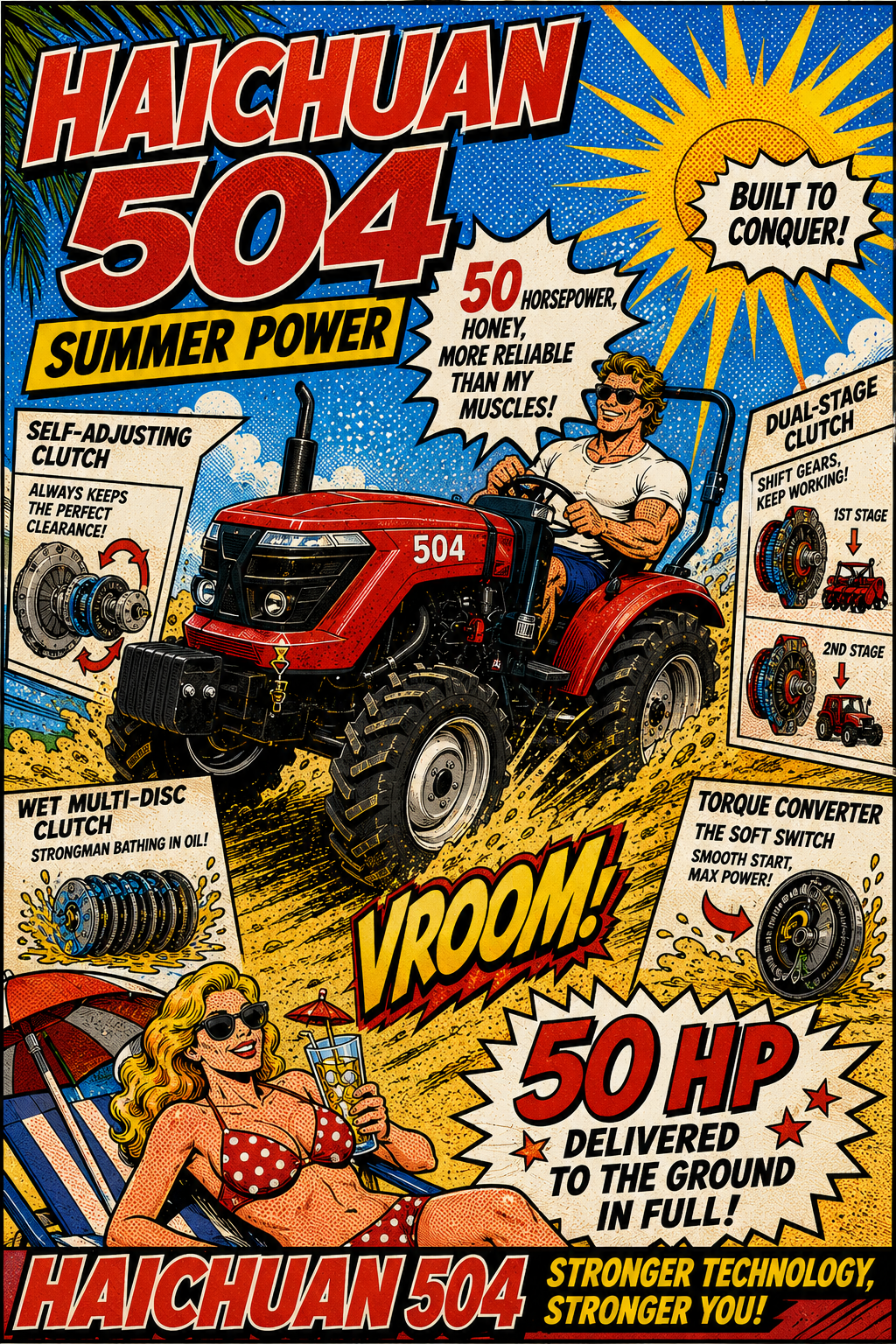
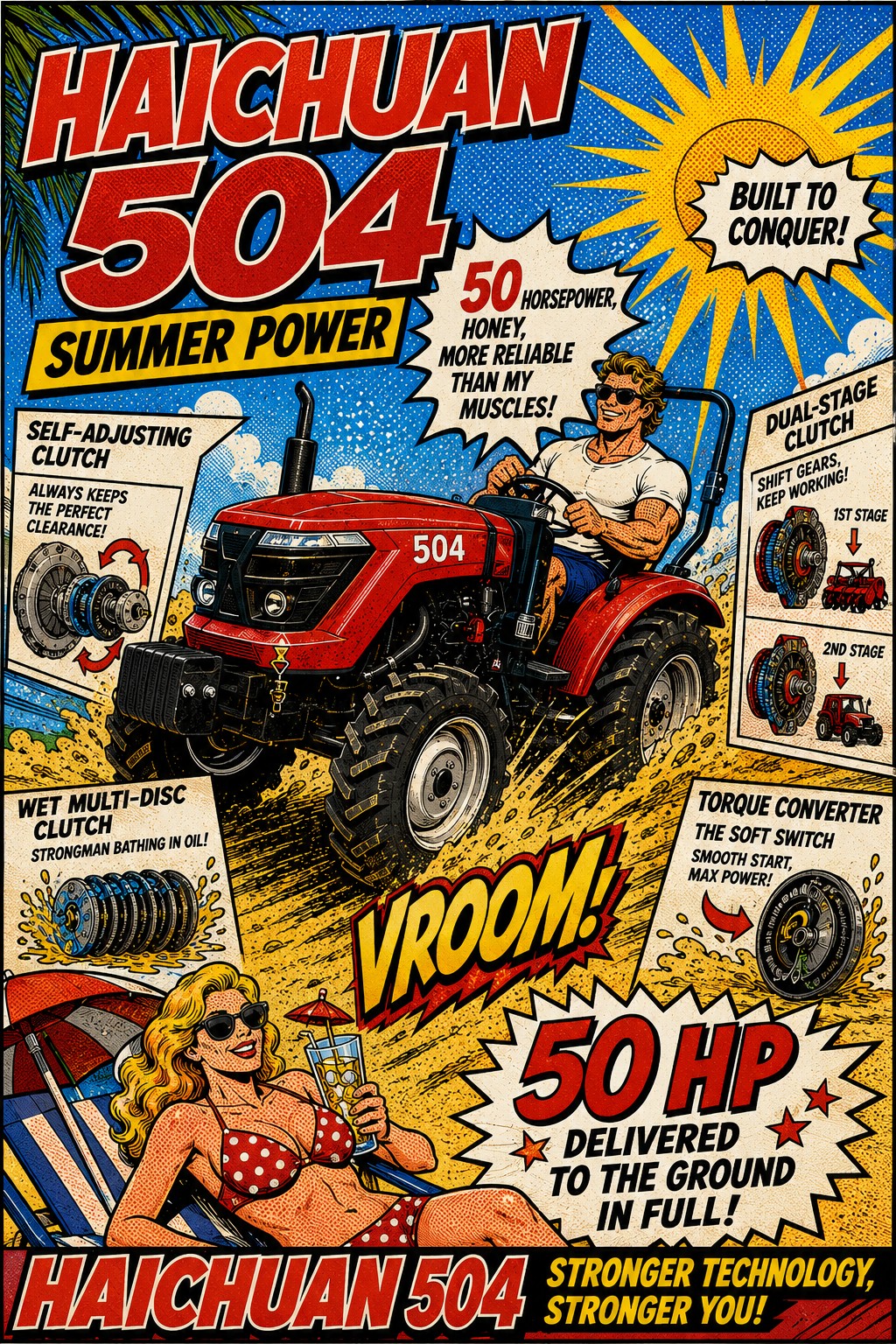
The old‑school fix was manual adjustment, which is time and labor. Then came self‑adjusting clutch technology. They pack a mechanical compensation mechanism inside the pressure plate. The idea's like a screw that tightens itself: every time the disc wears down a hair, a sensor ring triggers the compensation mechanism to rotate a tiny bit, pushin' the pressure plate a hair closer to the flywheel. That wear gap gets taken up automatically, so the release clearance stays factory‑fresh from the day it leaves the plant till the disc is completely worn out. Pedal height and feel barely change.
French company Valeo has this SAT (Self‑Adjusting Technology) across much of their agricultural clutch line, covering most European tractor models. It's purely mechanical—no electronics, no hydraulic lines needed. When you talk to a customer about it, one line sums it up: "Does the clutch pedal feel the same after a year of work as it did on day one?" A regular one sinks lower and lower; a self‑adjustin' one don't.
Tractor Special: Dual‑Stage Clutch
Tractors got one big difference from cars: besides driving the wheels, they gotta drive implements. That spinning shaft stickin' out the back—the Power Take‑Off (PTO)—runs rotary tillers, harvesters, seeders, all that good stuff. Here's the problem: sometimes you need to stop the tractor to shift gears, but the implement can't stop. That rotary tiller's down in the dirt chewin' away; if it stops every time you shift, you get a big ugly clod.
Engineers came up with a slick fix: the dual‑stage clutch.
Two clutches packed in one housing, controlled by a single pedal in two stages. First stage: you push the pedal partway down, and only the drive‑wheel clutch (main clutch) disengages. The PTO clutch stays clamped tight, so the implement keeps spinnin' happy. You can stop and shift gears without interruptin' the implement work. Second stage: you push the pedal all the way to the floor, and the PTO clutch (secondary clutch) disengages too. All power cut. When you backin' up to dump fertilizer, you floor it, everything disconnects, you grab reverse, ease off the pedal, and implements and wheels come back online together.
Picture a backpack with two chest buckles. Unclip the first one, the pack still hangs on your shoulders. Unclip the second, and you can take the whole thing off. Dual‑stage clutch is that same logic.
Wet Multi‑Disc Clutch: The Strongman Bathing in Oil
A dry clutch cools itself with air. Under heavy‑duty work—loaded starts, constant half‑clutch work, tight turnarounds at the headland—heat builds up wicked fast, and the disc can burn out. So engineers thought: let's dunk the clutch plates in oil. That's the wet multi‑disc clutch.
The structure flips the dry single‑plate idea around: multiple friction discs and steel separator plates are stacked in alternating layers, all submerged in cooling oil. Engagement comes from a hydraulic piston—when oil pressure pushes the piston, it clamps the whole stack together to transmit power. When pressure releases, the oil flows away, carryin' the heat with it.
The upsides are clear: killer cooling, no fear of long slippage periods; the multi‑disc stack handles huge torque in a compact package; and with an electro‑hydraulic proportional valve precisely controlling engagement pressure, starts and shifts come out smooth as silk. Last chapter we saw Haichuan Heavy Industry using a wet multi‑disc clutch with proportional valves on some higher‑spec models to get power‑shift and power‑shuttle without breakin' torque. Same path.
4.2.2 Torque Converter: The Soft Switch That Don't Need to Slide
The clutch solves the start‑up problem with sliding—metal on metal, slippin' on purpose. But what if there was a way that never let metal touch metal in the first place, so you ain't gotta slide at all? There is. That's the torque converter.
The Game of Two Fans Facing Each Other
The principle of a torque converter is easy to show with one experiment:
Grab two electric fans, set 'em face‑to‑face. Plug one in (that's your impeller, connected to the engine flywheel), leave the other unplugged (that's your turbine, connected to the transmission input shaft). When the powered fan kicks on, the airflow hits the blades of the fan across from it, and that second fan starts spinnin'. No metal touchin' metal anywhere—just air passin' the energy along.
A torque converter is the same deal, except it don't use air; it uses hydraulic fluid. Packed full of oil, three core parts inside:
Impeller (Pump): Connected to the engine. Engine spins it, and it slings oil outward like a pump.
Turbine: Facing the impeller, connected to the transmission input shaft. The high‑speed oil the impeller flings out slams into the turbine blades, and the turbine spins. Power passed without a single solid part touchin'.
Stator: Wedged between impeller and turbine, fixed in place. Its job is to redirect the oil flow.
Torque Multiplies Automatically on Start‑Up – The Stator's Magic
When the tractor first starts movin' and the turbine is turnin' real slow, the oil bouncin' back from the turbine flows against the impeller's rotation. The stator grabs that oil and redirects it so it flows back with the impeller's spin, givin' the impeller an extra push. At this moment, the torque converter's output torque can be more than double the engine's input torque. This is where it's different from a clutch: a clutch needs the gearbox behind it to reduce speed and multiply torque; a torque converter multiplies torque by itself right at start‑up.
Once the tractor's rollin' and the turbine speed gets close to the impeller speed, the oil‑flow direction changes. The stator then freewheels on a one‑way clutch and spins along, no longer multiplyin' torque—the converter becomes a "coupling," just passin' power without multiplyin'. At highway cruise, some torque converters got a lock‑up clutch inside that mechanically locks the impeller and turbine together. Boom—fluid drive turns into pure mechanical drive, and efficiency jumps back near one hundred percent.
Comparison and When to Use Which
In the ag and construction powertrain world, Germany's ZF has supplied power‑shift transmissions with torque converters for quite a few international tractor and loader brands. ZF's TORQUE series integrates the converter, power‑shift gearbox, and wet multi‑disc brakes into one package, lettin' the machine run stepless and without power interruption under heavy load. When a customer asks you about "automatic" setups on big tractors, you can tell 'em: behind that is usually a torque converter or wet‑clutch power‑shift package—ZF‑style integrated drivetrains show up in a lot of brands.
4.2.3 Wrap It Up: The Iron Handshake and the Oil Fan—Which One Gets the Job Done Smoother?
Aight, chief engineer, let's put it all together.
The clutch handles the start‑up problem with half‑clutch slippage—it lets the driven plate and flywheel slide on purpose, using that grind to soak up the speed difference and pass power gently. A dry clutch relies on the driver's foot to control that slide; a wet multi‑disc uses hydraulic proportional valves; self‑adjusting tech keeps that slide feel the same for life.
The torque converter goes even further. It don't slide at all—from birth, it don't let metal touch metal. Oil does the work, naturally carryin' a speed difference, naturally multiplyin' torque, naturally smooth.
One line for your customers: If it's got a clutch pedal, it's an iron handshake slidin' the job done. If you just hit the gas and go, an oil fan is doin' the work for you. When you talkin' with a customer, ask 'em straight: "Your ground over there—heavy clay for deep plowin', or sandy loam for haulin'?" That alone will pretty much tell you which direction to steer 'em.
Next time, we gon' climb inside the gearbox and watch how a pile of gears works magic, turnin' that engine's narrow attitude into all the different moods a tractor needs to get every farm job done. See you on the field bank!
Contact With Us

Please enter what you want to find
Send Your Inquiry Today
*We respect your confidentiality and all information are protected.