

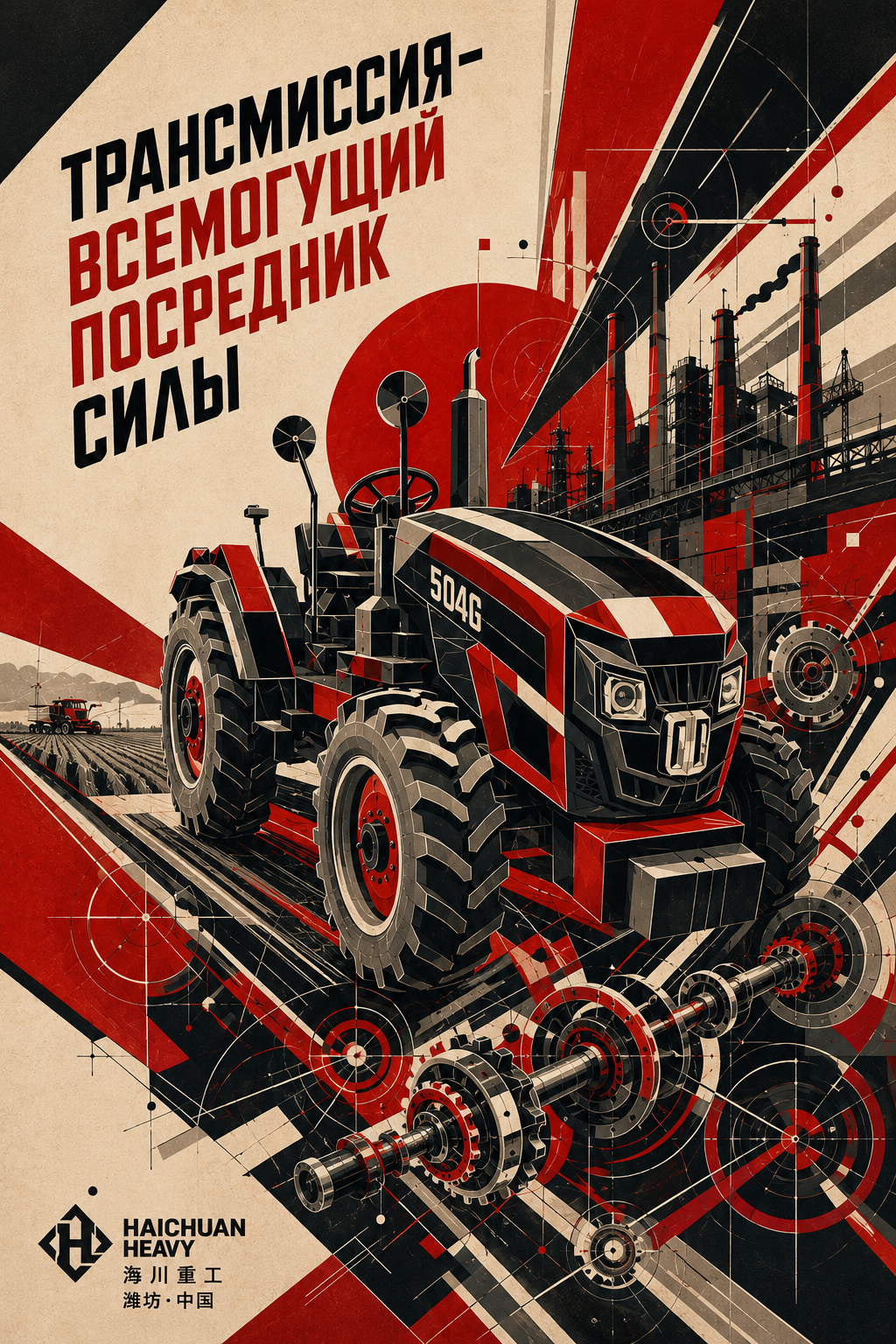
Why We Need a Middleman – Drivetrain Overview
Yo, check it out, chief engineer. We got this diesel engine rumblin' like a beast, and four big ol' tractor wheels with brakes and suspension all hooked up. You might be thinkin', "Man, this easy! Just grab a solid iron shaft, weld one end to the engine and the other to the wheels, done deal!"
But let me tell you somethin'—if you actually do that, the second you fire up this tractor, she gonna act like a stubborn mule that just got whipped. Either she choke and die with a clank, or she shoot off like a rocket and kiss a wall.
Why that happen? Today we gon' break down this "middleman"—the transmission system—and get all the way into the dirt with it, you feel me?
4.1.1 The Engine's "Attitude": A Strongman That's Real Picky
To get why we need a transmission, first we gotta understand this diesel engine's attitude. You think it's like a water buffalo that just pulls steady? Nah, brother, you way off.
You ever see them kids' toy bamboo dragonflies? You twist up a rubber band, let go, and that propeller goes vroom for a hot second—strong, but only for a blink. A diesel engine kinda like that, except it can keep goin'. But here's the problem: it's only strong like a bull when it's spinnin' fast and happy. The moment you slow it down, it turns into a weak kitten, can't even stand up, and just gives up the ghost on you.
Let's take this tractor out to the field and see what kinda headaches we run into:
Scene One: Loaded Start. You got a whole trailer full of corn hooked up, tires squished down, sittin' still on soft dirt at the edge of the field. The engine is sittin' there goin' putt-putt-putt at idle—it's gotta spin at least six, seven hundred RPM (that's the idle speed), or else it'll choke out. But the thing is, at idle, its strength is pitiful, ain't much more than a kitten scratchin'. You think you can drag a whole load of corn with that? Forget about it! So what you gon' do?
Scene Two: Steep Climb. Aight, you finally got that trailer rockin', cruisin' along the field ridge, and BAM—a big ol' irrigation slope hits you. Wheels push against it, and the resistance comes on like a wall. The engine starts strugglin', chug-chug-chug, RPMs droppin'. And here's the messed-up part: this diesel got a nasty attitude—when the RPMs drop, its strength don't pick up, it actually drops too! Less strength, RPMs drop faster—it's a death spiral, man! Couple seconds later, she coughs and dies right there, leavin' you stuck on the slope.
Scene Three: Haulin' Down the Road. Aight, now you took the plow off, empty machine on a country cement road, engine screamin', feelin' good. But the engine's happy zone is real narrow—it likes hangin' around two thousand RPM. Push it higher, it sounds like it's gonna crack the water tank, drinks fuel like it's water, and shakes like it's comin' apart. But you just wanna cruise at twenty, thirty miles an hour—how you gonna do that without killin' the engine or draining the tank in three minutes?
See? The engine's a one-subject genius: it only works good in a tiny high-RPM lane, but our tractor gotta do everything from startin' in mud, pullin' loads up hills, to haulin' down the road—all kinds of conditions. That's the core problem right there.
This engine headache, really, it's a mismatch between the diesel's torque curve and what the wheels need. So how we fix it? One way is to make that engine push out big torque even at low RPMs—like how Fendt did with their "iD Low-Engine-Speed Concept." Regular diesels get their peak torque above 1500 RPM, but Fendt tuned theirs to have a rated speed of only 1700 RPM, with the sweet spot between 1100 and 1400—way lower. One model kicks out 1680 Newton-meters at just 1200 RPM. Pair that with their VarioDrive transmission, and you can creep from 0.02 kilometers per hour (that's slower than a snail crawlin') all the way to 50, stepless, without ever shiftin' gears. Engine don't gotta scream.
4.1.2 The Transmission's Three Field Chores
To solve this whole mess, the "middleman"—the transmission system—grabs a hoe and steps onto the field. On our tractor, it's got three main chores to handle:
Chore One: Slow Down, Torque Up – Turn "Fast and Weak" into "Slow and Strong"
This is the transmission's most basic farmhand skill. Let me hit you with a country kid's example:
You ever see the chain and sprockets on the back of a walk-behind tractor or a three-wheel farm truck? Up front you got a small sprocket, in back you got a big chainring. The little one spins a bunch of times for the big one to turn just once. But what you get in return? You push that little sprocket with one finger, and that big chainring can drag a whole sack of fertilizer!
That's "slow down, torque up." You take the engine's "spinnin' crazy fast but weak as a noodle" energy, run it through some gear combinations, and turn it into "slow and steady, strong as an ox" power at the wheels.
Same deal: engine spins fast (couple thousand RPM) but weak. The transmission and final drive in the drivetrain act like them sprockets—they "reduce" that high RPM down to low wheel RPM, and at the same time multiply that twistin' force (torque) by dozens of times. Suddenly that kitten scratch from the engine turns into iron bull strength that can rip through hard soil with a plow.
Now, how exactly does this reduction happen between gears? That's where the transmission "tech ladder" comes in. When you doin' foreign trade, the customer ain't gonna ask "how many horsepower" first—they gon' ask "what transmission config?" Because that right there decides the price and who you sellin' to.
Bottom rung: manual sliding gear transmission. You just slide gears back and forth to engage 'em. Simplest, cheapest, but you hear that grrrrind every time you shift—normal business. Step up: manual synchromesh transmission. It uses a synchronizer ring to match gear speeds before they engage, so shifts are way smoother—this is the workhorse in mid-low horsepower tractors globally. Next level: power shift. You don't even touch the clutch to shift; hydraulics do the switchin' for you, power never cuts out. When you deep plowin' and can't stop, that's real efficiency. Top shelf: CVT (Continuously Variable Transmission). Like turnin' the volume knob on a radio, it changes ratios smooth across the whole range, so the engine can just chill at its most fuel‑sippin' RPM.
Let me give you a concrete example: Haichuan Heavy Industry, out of Weifang, Shandong. They make four‑wheel‑drive tractors in the 45 to 200 horsepower range, and their transmission setups span from basic to mid‑range. Entry machines use an 8F+2R manual sliding gear transmission—simple, tough. Mid‑range models step up to synchromesh, so shift quality jumps. Some higher‑spec machines use a wet multi‑disc clutch with electro‑hydraulic proportional valve control to achieve power‑shift and power‑shuttle without breaking torque. Wet multi‑disc setups dissipate heat better and last longer than traditional dry single‑plate clutches, and the proportional valve automatically adjusts clutch engagement pressure based on load, so starts and shifts are smoother.
Chore Two: Park and Wait, Reverse to Unload – Let Her Rest and Back Up
The engine can't just stop whenever; if she dies, you out there with a crank handle sweatin'. But when you get to the end of the row, you gotta stop to load seed, unload fertilizer, right? Maybe stop on the field bank and shoot the breeze with the neighbor? You gonna keep your foot on the gas the whole time so she don't stall?
That's where the clutch in the transmission comes in like a superhero. Think of it like an "iron handshake" between the engine and the wheels. Normally, that handshake is tight, and power flows to the wheels. You stomp the clutch pedal, that handshake opens up—engine just sits there goin' putt-putt-putt mindin' its own business, wheels stay put. When you ready to roll, you ease off the clutch, that iron handshake gently grabs hold again, and the tractor pulls away smooth.
And get this: once a diesel starts, its crankshaft only spins one direction, like a one‑way street. Never gonna reverse itself. But you gotta back up to dump fertilizer, right? Turn around at the headland? Inside the transmission, they use a little gear called an idler gear to flip the output shaft's direction—without makin' the engine run backwards, the tractor just backs up obediently. A whole lot easier than teachin' an old ox to walk straight backwards, I'm tellin' you!
Now, that iron handshake—the clutch—looks simple, but there's tech inside. The clutch disc is a wear item, man; it gets thinner and thinner, and the pedal gets lower and lower. The driver gotta keep adjustin' to a changin' feel. How you fix that? There's a technology called self‑adjusting clutch. Inside the pressure plate, they pack a mechanical compensation mechanism. Every time the disc wears a tiny bit, the mechanism automatically takes up the slack, keepin' the perfect gap between the release bearing and the pressure plate. The result? Pedal height and effort stay almost the same through the whole life of the clutch. French company Valeo has this SAT (Self‑Adjusting Technology) across a lot of their agricultural clutch line, coverin' most European tractor models. It's purely mechanical compensation—no external hydraulics or electronics needed. When you talk to a customer, you can sum it up in one line: "Does the clutch pedal feel the same after a year of work as it did on day one?" A regular one sinks lower and lower; a self‑adjustin' one don't.
Chore Three: Differential Action – Let the Left and Right Wheels Do Their Own Thing
You ever notice when a tractor turns, the outside wheel draws a big ol' arc, the inside wheel draws a small one—the outside wheel travels way further. If the left and right wheels are welded together on a solid axle, they gotta spin the same speed. So when you turn, the inside wheel overshoots, the outside wheel can't keep up, and the tires scrub and scrape on the ground—eats tires like they're pancakes, wastes diesel, and might even twist the axle shaft till it snaps!
That's when a clever little device called the differential steps in (we'll tear that apart in a later chapter). It lets the left and right wheels "do their own thing" in a turn—one faster, one slower—no fightin', no tire scrubbin', so the tractor glides around the corner smooth. That's another key member of the transmission crew.
But the differential got a built‑in weakness: it's too fair. The moment one wheel loses grip—say the left wheel drops into mud and spins free, while the right sits on hard ground—the differential sends all the power to the slippin' wheel, lettin' it sling mud like crazy, while the wheel with actual traction gets nothin'. That's the "differential dilemma": when you need grip, it stabs you in the back.
How we bust that? Engineers came up with the differential lock. You hit that diff‑lock switch, and a pin goes clack, lockin' the left and right axle shafts together into one solid unit, forcin' both wheels to spin together. Now whichever wheel has grip, the power goes to the ground, and your tractor crawls out the mud. Once you free, you unlock it, and the differential goes back to its smooth‑turnin' self.
Traditional diff locks are manual: you see slippin', you reach for the switch, lock it; you free, you unlock it. But anybody who's ever been stuck knows, in the time between the wheel startin' to spin and you reactin' to hit that switch, you done dug a hole deep as a washbasin. So they invented automatic differential locks—sensors watch steerin' angle, speed, and hitch status, and the system decides itself when to lock and unlock. Straight line? Locked for max traction. Turn the wheel? It instantly unlocks so you corner smooth. Hit a certain speed? Unlocks to keep you safe. New Holland's TerraLock™ system runs exactly that logic—driver just drives, lockin' is all on the sensors and solenoid valves. When you talkin' to a customer about diff locks, you can ask 'em straight: "So, the ground y'all work on—does it get nasty?" If they say when the rains come, the fields turn to soup, then you can lay out that TerraLock logic. 'Cause it ain't about makin' you scramble for a switch; it's about not givin' you a chance to mess up in the first place. That right there is a real talkin' point.
4.1.3 Wrap It Up: The Transmission Is the "All‑Purpose Bossman" of Power
Aight, chief engineer, let's sit on the field bank, have a smoke, and sum this thing up.
The engine is a one‑trick pony—it only runs wild in a narrow, high‑RPM furrow, and that's the only place it got muscle. The tractor, though? She's an all‑around farmhand—gotta start from standstill in the mud, pull a plow deep, climb hills, haul on the road, and back up at the headland.
The transmission system is the all‑purpose bossman that connects the two, and he got three big enforcers under him:
Transmission (Gearbox): Handles "slow down, torque up," turns the engine's fast‑weak into the wheels' slow‑strong, and takes care of reverse.
Clutch: Handles the "soft connection," lets you cut or feed power anytime, start without stallin', and stop to chat without killin' the engine.
Differential: Handles "conflict resolution," lets left and right wheels spin different speeds, so turnin' don't fight or eat tires. Add the differential lock, and you can force 'em to sync when slippin', gettin' you unstuck.
Without these "middlemen," the engine is just a hunk of iron on a frame makin' noise. With 'em, the engine turns into a real iron bull that can haul heavy loads over hills, plow fields, and move back and forth just how you want.
Next time, we gon' tear into that first middleman—the clutch—and see how that "iron handshake" uses a hard connection to work like a soft switch. Anything you don't get, holler at me right here on the field bank!
Contact With Us

Please enter what you want to find
Send Your Inquiry Today
*We respect your confidentiality and all information are protected.