

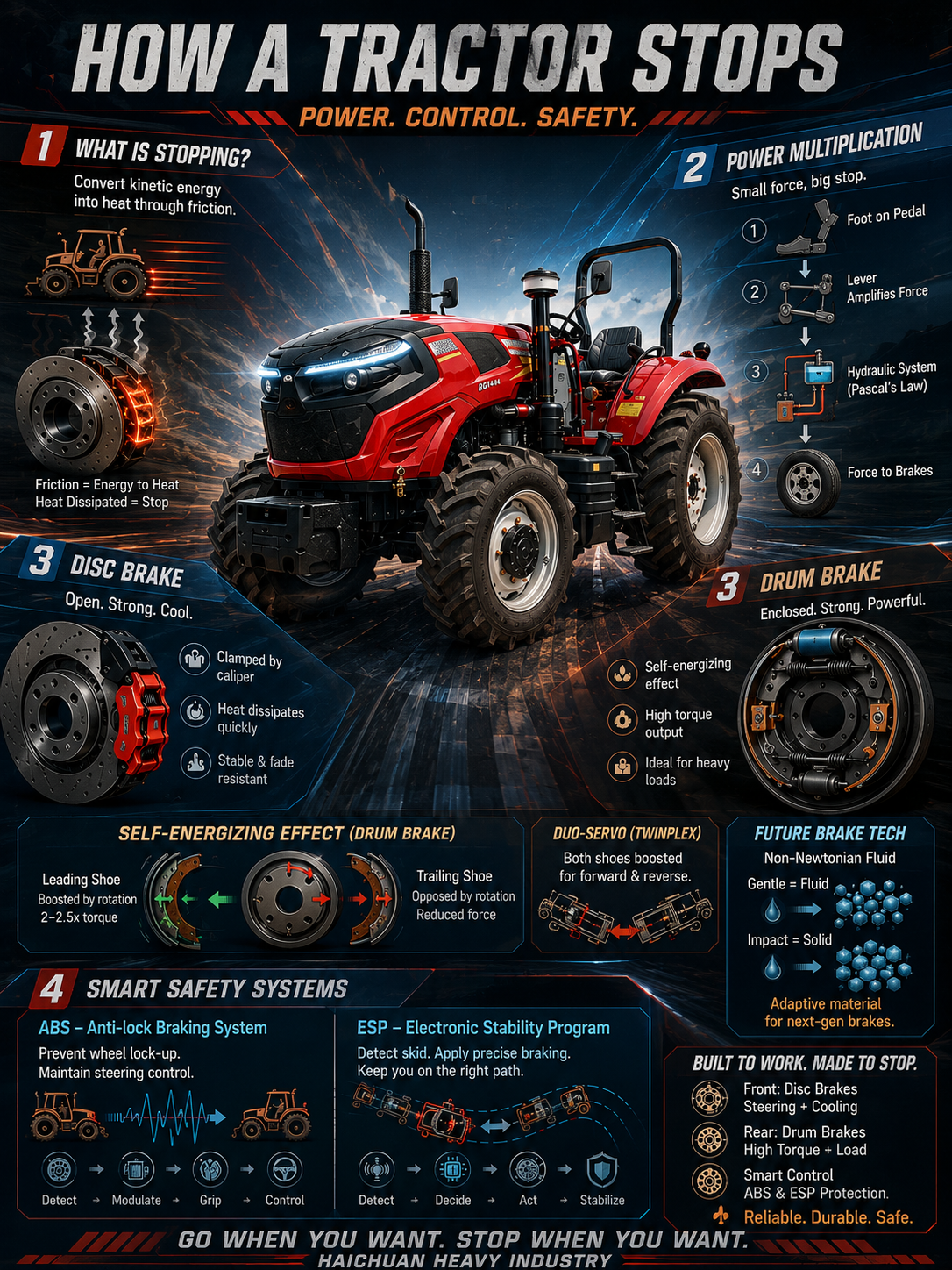
How a Tractor Stops?
Picture this, man. You on your bike, flyin' down a steep hill, wind in your eyes, and all you thinking is, "Stop! Stop right now!" So you grab them brake levers with your fingers and squeeze.
Look at that—just a light squeeze with two fingers, and that fast bike slows down smooth. That right there? That's a beautiful magic trick of force multiplication, brother.
Now, our tractor, she's hundreds of times bigger than that bike, and the "push" she got when she movin'—the momentum—is straight-up scary. But the idea is the exact same thing: the driver just press one pedal with his foot, and that heavy machine come to a smooth stop. The secret behind all that? The braking system. And today, we gonna open up that magic trick all the way, break it down piece by piece.
3.2.1 What "Stopping" Really Means: Fighting That "Go" Energy
First, we gotta understand what it means to stop a vehicle. Remember in Module 1 we talked about how a car moves? It's all about the friction the ground gives the tires. Now to stop, we gotta do the opposite: create a huge, backward-facing resistance to cancel out all that forward "wild energy" the machine built up.
That wild energy—physicists call it kinetic energy or inertia. And to make this big fella slow down nice and steady, we gotta find a way to burn off that energy quick. And the simplest, most boss way to do it? Friction.
You ever rub your hands together real fast? They get hot, right? That's friction making heat. So a vehicle's brake is like a super-efficient "kinetic-to-heat" converter machine. It takes that forward energy and—shooop—turns it into glowing red heat on the brake discs, then the wind carries that heat away. Once the kinetic energy is gone, the machine stops. Simple.
Aight, so friction is the game. But here come the real question: how does the little bit of force from the driver's foot turn into the massive friction needed to grab a multi-ton iron beast? That's when our two big homies step into the ring: the lever principle and Pascal's Law.
3.2.2 The "Small Force, Big Stop" Relay Race: From Your Foot to the Brake Shoes
This is like a relay race of power, but it ain't just passing a baton—it's multiplying that power at every stage, bruh.
First Leg: The Brake Pedal and Lever—Simple But Strong First Step
When you push that brake pedal, you kickstarting a small lever. Think of a nail clipper or a bottle opener—they all use levers. You put a little force far from the pivot point, and right near that pivot, you get a huge force. The brake pedal the same way: the pivot is the shaft, your foot goes on the long end, and after it works, the force already multiplied a few times before it even leaves this first station.
Second Leg: The Hydraulic System—Pascal's Magic Multiplication
Now, this the coolest, most magical part of the whole system. The force leaves the pedal and goes to push a piston inside a tube filled with brake fluid. And that right there taps into one of the greatest discoveries in physics—Pascal's Law.
This law sound fancy but the idea is straight-up beautiful. Let's do a little experiment, man:
Take a syringe with no needle, fill it with water, and cover the tip with your finger. Now push the plunger. You feel that strong pressure against your finger, right?
Now, imagine we made that syringe all crooked, super skinny on one end and super fat on the other. You push the skinny end with just your pinky finger, and the fat end could lift a whole watermelon, man! That's if the fat piston's area is way bigger than the skinny one's.
That's Pascal's Law right there: inside a sealed-up liquid, pressure you put in travels everywhere without losing no strength.
Pressure is like "force spread out over an area." You take 1 kilogram of force on a 1 square centimeter area, pressure is 1. Send that same pressure to a fat 100 square centimeter piston, and boom—you got 100 kilograms of force! Your force just multiplied 100 times, like magic.
In the braking system, the brake pedal pushes the "skinny piston" (called the master cylinder), and the pistons that press the brake shoes are the "fat pistons" at each wheel (called wheel cylinders). Through that network of precision pipes and the amazing brake fluid, the tiny tip of your toe turns into a divine force that can lock a wheel in place.
3.2.3 Battle of the Two Brake Masters: Disc vs. Drum
Alright, the power made it to the wheels. Now who's the final boss that gets in a fistfight with the wheel to make friction? In the brake world, there are two dominant schools, like Shaolin and Wudang in kung fu movies, each with its own killer moves: disc brakes and drum brakes.
1. Disc Brakes: The "Iron Palm" – Simple and Raw
What it look like?
Walk up to a tractor's front wheel (you see this on many modern vehicles), and there's a shiny metal disc bolted to the wheel hub—that's the brake rotor. Straddling that rotor like a clamp is the brake caliper.How it work?
Inside that caliper sits those "fat pistons" we talked about and two pads, like two palms, called brake pads.
You hit the brakes, that hydraulic fluid shoves the pistons, and they slam those two pads—BAP!—onto the spinning rotor from both sides. Just like you pinch a spinning top with two fingers—stops right then and there.What's its superpower?
Mantra: Heat Dissipation! This is the disc brake's biggest flex. The rotor and pads are out in the open air, like a dude sweating from a run, cooling off in front of a fan. Heat leaves fast.
Deep Inner Strength: Power and Fade Resistance! Because it cools so well, you can give it repeated hard stops without it overheating and losing power, which is crucial when you need brakes a lot.
2. Drum Brakes: The "Iron Wall Body" – Deep and Strong
What it look like?
Now walk around to the back wheel of a tractor or look at big trucks—you might see a big, black, iron shell, shaped like a drum. That's the brake drum. It's like a frying pan turned upside down and spinning with the wheel.How it work?
Inside this sealed "drum" are two half-moon-shaped brake shoes, curved like eyebrows, with friction material stuck on them. One end of each shoe is anchored, and the other end contacts the wheel cylinder.
Step on the brake: the fluid goes into that tiny wheel cylinder and pushes the two "eyebrows" outward, pressing them hard against the spinning drum's inner wall. It's like using a clothing prop rod to press a shirt tight against a suitcase from the inside.What's its superpower?
Mantra: Sheer Strength! The drum brake has a slick design trick called "self-energizing" effect. Basically, once the shoe touches the spinning drum, the drum grabs it and pulls it tighter, like it's putting itself in a chokehold. So, for the same applied force, a drum brake gives you way more stopping power than a disc. That's why heavy-duty trucks and tractor rear wheels still use 'em—they need that monster grip to hold back heavy loads.
[Let's Dive Inside The Drum: The Self-Energizing Effect, Source of the Drum Brake's "God Strength"]
Okay, chief engineer, we're gonna crawl right inside this dark brake drum and peep the physics magic. So what's this "pulled in tighter" business really about?First off, meet two new friends: the leading shoe and the trailing shoe. Open up a drum brake, and these two half-moon shoes ain't identical twins; one's the leader, one's the follower. That's the heart of the self-energizing secret.
Imagine this, man. You on your bike again, goin' fast. Now, if you wanted to stop with the laziest move possible, what would you do? Would you stick your foot straight down? Nah. You'd stick your foot forward, along the direction the wheel is spinning, and wedge it into the spokes. (Yo, don't really do this! Dangerous! Just picture it.)
If you did that, something magical happens: the spinning wheel itself grabs your foot, pulls it deeper into the gap between the frame and wheel, and jams it tighter and tighter. The bike stops quick. You didn't use much muscle—the spinning wheel did the work for you.
That is the whole idea of the drum brake's self-energizing effect: let the spinning drum itself help you press the brake shoe harder.
Okay, back inside the drum. The wheel cylinder pushes both shoes outward to contact the spinning drum. Because the drum is spinning, the instant contact happens, it creates huge friction. That friction doesn't just resist—it acts like an invisible hand, dragging each shoe to rotate a tiny bit in the direction the drum is spinning.
And now, the two shoes' fates split:
Leading Shoe: This one gets dragged by friction in the same direction the drum is turning, just like your foot got pulled deeper into the wheel. The leading shoe gets wedged tighter into the space between the drum and the fixed anchor pin. Pressure skyrockets, and the braking force becomes way bigger than the cylinder's initial push. This "pressing itself harder" is called self-energizing—so it's the leading shoe. On the front line, it can produce 2 to 2.5 times the braking torque of the trailing shoe!
Trailing Shoe: The other shoe, poor fella, gets dragged by friction in the opposite direction of the drum's turn. It's like the drum is pushing it away right when it tries to make contact. The pressure doesn't rise—it actually falls. That's called self-deenergizing, so it's the trailing shoe.
Same drum, same cylinder force, but just because they're on different sides, one gets a divine power-up, the other gets its power drained. This clever design using friction's direction lets the drum brake take a tiny hydraulic push and multiply it by the drum's own speed into a monster grip, like grabbing a bull by the leg.
And that ain't even the fanciest part. Engineers thought, "We can do better." They invented the duo-servo (twinplex) brake, an advanced self-energizing design. Here, the leading shoe doesn't just get strong itself; it connects to a sliding "link" (adjuster strut). When that leading shoe gets pulled in and shifts, it uses that link to push its body against the other side's trailing shoe, forcing that trailing shoe hard against the drum too.
You feel what that means? It's like a tug-of-war: the first guy pulling (leading shoe) doesn't just pull with all his might—he also wraps the rope around the second guy's (trailing shoe's) waist and yanks, doubling the whole team's power. With this slick linkage, whether the wheel is spinning forward or in reverse (like when you throw it in reverse on a steep hill with a load), it automatically figures out who's the "point-man leading shoe" and sends the force there, keeping the braking power smooth and strong.
That's the drum brake's secret strength, man: it ain't just using hydraulic fluid, it's brilliantly using the friction force itself as an amplifier, setting off a chain reaction of power.
Fatal Weakness: Afraid of "Internal Injury" (Heat Fade)! But you know what they say: what makes you strong also makes you weak. It's strong, but all that friction happens inside a sealed drum. Heat got nowhere to go. You brake too much, too hard, the inside temp shoots up, the friction material starts to weaken, maybe even gets glowing hot and soft, and your braking power falls off a cliff. That's the dreaded heat fade.
[Future Brake Magic Liquid: Using Non-Newtonian Fluid to "Keep Cool Naturally"]
That heat problem comes down to one thing: the drum can't get rid of heat. So what's the fix? Some smart engineers thought of a radical solution: "What if the brake shoe material could keep itself cool?" But how—friction always makes heat, right? Well, here come something that sounds wild but is actually in your kitchen: non-Newtonian fluid (also called a shear-thickening fluid).Don't let the name scare you off, bro. Non-Newtonian fluid ain't mysterious. You ever do that experiment? Grab a bowl of cornstarch, mix in just a little water till it's a gooey paste. Stir it slow and gentle—it flows like smooth cream soup. But then you suddenly smack it hard with a spoon or punch it? That goo instantly turns rock-hard, your fist can't even go in. That's called shear thickening: you're gentle, it's a liquid; you hit it hard, it instantly "switches face" and becomes a stubborn solid.
Why that happen? Let's picture it another way. Imagine a packed dance hall, everybody slow dancing, flowing past each other. Easy to move through. But somebody yells "FIRE!"—everybody panics and rushes the door at the same time. Suddenly it's a logjam, shoulder to shoulder, and that doorway becomes hard as a wall. The molecules in cornstarch goo are the same: gentle movement lets them slide past; a sudden impact makes 'em jam together, and they lock up to resist the hit.
Brake engineers eye this weird behavior and think: what if we put this non-Newtonian fluid material into the brake pads?
Regular braking, you gently press—the pad material stays soft, smooth, you don't feel nothing. But in an emergency, you stomp that pedal, the massive impact instantly hits this smart material, and its molecules hear a "battle stations!" whistle. They instantly lock arms and turn from soft liquid to rigid solid. This change takes less than a thousandth of a second, and it's completely reversible—you let off the brake, the impact goes away, the molecules go back to their slow dance, and the material's a soft liquid again.
You see the beauty of it? The genius part is: it's magic that uses the impact itself to fight the impact. Bigger the hit, the harder it gets, the stronger the braking force. And because the "hardness" is a physical state change, not a brake pad desperately gritting its teeth against high heat, it avoids the whole "gets hot, gets soft, fails" trap of traditional material from the ground up.
This tech is still in labs and patents for now. But it opens a window: one day, tractor drum brakes might keep that "self-energizing" beast strength and totally ditch the heat problem. A perfect example of using physics magic to beat a physics curse.
3.2.4 "Brake Failure" Savior: The Mind-Reading of ABS and ESP
So now we got powerful brakes. But in a panic situation, that power can sometimes cause big trouble.
Picture the most dangerous scene: your tractor's loaded heavy, you see danger ahead, panic, and stomp that brake pedal through the floor. What happens?
If the wheels lock up from that massive force and stop spinning, they start sliding on the ground instead of rolling. And that's trouble!
First: Steering Wheel Becomes Useless! Front wheels lock up? No matter how you spin the wheel, the tractor goes straight like a giant eraser, totally ignoring you. All you can do is watch it crash.
Second: Might Not Stop, Might Roll Over! Sliding friction on the ground is way less than that peak "just about to skid" static friction. And worse, if the rear wheels lock first, the back end will swing out like a wild pendulum—easy to jackknife and flip.
To stop that nightmare from happening, smart engineers invented the "ABS" – Anti-lock Braking System. It's like a magical foot that can tap the brakes dozens of times per second.
ABS handles it for you. It uses sensors to watch each wheel's speed nonstop. The moment it senses a wheel about to lock up, it instantly tells the hydraulic system to "ease off, press, ease off, press" real fast on that wheel's brake. This keeps the tire at that sweet spot—the "just about to slip, but still gripping" limit—which is exactly where the friction is the strongest, man! So not only do you stop in the shortest distance, but more importantly, you can still steer while panic braking, and dodge the danger!
Smarter than ABS is its big brother: ESP – Electronic Stability Program. If ABS helps you stop without losing control, ESP is a higher-level "anti-skid" god skill.
Say you take a wet curve too fast, feel the rear end sliding out, or the front end pushing wide. Before you can even react, the ESP system already "predicted" the danger using steering angle, throttle, and each wheel's speed. It will cleverly and precisely apply a tiny bit of brake to just one specific wheel—like the left rear or right front. It's like an invisible hand giving a slight, corrective tug just as the machine starts to break loose, instantly snapping the body back onto the path you wanted.
You don't feel the thousandths-of-a-second calculations and actions. You just feel the machine suddenly got smart, following your thoughts steady. That's the modern vehicle's mind-reading trick.
3.2.5 Wrap Up: Picking the "Battle Boots" for Our Tractor
Alright, chief engineer, let's sum it all up. This tractor's braking system is one beautifully planned relay race:
Your foot (first leg, weakest)
→ Lever pedal (first multiplication)
→ Pascal's hydraulic magic (second and core multiplication—hundreds, thousands of times)
→ At the wheel, disc or drum brakes (the final executors) duke it out with friction
→ ABS/ESP (the smart brain) standing by, making sure nobody loses control.
So, how do we pick for our tractor?
Front wheels: Need to steer, need to cool down—gotta use disc brakes for safety.
Rear wheels: Carry heavy loads, need monster force to hold back cargo and pull plows—we can trust drum brakes to be the strongman. If we want to beat that heat fade weakness, we can even step up to more advanced "wet brakes" (soaked in oil, they cool and last longer).
And just like that, the "how to stop" problem for our workhorse that handles business is solved. You feel more at ease now, right? Goes when you want, stops when you want—that's a good machine.
Next time, we'll tackle the "where you goin'" problem, see how that steering wheel makes this big fella turn obedient. Take a break, and if anything don't sit right, you just holler at me!
Contact With Us

Please enter what you want to find
Send Your Inquiry Today
*We respect your confidentiality and all information are protected.