

The Tractor Steering System — How the Hell Does Spinning That Round Thing Make the Iron Bull Turn?
So you pull up to the end of the row. You lift the plow, but that disc harrow's still draggin' behind, clangin' and bangin'. Time to spin it around.
You just rub that steering wheel with both hands, and this whole heavy-ass rig—we talkin' tons of steel, flesh, and sweat—swings around smooth as butter. You ain't even breakin' a sweat, and the iron bull don't put up a fight, not one bit.
How, though?
What you holdin' is just a plastic-wrapped steel hoop with some worn-out shiny leather on it. But this hoop? It's connected to metal rods, gears, hydraulic lines, all twistin' and curvin' its way down until it's poking at the two front wheels. Those wheels barely tilt, and the whole damn machine follows suit.
If you strip it all the way down, it ain't rocket science. But when you crawl underneath and trace that steering column all the way to the tires, you’ll see there's more to the story. So today, we ain't goin' nowhere. We're posted up under the front axle, like we sittin' around a fire, chattin' about one thing and one thing only — why does the beast turn when you flick your wrist?
1.1 The Dumbest Way: One Solid Bar Pushing Both Wheels
Now, if you’s an impatient blacksmith back in the day, trying to build your first steering setup, you’d do it the simplest way possible — straight, no chaser.
You take one solid axle, hook both front wheels onto it. This axle is one piece—no joints, no give. Right in the middle, you weld a vertical pipe straight up toward the sky, then slap a steering wheel on top.
You turn the wheel, the whole axle turns with it. Left wheel tilts left, right wheel tilts left—same exact angle. You turn right, both wheels lean right in unison. Clean and simple, right? Looks tough as hell.
But the moment you drive that thing out to the field? It all falls apart, bro. Real talk.
Think about what happens when you're takin' a turn. Not even at speed, just a slow, lazy right-angle turn at the field's edge. Peep the tracks those two front tires leave in the dirt.
The inside wheel draws a tight little circle. The outside wheel draws a wide-ass loop. Big circle means more distance; small circle means less. It's like runnin' laps back in grade school—the kid on the inside barely jogs, while that tall kid on the outside has to sprint to keep up.
But that dumb, beefy solid axle don't know any of this. It's one piece; it can't give different speeds to each side. It forces both wheels to spin the exact same amount at the exact same time.
Now you got drama.
The inside wheel only wants to cover its short path, turn just a few rotations. But the solid axle says, "Nah, you gon' keep spinnin'"—dragging it, making the rubber scrub the ground, squealing like crazy. The outside wheel is starvin' for more rotations to cover its long path, but the axle already gave it all it got, so it just gets dragged along, scrubin' too.
And a farm field ain't no smooth-ass paved road. One wheel might be sinkin' into soft, worked soil while the other's riding up on a hard, packed ridge. Grip difference is wild already. Add that solid axle into the mix, and now your steering wheel starts fighting back. You feel it in your arms—the front end ain't turning smooth; it’s pushing sideways like some invisible giant is wrestling you for control.
One turn, and you've ground rubber off the tires, churned up dirt, and left wobbly, messed-up plow lines. Fight it too hard, and your arms will feel like they 'bout to fall off.
So here’s lesson number one, the big dog rule: When you turn, the inside wheel and outside wheel absolutely cannot spin at the same speed. The outside wheel gotta hustle faster; the inside wheel gotta chill slower—that’s the only way you get a clean, smooth turn.
1.2 How to Let Each Wheel Do Its Own Thing — The Differential, That Sly Old Hustler
After hearing that, you’d be like, "Man, that’s easy. Just saw that damn solid axle right in half—two separate half-shafts. Left half for the left wheel, right half for the right wheel. Let 'em spin on their own, don't bother each other."
That idea's solid, no doubt... but you only solved half the puzzle. You gave 'em freedom, but you ain't delivered the power yet.
The driveshaft coming from your engine's gotta hand off that twisting force to your two new half-shafts. If you just connect it any old way, that torque—that force—is sneaky, man. It always picks the easiest path.
Picture this: Left tire's jammed against a hard dirt ridge—heavy, refusing to turn. Right tire's dangling in a mud pit, zero resistance. You send power in, and all that force just dips straight to the right wheel that ain't puttin' up a fight. Left wheel stays frozen. One's spinning, one's doing nothing. You stomp the gas, mud flies everywhere, but the tractor don't budge an inch.
That's like you trying to carry a heavy bucket of water with a partner who’s got no backbone. You over here breaking your back, and that fool over there lets the bucket tilt to his side—water spills everywhere, and you just wasted all that effort.
So what you need is a joint that not only allows 'em to spin at different speeds, but also smart enough to split the torque—to force some power to both, no matter what. Freedom to differ, but still deliver the strength. That right there? That’s the job of the differential.
What's a differential look like? Don't overthink it. You crack open that housing, it's just a bunch of gears. Think of it as a gear-made "mediator," a smooth-talking middleman.
Power from the transmission's tail-end spins the big bowl-shaped differential case. This case is like a drum, with a bunch of small "spider" gears inside. These spider gears are meshed simultaneously with the gears at the ends of your left and right half-shafts.
When you're rolling straight on flat ground, both wheels feel the same resistance. The big case turns, and those spider gears? They chill. They don't spin on their own; they get pushed by the case as a whole unit, dragging both half-shafts along together like they're welded solid.
But the moment you crank the steering wheel and start turnin'? That's when the magic happens.
The inside wheel's loaded up by the tractor’s weight and takin' a tighter line. It feels heavy, binds up, and its half-shaft slows down, reluctant to turn. The outside wheel, freed from that squeeze and cruisin' the big arc, wants to spin faster.
Now those spider gears that were just loungin'? They can't be lazy no more. They're biting into two gears goin' different speeds now. They're forced to start spinning on their own. When those spiders rotate, they literally take the "stolen" rotation speed from the slow inside wheel and hand it over as a bonus to the fast outside wheel.
Whatever the inside wheel loses in speed, the outside wheel gains—transferred clean by those little spider gears.
You didn’t have to do a thing. This gear family just born with that attitude: If both sides resist equally, they play fair and push both evenly. If they resist differently, they play favorites—steering speed and force toward the easy side. It's a natural-born, crooked player... but it plays crooked exactly right.
During that slow, lazy turn at the field's edge, this differential is your MVP. You feel it in the steering wheel—smooth, the tractor's front end cooperating, both tires quiet, nobody scrubbing, nobody fighting. The dirt at the headland only shows clean tire tracks, no churned-up mud ridges.
But this old hustler can switch sides and become a straight-up traitor.
You've been stuck before, right? Left tire on hard, dry ground with tons of grip—you wish you could blast all the engine's torque to it so it can yank you out. Right tire? Sittin' in sloppy mud, spinning free, zero resistance.
The differential, with its favoritism, sends ALL the engine's torque straight to that mud-slinging slacker. The good tire on dry land? Gets absolutely nothing. The harder you hit the gas, the faster that free tire spins, throwin' mud to the sky, while you don't move a single inch.
This is like knowing your buddy's unreliable, but your accountant still gives him all the money. You just smack your leg cussing, but it's useless. Don't worry—we got a way to deal with this later. Right now, we're laying the foundation, solid.
1.3 It Ain't Just Speed — The Inside Wheel Gotta Turn Tighter Than the Outside
Alright, the speed difference problem? Differential got that handled. But turning's got another catch.
Draw it in the dirt with a stick: Tractor’s making a sharp turn. The inside wheel's path is small as a washbasin. The outside wheel's path is wide as a barn door. Not only are their speeds different—the sharpness of their turn is different too.
That inside wheel, tracing the tiny circle, needs a sharper angle—gotta lean in more. The outside wheel on the big, gentle loop? Its turning angle can be smaller, just a little tilt.
If your linkage is a dumb one-piece setup making both wheels lean the exact same angle, you still got problems. Even if the outside wheel's angle feels perfect, the inside wheel's angle ain't enough. It's still scrubbing sideways a little, not clean. Way better than that solid-axle mess, but still not butter.
So, the ideal situation when you crank the wheel: The inside wheel has got to turn a few degrees sharper than the outside wheel. Inside leans aggressive, outside leans chill.
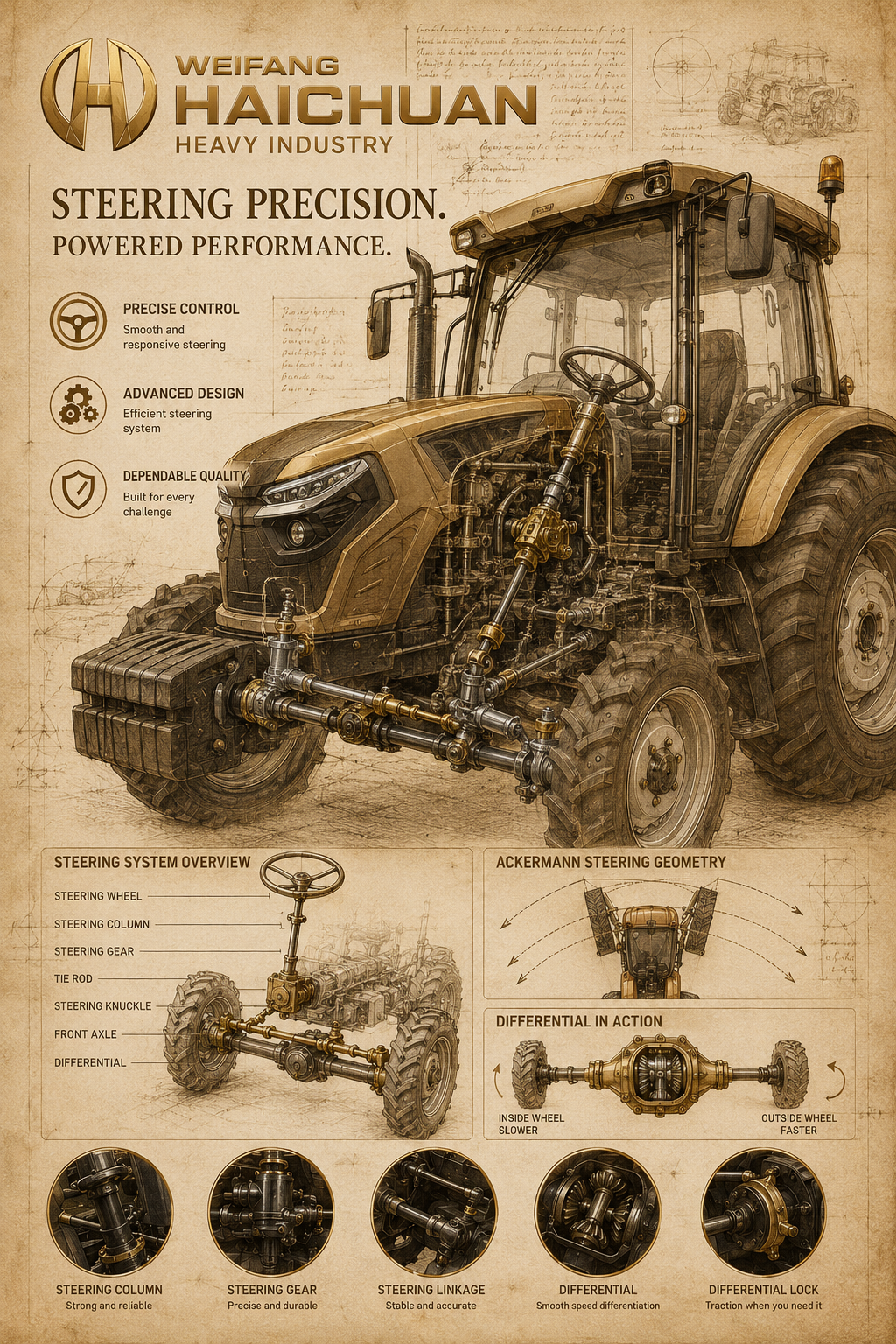
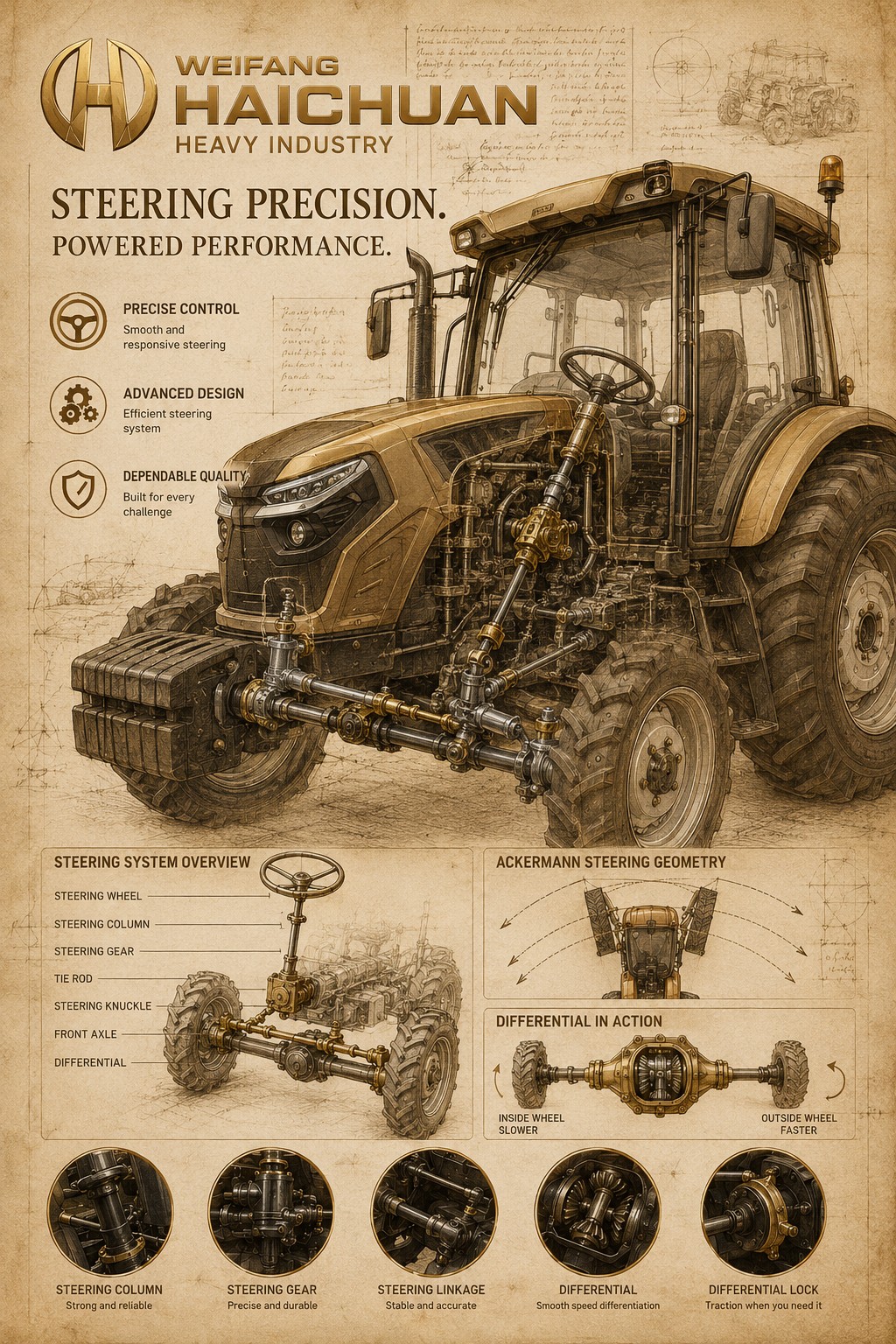
How do you achieve that? Through a geometry hustle using a few iron rods. This trick got a textbook name: Ackermann steering geometry. Sounds all professor-ish, but stripped down, it’s just a trapezoid-shaped linkage—narrow up front, wide in the back.
Crawl under that front axle and look. The steering arm from your steering box pulls a long tie rod. That tie rod connects to two steering knuckle arms. Peep the setup: The tie rod isn't a straight rectangle parallel to the axle—nah, it forms a trapezoid, with the front tie rod shorter than the virtual line in the rear, or the knuckle arms angled to create that narrow-front, wide-back shape.
When you spin the steering wheel, the steering arm pushes or pulls that tie rod, which then drags the steering knuckle arms. Because of that trapezoid geometry, when you push, the inside knuckle arm gets yanked through a longer travel; the outside one moves less. Result? The inside wheel automatically leans in those crucial few extra degrees more than the outside.
You ain't doing math. The factory locked in the lengths and angles of those rods; they just born with that favoring nature. You just turn the wheel, and this linkage silently figures out the angle difference for you.
One day, find a flat spot, park, and crank the steering wheel all the way to full lock. Hop off and squat dead center in front of the tractor. You'll see it: The inside wheel, pointing into the turn, is tilted harder, giving you the side-eye. The outside wheel tilts more gracefully. The inside wheel ain't broken—it's purposely crooked. Without that extra lean, during tight turns, the inside tire would still be suffering, and your front end would push dirt sideways, wasting fuel and leaving messy, scrubbed-up mud ridges at the end of your rows.
1.4 How Your Wrist Strength Moves a Thousand-Pound Wheel?
So now the underground setup is clear: the differential in the middle handling speed differences, the trapezoid linkage at the ends handling angle differences. But ain't nobody told them what to do yet. This whole system lacks one chain—the force path from your hands to those parts.
You're sitting up in the cab, rubbing that steering wheel with both hands. All you got is wrist and arm power, but those front tires, buried in a foot of soft soil, are heavy as hell to turn. So what now?
You need a force chain hooked under the steering wheel to take that small twist you put in, then multiply it stage by stage, until it becomes big muscle that can muscle around a thousand-pound assembly.
This chain has a few stations. Let's trace it top to bottom.
Up top, right in your face—steering wheel connected to the steering column. The column is just a long steel tube inside a metal shroud, straight down from the dash to the floorplate. You twist the wheel, the column twists too. It's loyal: its only job is transferring that twist. But on a tractor, it does more. Sometimes you grab that wheel to pull yourself up—so this column gotta be strong like a flagpole. You can hang your whole body weight on it, and it better not bend.
Where the column punches through the floor, it mates with a burly iron box—looks like a roundish housing. This chunk of iron is the steering gear.
What’s the steering gear do? It's a force lever, a muscle amplifier.
Your wrist torque, even with all your might, ain't directly budging those front wheels. The wheels ain't just heavy from their own weight; they're sunk into soft ground with dirt pressing hard against the sidewalls. You need something that takes your "fast and light" twisting effort, and turns it into "slow and heavy" pushing effort.
The steering gear is that converter. You spin the wheel several full rotations, and down below, the wheels only tilt a few degrees. You put in small force over a long distance; it spits out large force over a short distance. It’s like shifting your mountain bike to the big granny gear for a steep climb—your legs spin like crazy, many rotations, and the rear wheel barely makes one lazy revolution, but it's light af, and you make it up the hill.
A classic steering gear used in tractors is called the recirculating ball type. The name kinda tells the story. Inside the housing, there's a big threaded screw-like shaft, with a nut riding on it—but between them sits a bunch of ball bearings rolling in grooves. When you turn the steering wheel, the screw turns, and those steel balls roll, pushing the nut up or down. Rolling balls means minimal friction; so even on a big, heavy machine, the wheel don't feel brutally stiff. And the balls circulate—roll to the end, then loop back through a return tube, endlessly flowing. The feel, old heads say, is slick—not gritty.
This steering gear takes your many wheel rotations and turns 'em into a single, direct, linear push. This push is then handed off to the next station—the steering linkage.
The push rod (or Pitman arm) from the steering gear hooks straight into that trapezoid linkage we spent all that time on. Steering gear pushes, the tie rod moves sideways, the linkage deforms, the inside wheel automatically gets its extra degrees, the outside wheel gets fewer—and then the linkage twists the steering knuckle (steering knuckle), which rotates the whole wheel assembly neatly.
Your whole process of turning the tractor, broken down, is an assembly line:
Hands rub the steering wheel. That twist travels down the steering column, untouched. The steering gear receives this high-speed, low-force twist, and inside its oil-bathed housing, processes it into low-speed, high-force push. That push goes through the tie rods to the front axle, handed to that geometry-calculating linkage. The linkage, according to its factory-set nature, sorts out the inner and outer angles, then twists the steering knuckles. Knuckles tilt, those big-ass tires tilt too.
And the whole time this is happening, that differential sitting dead center of the front axle? It stays out of your steering business. You're turning; it's inside that black housing, silent, automatically sorting out the speed difference between inside and outside wheels. Everything's in harmony.
1.5 But What if the Iron Bull Gets an Attitude, Steering Wheel Not Listening?
This steering system is the only language you and this iron bull speak to each other. If something's off, you're like a mute riding a blind horse, and that's no joke. Knowin’ how it works when it's right? That tells you what’s up when it starts moaning for help.
Let's start with steering wheel slop. You’re turning the wheel a half-turn left and right, but the tires down low ain't even paying attention. Too much free play. Driving a tractor with this on a straight road, you feel like a rookie driver, constantly correcting, and the plow lines wiggle like a snake. Most likely, the gears inside the steering gear are worn after years of service, got gaps now. Or a tie rod end ball joint is bone dry, worn loose. Feels like that old iron yard gate with rusted hinges—you push it forever, it just rattles, don't move where you tell it. Find that free play fast; adjust or replace. 'Cause if you're hauling down the road, your confidence is shot.
Next: The turning suddenly gets heavy as hell. Feels like you ain't stirring butter, you're churning frozen lard. First thing, check the easiest fix—front tire pressure. Low air, tire spreads out flat, tryin' to twist that giant footprint takes a ton of effort. Pump 'em up to spec. If it's still heavy, start thinking about the hydraulic power assist. Big modern tractors got hydraulic power steering; we got a whole chapter for that later. But just remember this: If the hydraulic oil's leaked out, or the pump ain't turning, the entire weight of the front end drops smack onto your arms. Do a headland turn like that, you'll sweat through your shirt, arms sore for two days. It ain't you gettin' weak—your helper went on strike.
Another thing: Pulling to one side on a straight path. Road's flat, but you let go of the wheel, and the nose drifts off slowly. Don't immediately blame the steering gear. Hop out, kick the front tires—see if one's lower than the other. One high, one low, you're runnin' with a limp, bound to drift toward the soft one. Pressure's good? Then get on flat ground, use a string or tape measure on the front tires. There's a factory-set angle called toe-in, set with instruments. If you recently slammed into a big rock at the field's edge or bottomed out in a dry ditch, that alignment might've shifted. Toe-in out of whack means the tires are fighting each other—one wants to go left, one wants to go right. Your steering wheel's the referee in a tug-of-war, and the moment you loosen your grip, it leans toward the stronger side. No magic fix here: measure it, look up the spec in the manual, and adjust it back.
The stuck-in-the-mud saga—gotta pull that out special. Time to untie that knot we left earlier.
You stuck. One wheel's spinning like crazy, other frozen solid. You're fully seein' that differential's traitorous, favoritism nature. Only one thing can tame it now—a rough, no-nonsense partner: the differential lock.
What's a differential lock? Let me break it down. It's a device that straight-up murders the differential's ability to let those spider gears mediate.
It's either a beefy dog clutch pin or a pack of clutch plates that get mashed together. Normally, it stays out the way, quiet. You get stuck. You glance at the dash; one wheel's slinging mud like a fountain, the wheel on hard ground ain't doing nothin'. Reach down in the cab and yank that lever—some tractors you stomp a pedal. That pull? That shoves the diff lock home.
What's it do? It locks those sneaky little spider gears directly to the big case. They can no longer spin by themselves—they're seized. Once they can't freespin, they bind the two half-shafts tight, forcing them to rotate as one solid unit again—speed difference totally eliminated.
Boom, you just recreated that old solid axle from way back. But now? You need that solid-axle energy. The slacker wheel spinning in mud can't steal all the power no more, 'cause the locked shaft drags it along, forcing it to turn the exact same as the good wheel with grip. The good wheel on dry land finally gets its share of torque. Both wheels dig together, and the tractor lurches free with a roar. You basically took an iron bar and tied those two lazy brothers together: you work, we all work; you rest, we all rest.
But never forget: differential lock is for getting unstuck. The second you're free and back on solid ground or normal working soil, release that handle immediately. If you don’t, you can't turn, and forcing it could twist a half-shaft like a pretzel or chew your tires down to the cords.
Last thing: When you're doing a tight turn at the headland, steering wheel almost at full lock, sometimes you hear a sharp squeal—REEEEE. Don't trip. That ain't the linkage rubbing. That's the hydraulic power assist system shouting, "I'm maxed out!" The oil's pushed to the cylinder's end, deadheaded, nowhere to go, screaming through the pressure relief valve. When you hear it, don't keep forcing it. Ease the wheel back a hair, let it breathe, save the hydraulic pump from blowing. That's the iron bull whispering to you—you gotta understand its language.
We've done a whole lot of talkin' now. So next time you climb into that cab and put your hands on the wheel, it should feel different. You ain't just touching a bare round hoop. You can feel that steel column underneath, straight through the floor, connected down to that recirculating ball steering gear bathed in oil—taking your circles and turning 'em into tiny wheel angles. You feel the calculated trapezoid linkage rods, that narrow-front-wide-back hustle, running all the way to the knuckles. And in the axle's center, hidden from view, that differential's quietly spinning its spider gears, faithfully delivering the speed split; and the diff lock is right next to it, ear cocked, ready for your command to disarm that crooked hustler in a heartbeat.
You move your hand, and all these parts come alive. Down in that dark, greasy space, gears press gears, rods push rods, transmitting your wrist's intent all the way down into the dirt, carving out a beautiful turn. Next time you're spinning around at the field's edge, pat that steering wheel—you already know what's good.
Contact With Us

Please enter what you want to find
Send Your Inquiry Today
*We respect your confidentiality and all information are protected.