

LOCKED BACK, SEESAW FRONT: A RAW-ASS BREAKDOWN OF THE TRACTOR’S FRAME & SUSPENSION
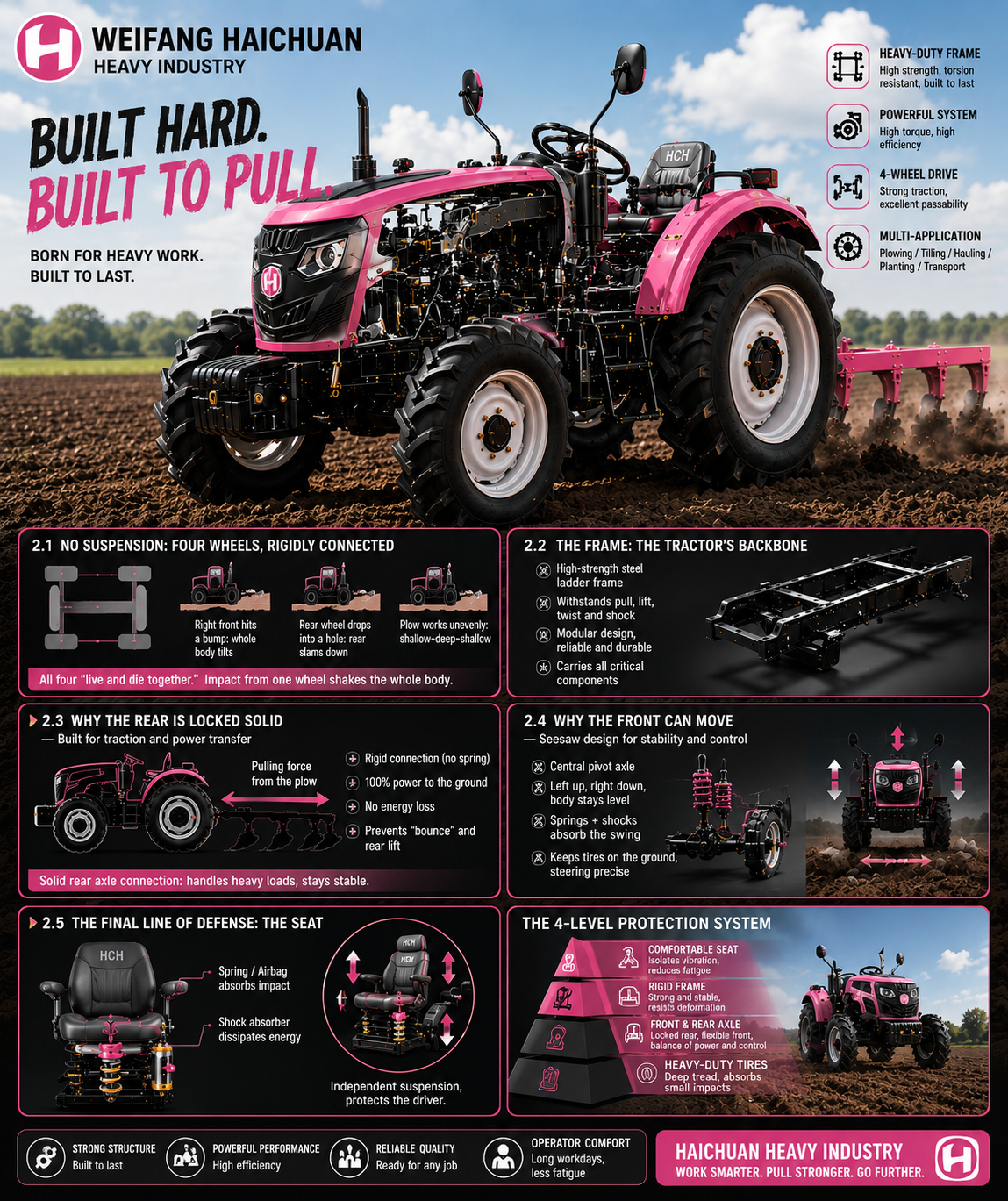
A tractor sittin’ by the field, got a plow hitched up behind it. Its four wheels tall and big, covered in deep chunky tread. Its body ain’t no slick streamlined shell — nah, it’s a bare, thick, raw-ass skeleton hangin’ out for everybody to see.
Why it built like dat? Why it don’t need to squat low and look pretty like a sedan?
To answer that, you gotta crack open two basic structures: one, the frame. Two, the suspension.
2.1 Four Wheels Welded to a Iron Bar — A World with No Suspension
‘Fore we talk about the real machine, let’s do a lil’ paper experiment, ya dig?
Take a piece of paper, draw a rectangle iron frame — that’s your body. Draw four round wheels, and weld ’em straight to the frame with four thick iron rods. No springs, no joints that can move. That right there is the simplest, rawest tractor ever made.
Now push that thing into the field. The ground ain’t flat, bruh. It’s got hard dirt clods, deep holes, old ruts.
Right front wheel rolls up on a hard chunk of dirt. The clod don’t budge, so the wheel gotta lift. But the wheel and the frame welded together — wheel go up, the right front corner of the frame get yanked up with it, and the whole tractor lean hard to the left. The steering wheel snatches so violent it’ll damn near rip the webbing between your thumb and finger.
Next second, the rear wheel drop into a hole. Welded rear wheel drag the frame slammin’ down — the rear end squat, the nose pop up. The plow hitched behind first stab deep into the dirt, then get snatched back out, leavin’ a trail of shallow-deep-shallow cuts across the field.
Why it beat you up like that? ’Cause all four wheels “live together and die together.” One wheel catch a hit, the whole body gotta catch it too. That’s the consequence of a hard connection. Ain’t no wheel dare move on its own — they locked into one solid chunk by that iron frame.
Now picture you sittin’ on top of that. What it feel like? Your butt straight on a pile driver. Every lil’ rock, every crack in the ground, travel straight from the wheel to your spine, unedited.
That’s the world with no suspension.
2.2 Frame — The Tractor’s Backbone
‘Fore we talk about fixin’ the shakes, let’s look at how a tractor’s bones really built.
A sedan got its skin and bones all fused together — that’s called a unibody. You rip the door off, the whole body might sag, ’cause it’s the shell itself doin’ the carryin’.
The tractor don’t play that game. It use a body-on-frame setup. They built a super heavy, super tough steel ladder frame first — an absolute unit. Then they bolt the engine, transmission, cab, everything onto that frame piece by piece. That outer sheet metal? It just keep the wind and rain off you — it don’t carry no load at all.
Why? ’Cause a tractor ain’t for haulin’ people — it’s for pullin’ plows, pushin’ dirt, liftin’ heavy stuff. When a plow yank it, the force pullin’ straight backwards. When you hang a loader bucket up front and lift somethin’, the force pushin’ up, pressin’ down, twistin’ sideways. You send a regular unibody sedan to do that work, it ain’t lastin’ half a day — the seams start crackin’, doors won’t shut, glass shatter.
So the tractor’s backbone is one giant skeleton made of super thick high-strength stamped steel or heavy channel iron riveted together. Like a weightlifter’s spine — it ain’t just gotta take compression, it gotta handle twistin’ too. All them outside shocks, twists, pulls — they don’t go nowhere else first. They come straight to this backbone to report.
That solid, unshakable beam — that’s the anchor you finna bolt the four legs to. If the anchor move, the legs ain’t worth nothin’.
2.3 Why the Back Legs Got Welded Solid — The Logic of Pullin’ a Plow
Now let’s mount them back legs — the two giant rear wheels. They do all the work draggin’ the plow.
On a tractor, between the rear axle and the frame? Ain’t no spring, homie. The engineers take rows of fat bolts and lock the rear axle housing dead solid to the frame rails and the tail of the transmission. Steel to steel, zero cushion.
In the car world, that’s some barbarian-type mess. But in the field, it’s the most sensible design out there. To understand why, you gotta start with the plow.
The plow in the dirt, bein’ dragged forward. The ground don’t wanna let go — it push back on that plow with a crazy amount of rearward force. That force travel up the draft links to the rear axle, the rear axle shove it to the frame, and the frame brace against it.
Peep the direction. It’s horizontal, pointin’ backwards, and pushin’ right under the rear end. That backward force, combined with the wheel-to-ground contact point as a fulcrum, create a massive twistin’ torque tryna pry the front end up and squat the rear. Same as when you grab a rope tied low to the ground, lean back hard — your heels become the pivot and your upper body wanna flip forward. The plow is basically tryna pry the tractor over.
Now, what if you put a spring between the rear axle and the frame?
The plow yank backwards — the rear axle don’t pull the frame right away, it first squash that spring. The whole body squat down hard. The plow’s pull plus the tractor’s weight pour a ton of energy into that spring. But a spring ain’t a safe deposit box — whatever you put in, it gotta give back. And when it give back, it mix stored energy with the raw torque the engine just sent, and snap back twice as vicious. The nose that just dipped hard now jerk up violently. That jerk can pull the front wheels clear off the ground, and the tractor flip backwards.
Even if it don’t flip, the engine supposed to send all its muscle to the plow, but now a chunk of that power wasted on the “compress-the-spring” dance. It’s like runnin’ a race with sandbags strapped to your legs — you can’t put down full force.
So the engineers made a decision: between the rear axle and frame, ain’t nothin’ allowed to move.
The plow pull the rear axle, the rear axle yank the frame directly, and the frame’s couple-thousand-pound inertia answer straight back to the earth. Force transfer 100% steel on steel — no delay, no power leak. The cost? When the rear wheel smash into a ditch or bump, that impact also transmit 100% bone-straight to the frame, no spring to absorb it. How you pay that cost? We’ll get to that later.
Rule for the back legs: hard for hard work — stiff like a bridge pier.
2.4 Why the Front Legs Can Move — The Wisdom of the Seesaw
Back legs welded solid. What about the front ones?
The front wheels ain’t pullin’ no plow. They only got two jobs: hold up the front end, and turn when the steering wheel tell ’em to.
Kneel down by the front and peep this. The front axle structure totally different from the rear. It ain’t one solid chunk of iron — nah. It’s a thick cross-beam, and right in the middle, it’s pinned to the very front of the frame with a big vertical kingpin. That beam can rock around that center pin like a giant seesaw — left side go up, right side go down, and vice versa.
The number-one problem this seesaw solves ain’t comfort — it’s to make sure the front wheels never leave the ground.
Field ground… left side could be a rut eight inches deep, right side a hard dirt mound. If the front axle was a dead solid piece like the rear, the left wheel drop in the hole, the whole left side of the nose crash down with it; the right wheel get pushed up by the mound, the whole nose try to tilt. The scary part: if that hole too deep, the left wheel be danglin’ in the air. One front wheel off the ground — steering useless — on a slope, that’s the prelude to a rollover.
But swap in the seesaw front axle, whole different story. Left wheel drop into the hole, the left half of the beam swing up. Right wheel press on the mound, the right half swing down. The beam tilt like crazy, but what about that center pin connectin’ to the frame? Since left go up and right go down, them two movements meet in the middle and mostly cancel each other out. The pin itself only drop a tiny bit — the tractor body stay mostly level.
The two front wheels like dancers — their feet hittin’ different highs and lows — but that center pin “harmonize” all that movement so the body don’t get twisted around. That keep the steering effective and the tires planted.
Now, between the front axle and frame, it ain’t totally without some give neither. To keep that seesaw from slammin’ into the metal limit stops too violent, they use coil springs and shock absorbers. The spring catch the energy of the harsh swing; then the shock absorber turn that energy into heat in oil and eat it up — so it don’t bounce back.
So the rule for the front legs: move to stay planted — bend and flex. The softness is for stability.
2.5 The Last Line of Defense — A Seat That Moves on Its Own
By now the chassis situation is split clean in two: back legs locked solid, impacts go raw into the frame; front legs flexible, but their big swings still feed force into the frame constantly.
The whole frame still shakin’ — just shakin’ in a more “organized” way than if it had no suspension at all. All them impacts eventually gather right at the mounting point of the seat. So how the driver survive?
You can’t put soft mounts under the engine — that’d leak away the plow-pullin’ force. You can’t hang the frame on springs — that’d kill the torsional stiffness. So the engineers took all the softness they had, and poured it into one humble spot: the seat.
Lift up a tractor seat. Under the cushion, you find a thick coil spring, or an air bag adjustable by pressure. Right next to it, mounted at an angle, there’s a short, stout hydraulic shock absorber — look like a lil’ syringe packed with thick oil.
The frame send the shock to the seat base. The seat base pass that force to the spring. The spring compress, and the driver’s body start sinkin’ down slow. Just when the spring about to rebound, that shock absorber’s tiny piston start fightin’ to push thick oil through a pinhole-sized valve. That sticky resistance swallow up nearly all the upward bounce, turnin’ it into a tiny bit of heat and just lettin’ it fade away.
Down below, the tractor body twitchin’ and shakin’ like a mad bull. Up top, the seat “detached” from all that. It’s like a man ridin’ an enraged bull — the bull gotta buck, but they put a miniature palanquin made of springs and oil right under your butt. The bull’s jerks get soaked up by that palanquin — your spine is saved.
That’s the deepest philosophy of tractor shock absorption: you can’t make the big workin’ system soft, so you build an independent lil’ buffer zone right between the man and the machine — a zone that only serves one person.
Now when you look at a tractor parked by the field, from the front or from the side, there should be four things stacked in your mind like a human pyramid.
At the very bottom: four deep-tread rubber tires — soft — they eat up the tiniest rocks and sharp dirt edges. One level up: seesaw front axle, solid rear axle — they split the two enemies, “keepin’ rubber on dirt” and “transmittin’ brute force.” Above that: that heavy, steady steel beam frame refusin’ to let any twist warp the body. And finally, at the end of all that hardness and shakin’, that self-adjustin’ seat catches it all.
Its suspension and frame ain’t built for comfort — they built so it can bust heavy work in the mud for a lifetime without comin’ apart, without flippin’ over. Every bolt locked down tight, every angle that seesaw swings — underneath all of it, a law of physics holdin’ it down, straight up.
Contact With Us

Please enter what you want to find
Send Your Inquiry Today
*We respect your confidentiality and all information are protected.