

The Big Knowledge on Wheels — Why Yo’ Whip Wears Them Black Rubber Kicks?
You remember how we talked last time? Engine's the heart, but even a beast heart can't do nothing if it can't get the word to the ground. It needs a middleman. And that middleman? Four black, round, rubber things sittin' under your whip.
You probably thinkin', "Man, what's the big deal? Ain't they just rubber hoops?"
Nah, bro. That's where you got it twisted. Those four black hoops? They the smartest, most slept-on, most disrespected, and straight-up greatest invention on the whole ride. Without 'em, even if your car had ten thousand horses, all it would do is scream in place like a hippo throwing a tantrum—ain't goin' nowhere.
So sit back and let me lay down a story about wheels. Real talk.
1.1 A Genius Idea: Why Don't We Just Run in Iron Shoes?
Way back, people rolled on wheels made of iron, or wood. Hard against hard. Tough as nails. But imagine you strappin' on a pair of solid iron boots. How's that feel?
First thing, the bottom of your feet would be screaming. Every little pebble on the road pokes you like a needle, sending shocks straight to your dome. That's zero shock absorption right there. Second, you'd be slipping and sliding. You step on a wet stone, next thing you know, you're flat on your back. No grip. Third, heavy as hell. Can't lift your legs, tired after a few steps.
Then some genius had a lightbulb moment and invented the pneumatic tire. The idea was beautiful—we ain't putting iron shoes on the wheel no more, we giving it a pumped-up leather ball to wear!
See? That one simple thought solved everything:
The bump problem? Let air handle it. Air is the comfiest spring in the universe. You squeeze a balloon, it changes shape but it don't fight back all angry. Your tire rolls over a rock, the air inside gets a gentle squeeze first, softly swallows that shock, then slowly gives it back. Your behind don't feel a thing.
The sliding problem? Use soft skin to grab. A hard iron shoe skates on the ground; soft rubber grabs like your fingertips digging in. Feel a tire—kinda sticky, kinda soft. It can sink into every tiny crack and crevice on the road and hold on tight.
So remember lesson number one: A rubber hoop filled with air is the comfiest, grippiest "shoe" humankind ever came up with. That's why, to this day, your ride's still rocking rubber kicks.
I been doing farm machinery trade for a minute, and I’ve watched whole regions move from iron wheels to rubber. In some rice paddies in Southeast Asia, hand tractors used to roll on nothing but iron. Farmer goes out to work the field, those iron teeth chew up the ridge, and the vibration rides straight up the arms. By forty, a lot of them had serious joint damage. Then they switched to air tires. Same field, same man, but the machine walked lighter, and the body caught a break. Moving from iron to rubber wasn’t just a material swap—it was a whole human-factor upgrade.
1.2 How Much Can This Shoe Do? — Other Shoes Do One Job, This One Does Four
The shoes on your feet only got one job: protect your feet. But your car's "shoes" gotta clock in for four shifts at once. And they gotta be elite at every single one.
First Job: Hold It Down.
You sittin' comfortable, but you ever think about two tons of steel resting on nothing but four palm-sized patches of rubber? Who's holding all that up? That compressed air trapped inside.
And here's the serious truth: if the air pressure gets low, the tire will "kneel down." When it's soft and sagging, the air can't hold the weight no more, so the rubber itself has to take over. It bends, snaps back, bends, snaps back—just like you bending a paperclip over and over. It heats up, gets tired, then one day—BANG—it pops. That's why you check your pressures before a highway run. You ain't looking at some cold number; you checking if your tires can still stand on their own two feet.
Then there's this dangerous myth: when you're overloaded, you just pump more air in to make it handle the weight. Homie, that's backwards thinking. The tire's ply rating and max load are set at the factory by the cord density and body structure. Take a common light truck tire, like a 7.00-16 12-ply—the sidewall will tell you max pressure usually between 450-530 kPa, and max load around 1,500 kg per tire. You pump it past that limit, the cords are permanently overstretched. Their fatigue life drops off a cliff. Then you hit a pothole, and with stress piling up from inside and outside, it's not a slow leak—it's a carcass explosion. In our export warranty claims from the Middle East and Africa, this kind of thing pops up almost every year. Look into it, nine times out of ten, it's bad pressure management.
Second Job: Massage.
We just talked about the air spring. But it’s more like a tai chi master, redirecting energy. Imagine a sharp little rock. If you ran over it with solid steel wheels, it'd be a hard, direct hit. But when the tire hits it? The rubber first "cups" that rock, wrapping it in a thick, fleshy pad, then passes it to the air, and the air turns it into a mild shiver. The tire's like a loyal butler—any sharp, rough hit, it takes with its own body, kneads it smooth, rounds it off, and only then passes it along to the suspension and your seat.
Third Job: Deliver the Message.
This is the holiest mission: talk to the earth, and get a reply. The engine burned all its energy to turn the wheel. The wheel's trying its hardest to spin. But without the tire, just a bare metal rim, you'd just sit there spinning, digging a hole. With the tire, that rubber is gripping the ground dead-on. The wheel wants to turn, but the patch of rubber touching the ground says, "Nah, I'm holding tight." At that standoff, a miracle happens: the tire pushes backward on the dirt, and the earth, being the heavyweight champ, pushes back forward. Your ride moves. Every time you hit the gas, tap the brakes, turn the wheel—it's the tire begging the earth for a favor, asking it to step in. It's the ultimate communicator.
Fourth Job: Lead the Way.
Wherever you wanna go, the tire has to follow. It's constantly fighting inertia trying to kidnap you. In this sense, the tire is the embodiment of your will. You point to the curve, it draws the line.
So see? This black, dirty thing—ain't it a whole lot more than you gave it credit for?
1.3 Cut It Open—It's a Creature with Muscles and a Skeleton
You think it's just a solid rubber tube? Nope. Slice it open, you'll see it's like a living thing: skin, flesh, bones, and an inner waterproof liner. Let's peel the layers.
The Outermost Layer You Can Touch: The Tread
This is the tire's "meat" and its face. A thick layer of extremely wear-resistant rubber. And I'ma let you in on a little tire-industry trade secret: this rubber compound walks a tightrope between soft and hard.
You want crazy grip? It's gotta be soft. Soft lets it stick like a gecko's foot, glues you to the road, shortens braking distance. You want long life, tens of thousands of miles? It's gotta be hard, to take the wear. So how they do it? They throw in classified recipes—stuff like silica (sometimes called "white carbon black")—that lets the tire be soft and grippy and still last. Especially on wet roads, that stuff is your "rainy day savior."
The Next Layer, Invisible: The Belt Package
This is the tire's "chainmail," the real secret weapon of a radial tire. It's two layers of mesh woven from ultra-fine steel wire, hugging the tire's circumference like a tight headband. It does two jobs, each one heavier than the last:
Keep the tire from flying apart. At high speed, crazy centrifugal force wants to stretch that tire out like a pizza dough into a big donut. This steel belt holds on for dear life, keeping it in shape.
Separate muscle from skeleton. This is the key. Because of this steel straitjacket, the "skeleton" (the casing below) and the "muscle" (the tread above) are completely divorced. That means the tread can lie flat and grab the ground without getting yanked around by the skeleton's movements.
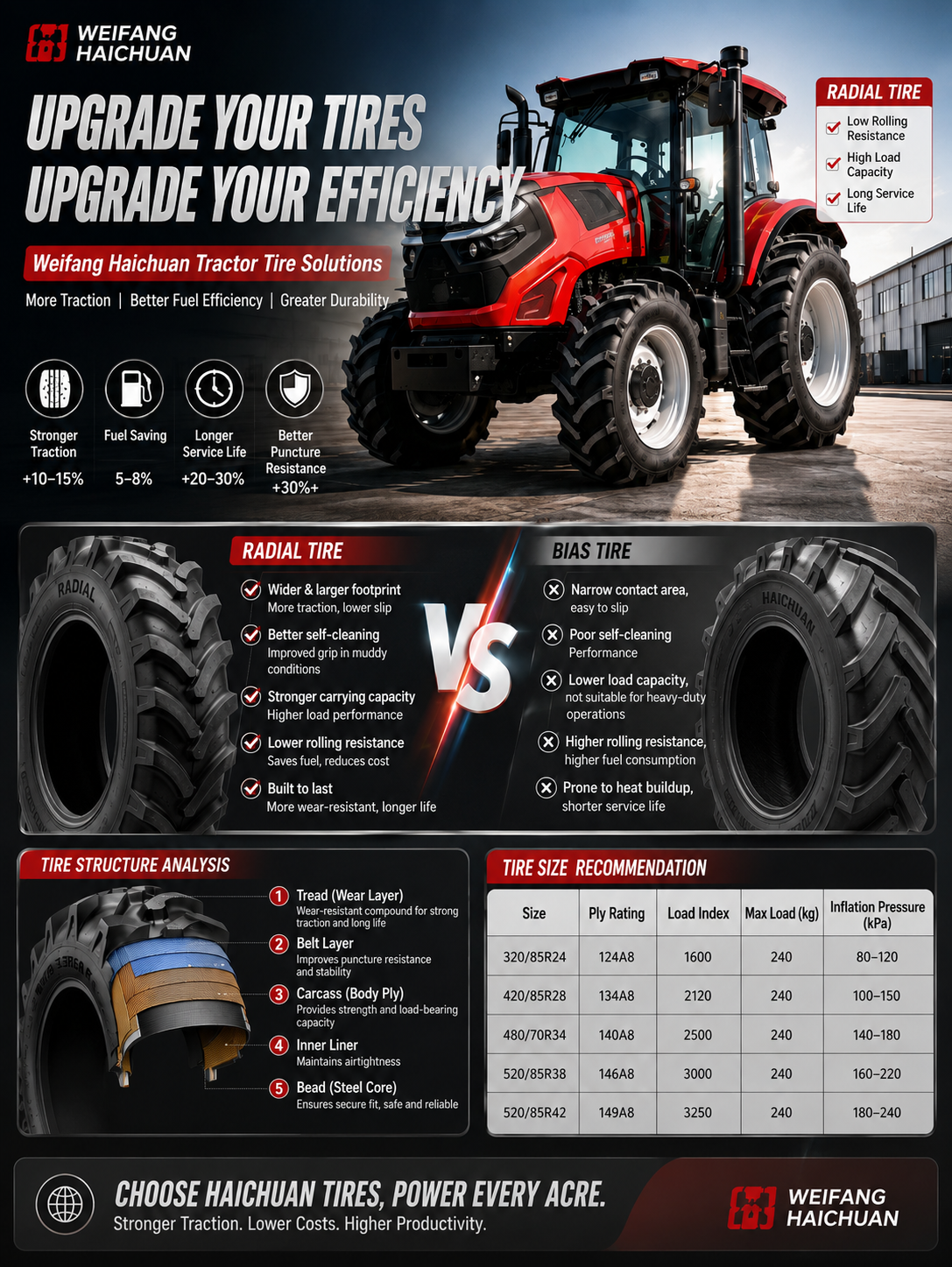
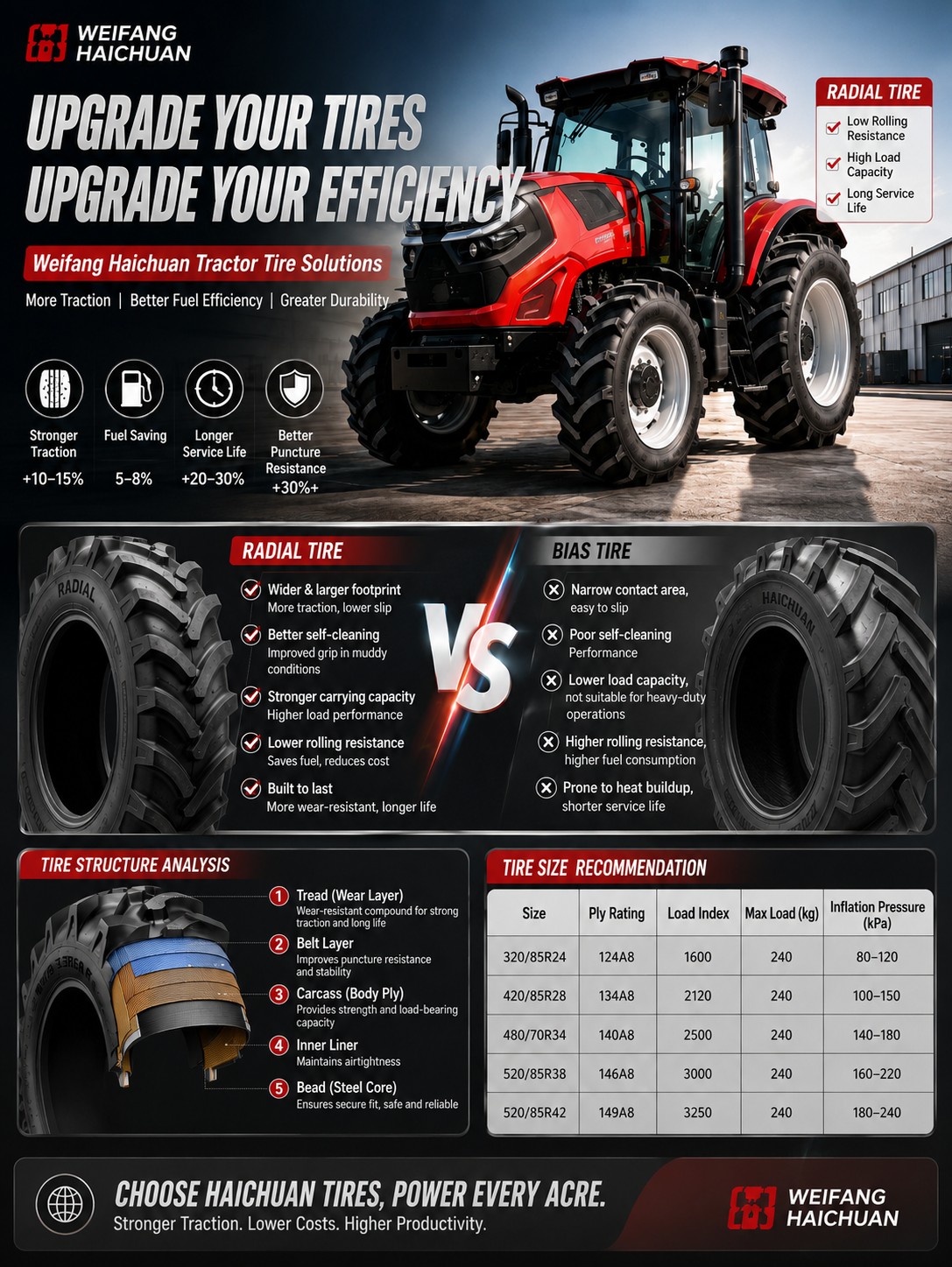
In ag tires, this radial construction is the biggest game-changer of the last thirty years. On bias-ply tires, the cord layers crisscross; when the sidewall flexes under load, it twists the tread right along with it, so you lose ground contact. A radial keeps the tread planted flat with that steel belt, while the sidewall does its own flexing. In the field, same horsepower tractor, radials can get you 10 to 15 percent better traction efficiency than bias. Sizes like 480/70R38 and 520/85R42 are standard on big tractors in Europe and the US—and they’re also what you’ll see spec’d on the rear of those massive machines coming out of Weifang Haichuan Heavy Industry these days. One tire ain't cheap, but you run the numbers on fuel savings and work done, and that upgrade pays for itself within three seasons. The farm managers running big operations, they got that spreadsheet down cold.
Deeper Still, The Real Skeleton: The Carcass Ply
This is the body's foundation. Rows of fiber cords, like the ribs in your chest. How they arranged? Like lines of longitude on a globe—from the North Pole to the South Pole. That's why it's called a "radial" tire.
This design is pure genius. See, on old-school bias-ply tires, the skeleton was laid diagonally. Hit a rock, sidewall flexes, the diagonal cords yank the whole tread out of shape, and you lose half your grip instantly. On a radial? The sidewall flexes, but each rib works independently. The tread, held firm by that steel belt, keeps maximum contact. That's why today's cars grip better and last way longer than old cars. It was the single greatest leap in tire history.
The Innermost: Inner Liner
Don't worry about air leaking. Inside is a very thin but super-dense layer of butyl rubber, like a high-end airtight bag, locking every air molecule in. This is the inner tube of a modern tire.
The Edge: The Bead
Hard as hell, like the heel counter of your shoe, with steel wire wrapped inside. It clamps onto the rim like your fingers gripping tight, making sure the tire never lets go, no matter what.
See that? This one black circle is structural mechanics and material science rolled into one. It’s a precision-engineered industrial product.
1.4 The Secret Code on the Tire—It Tattoos Its Résumé on Its Body
You ain't gotta be scared of those numbers and letters no more. They're just the tire's ID. Let's read it. Take a typical one: 225/55 R17 97V.
225 — How Big the Foot
That's the tread width, 225 millimeters. The width of its footprint. Is wider always better? Nah. Wide is like snowshoes—great grip. F1 dry tires are wide as tank treads to put down huge power without spinning. But wide is also like wearing snowshoes to a poolside: in rain, too much width can't shed water fast enough, and you end up hydroplaning. Plus wider is heavier, costs fuel. So the width your car gets is the engineer's balance point between power, fuel burn, and safety.
55 — How Thick the Ankle
That mysterious number is the aspect ratio: sidewall height = tread width × 55%. This decides if your ride is on "air-cushion running shoes" or "thin-soled kung fu slippers."
High number like 65 or 70? Thick sidewall, like an air cushion. Soft, comfy ride, sitting on a couch. That's your old Corolla or Maxima, all about soaking up bumps. Low number like 40 or 35? Thin sidewall, like a skin of rubber on the rim. Road feel so sharp you can tell heads or tails on a coin. That's why BMW and Porsche drivers feel connected, point and shoot—but it's also why they feel every crack, and pucker up at deep potholes, 'cause the rim and tire can both get busted.
R17 — What Shoe Size
R means Radial construction. 17 means it fits a 17-inch rim. They gotta match.
97V — How Much Weight, How Fast
These are codes. 97 means this single tire can carry a maximum of 730 kg (four of them add up to nearly 3 tons, way more than your car weighs, for safety margin). V says it's rated for up to 240 km/h. Even if you never go that fast, a higher speed-rated tire has a stronger internal build, which means more safety at any speed.
Ag tires got their own code language. You see "320/85R38 131A8" on a sidewall, you read it the same way: 320 mm section width, 85% aspect ratio, Radial, 38-inch rim. 131 is the load index (max load 1,950 kg per tire); A8 is the speed symbol for 40 km/h—for a tractor, that’s flying in the field. The size and load/speed rating together are the tire’s full technical ID. If the numbers don't match the machine's specs, you don't run it. This ain't a suggestion; it's the baseline.
1.5 The Imagination of Tread Patterns—Looks Is the Most Useless Feature
Look at the tires on the road—all kinds of wild patterns. None of it is for looks. Every groove is a fluid dynamics equation.
Rainy Day Magician: Longitudinal Grooves
Ever been caught in a downpour on the highway, and suddenly the steering feels light, like you're sailing a boat? That’s hydroplaning—one of the scariest things behind the wheel. What happened? You’re going too fast, and the tire can’t shove the water out of the way. Water builds up between tire and road, forming a razor-thin "water wedge" that lifts the whole car. In that moment, you’re surfing. Steering? Nothing. Brakes? Nothing. The fix? Those deep, wide grooves running around the tire—they’re like the main drainage canals in a city. They slice through the water, channel it, and spit it out the back so the rubber can grab the asphalt again. That’s why every passenger tire pattern, no matter how fancy, must have these lifeline grooves.
Mud Shovel: Transverse Blocks
Look at an off-roader or a tractor tire. It's like tank tread, covered in big chunky blocks. These ain't designed for the highway. In loose mud, sand, or snow, they don't just rely on friction; they dig. Each block is like a little shovel, stabbing into the soft ground and shearing the soil for thrust. But the price? On pavement, the noise is like a squadron of bombers, the blocks squirm so cornering’s unstable, and they wear down crazy fast. All trade-offs.
Farm tire treads follow a standard code, not random nicknames. R-1 is the universal ag tread—a herringbone pattern. Go-to sizes like 13.6-38 and 18.4-30 run this for general dry and wet field work. R-2 is deep tread, grooves way deeper than R-1, meant for mud and swamp ground. Then there's R-1W, a deepened version of R-1 for folks who also run some road transport. Pick the wrong one, and it ain’t about good or bad, it’s about whether the job gets done at all. Slap R-1 on a perpetually flooded lowland field, the slippage is so high you can’t work. Put R-2 on a tractor doing road haulage, and you’ll scrub the tread off in a few thousand klicks, plus the vibration will shake the driver apart. A serious farm or contractor picks the tread based on soil type, drainage, and roading distance. Every choice is a cost calculation.
Ear Tuner: Variable Pitch Design
You ever notice some tires hum quiet, others just drone? Beyond the grooves, there’s another secret: the beat of the sound. If every tread block were the same size, rolling down the road they’d hit at a steady, even frequency, and harmonize into one huge, boring, brain-drilling howl. Smart engineers mix up the block sizes, randomly shuffling the pattern so it turns that annoying "EEEEEE" into a soft shhhhhh—white noise your ears just tune out.
Alright, that's the story of the tire. Now whenever you look at one, you should know: it ain't just a black hoop. It's the workhorse holding up your ride on a cushion of air, a gladiator wrestling physics with rubber, and the one and only connection between your ride and the earth. Straight up.
Contact With Us

Please enter what you want to find
Send Your Inquiry Today
*We respect your confidentiality and all information are protected.