

What Makes a Tractor Move?
You prolly thinkin’, “’Cause it’s got an engine, fool. Diesel fires up, that big hunk of iron rolls out.”
Aight, bet. Let’s run a little experiment.
Jack that tractor up—all four wheels danglin’ in the air. Climb on up, fire it up, drop it in gear, and stomp on the gas. Wheels gon’ spin like crazy, engine screamin’ so loud your chest rattles. But that tractor? Did it slide forward one single centimeter? Nope.
So what that tell you? The engine, by itself, ain’t pushin’ nothin’.
So who’s really movin’ the tractor?
The ground, baby.
That same dirt, gravel, or concrete you walk on every day—that’s what shoves you forward. Sounds upside down, right? Hold that thought. We gon’ start with somethin’ a three-year-old already knows, and peel this whole mystery back layer by layer.
2.1 Take It Back to Pampers: How Did You Learn to Walk?
You don’t remember learnin’ how to walk, but you seen a baby do it. First move they make? They grab a wall or a grown-up’s hand, and they push they foot backwards against the floor.
Think about it. Foot goes back, body goes forward.
Why?
Basic law of the universe right here—Newton’s Third Law. Don’t trip off the name. All it’s sayin’ is: you push on something, that something pushes back on you just as hard, opposite direction.
Test this right now: shove your hand against the wall in front of you. Push hard. Harder. You feel that? Your palm hurtin’? That shove you gave the wall—that’s the “action.” The wall smackin’ your palm back—that’s the “reaction.” The harder you push, the harder it claps back at you. Forces always roll in pairs.
Now put that law on your legs.
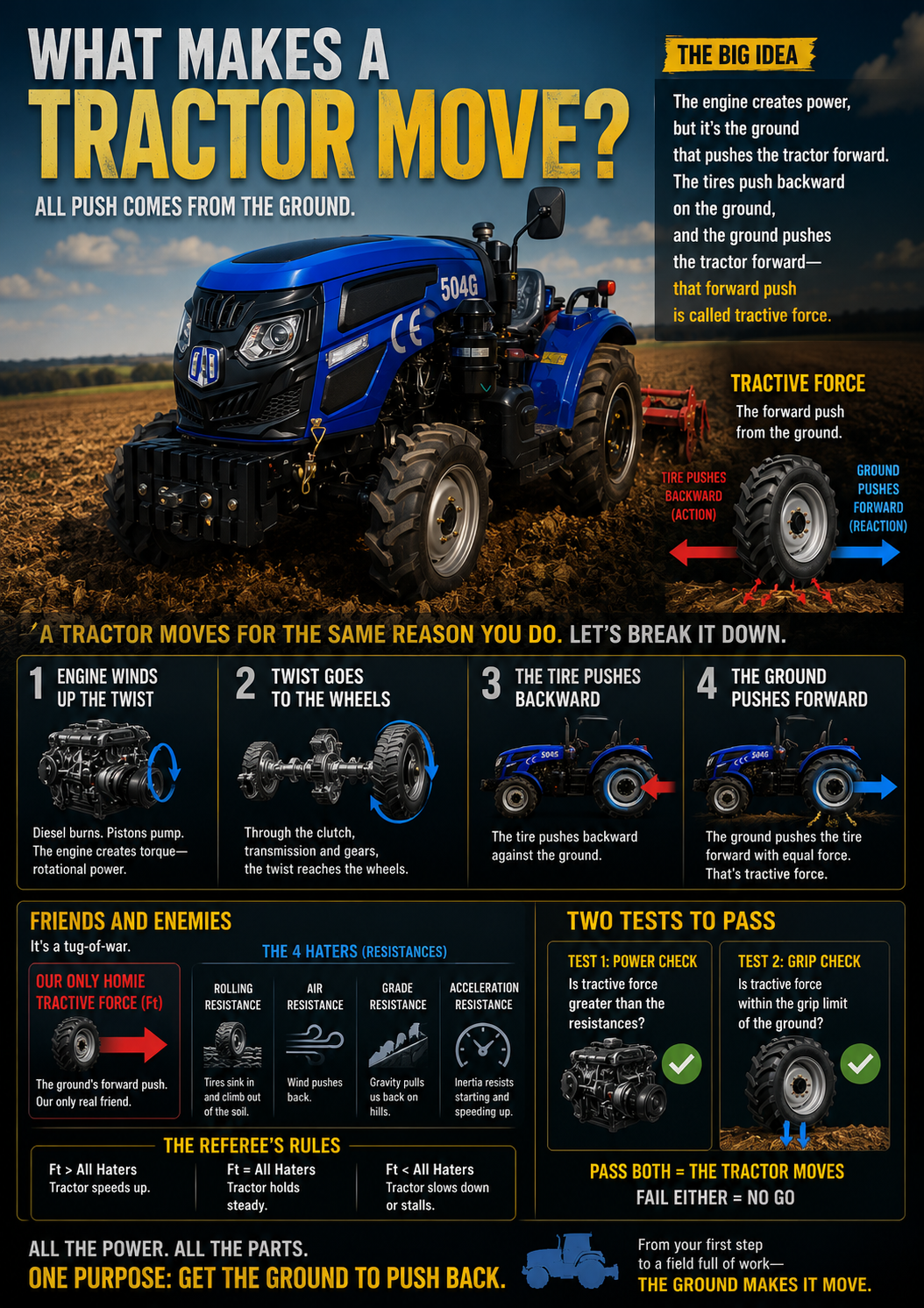
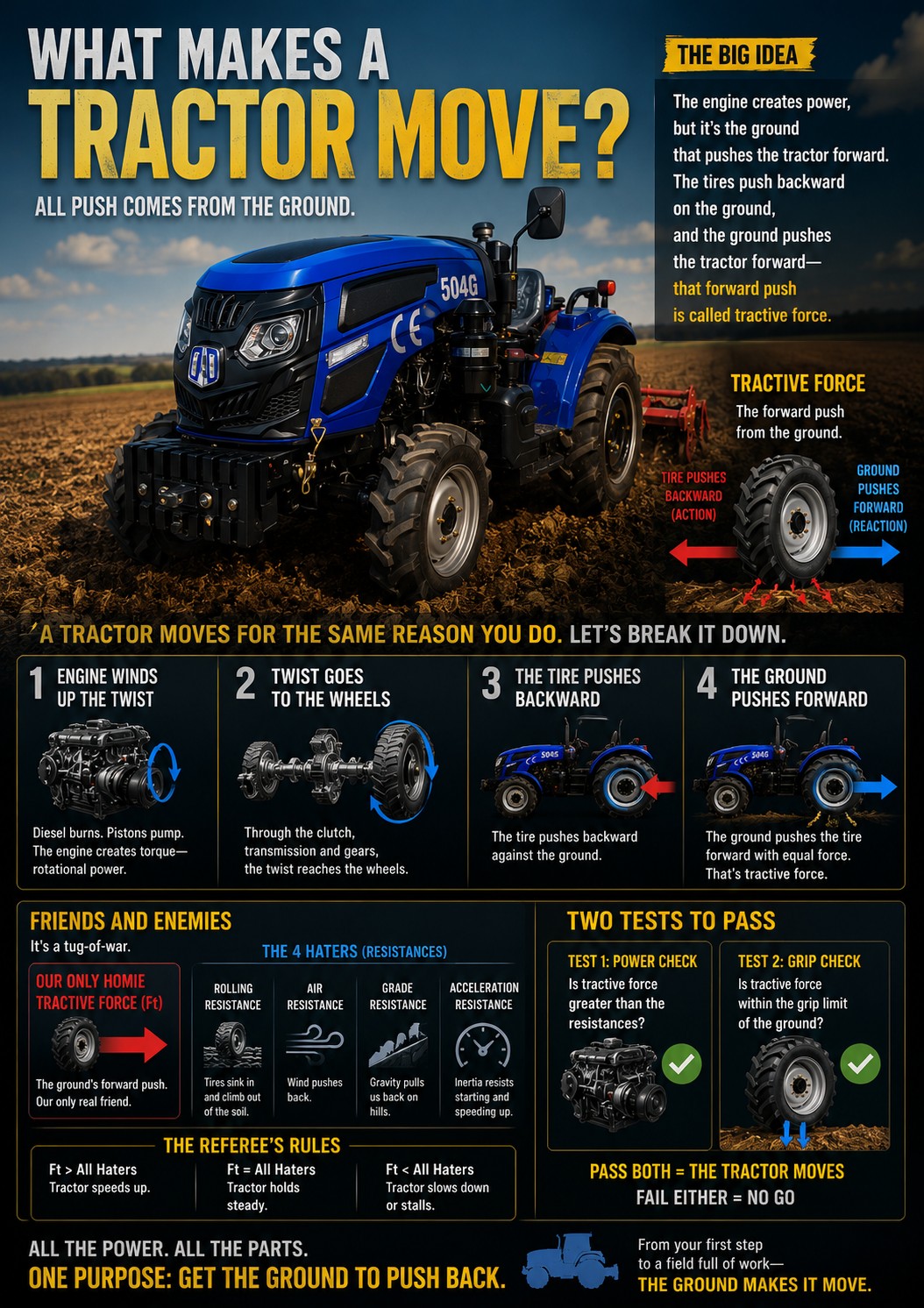
You stand on the ground and push your foot backward. Your foot puts a backward force on the ground. Well, “forces come in pairs” says the ground has to throw a forward force back at your foot—same size, opposite direction. That forward force? That’s what pushes you ahead.
The ground pushed you forward, not your muscles. Your muscles just the homies you hire to make the trade happen.
Let’s swap the scene. Now you standin’ in some fresh, rain-soaked mud, tryna walk. You still shove your foot backward. What happens? Foot slides out behind you, body don’t go nowhere, and you ’bout to bust your behind. Same motion—why different results?
’Cause this time, the trade didn’t go through. You tried to give the ground a force, but the ground was too slick, too soft—it couldn’t catch what you were throwin’. You couldn’t get no purchase.
So movin’ forward need two things:
You gotta have the muscle to push.
The ground gotta be able to catch that push and hand it right back.
2.2 Now, Imagine You Are the Tractor
Let’s swap souls. You ain’t a person no more. You a tractor, out in the field getting’ work done.
Your “muscle” is that diesel engine. It makes the pushin’ force. Engineers call it torque—just picture the twist you put into a towel when you wringin’ it out. That twist. A four-cylinder water-cooled diesel, spinnin’ at 2400 rpm, crankin’ out about 50 horsepower—that’s like 50 horses all twistin’ the same invisible pipe at once.
Your “legs and feet” are the whole setup: clutch, transmission, driveshaft, down to the tires. They deliver that twist down to the ground.
The road you standin’ on still the one callin’ the final shot.
Secret to a tractor movin’ is exactly the same as you walkin’. Let’s slow-walk it, step by step.
Step 1: The Engine “Winds Up the Twist”
You hit the gas. Diesel burns. Pistons pump. The crankshaft starts twistin’ mad hard. The whole engine pumpin’ out serious rotational force—that’s torque. But all this action still trapped inside. Imagine a wind-up toy frog—you crank that key, it’s all tight and tremblin’, but as long as you hold it down, it ain’t hoppin’ nowhere. Engine spinnin’ with the tractor in the air? Same thing. Loaded with power, goin’ zero miles an hour.
Step 2: Get That Twist to the Wheels
That twist rides through the clutch, through the transmission, through a gang of gears, and lands right at the center of the wheels. Now the wheels got a serious need to turn.
Now, let’s talk about the tractor’s ace in the hole: the transmission.
Think about the gears on your bicycle. Hit a hill, you shift to a big ol’ gear. Your feet spin a whole circle, wheel barely turns halfway—but it’s light on your legs. On flat ground, you shift to a small gear: one pedal crank, the wheel spins three times—you flyin’, but your legs gotta work harder.
Tractor transmission runs the same play. Plowin’ a field? Drop it into low gear—like your hill-climbin’ bike gear—and that transmission multiplies the engine’s twist by a whole lot before it hits the wheels. Gives the tires more push-power against the dirt. Hittin’ the road? Grab a higher gear so the wheels spin faster. Some tractors got eight forward gears and two reverse—that’s eight different “bike gears” you can swap anytime.
Step 3: The Big “Foot Push”
Them wheels ain’t bare metal. They wrapped in fat rubber tires, pressed down heavy on the ground. When the wheel tries to spin, the little patch of rubber touchin’ the dirt shoves backward against the ground. Same exact move as your shoe pushin’ backward when you slide a heavy box.
Step 4: The Ground Claps Back!
Our “must come in pairs” law kicks in. Tire pushed backward on the ground? The ground immediately, instantly, no questions asked, pushes the tire forward with the exact same force.
That right there! That forward force the ground hands to the tire—that invisible hand shovin’ the wheel, the axle, the whole body forward—that’s the one.
We give that sacred push a street name: tractive force.
Tractive force = the forward shove the ground puts on the tire.
So check this: whole tractor, burnin’ diesel, hundreds of parts movin’ in perfect sync, makin’ all that beautiful noise—all that work just to get the tires to push down on the ground real nice, so the ground gives ’em a push right back.
Tractive force? 100% from the ground. This the most important thing you gonna learn today.
2.3 Friends and Enemies: Who’s Helpin’, Who’s Hatin’?
We know tractive force is the one and only push movin’ us forward. But is that all it takes? When you pullin’ a wagon full of bricks, you feel somethin’ tryna hold you back, right?
Tractor in motion got several forces tryna snatch it backwards.
The Only Real Homie: Tractive Force (Ft)
Three things decide how big this homie is:
Engine twist (torque): More twist, stronger base.
Transmission leverage: Low gear makes you stronger (like a crowbar); high gear makes you faster, but your legs gotta hustle.
Wheel size: Same twist, a smaller wheel bites harder than a big one. Try twistin’ a tiny bottle cap—hard, right? Now twist a big ol’ steering wheel cover—way easier. When the engine twists the wheel, smaller wheel means more fight to put the power down.
Now, the enemies. Got four of ’em.
Hater #1: Rolling Resistance (Ff)
Ever ride a bike with a flat tire? Felt like you was pedal-in’ through peanut butter.
That’s rolling resistance. Tractor’s heavy. Pushin’ down on soft dirt, the tire sinks in and makes its own little ditch. Every time the wheel rolls forward, it gotta climb out the hole it just made. The deeper it sinks, the steeper that climb. Tractor tires got deep treads, like hikin’ boots, to grip that dirt—but the price you pay is all that musclin’ through the muck.
Hater #2: Air Resistance (Fw)
Ever stick your hand out the car window? Slow speed, just a breeze. Fast speed, that wind feel like a wall tryna push your arm back.
Air resistance got a nasty trick: when you double the speed, the wind don’t just double up on you—it quadruples. Triple the speed, wind hits you nine times harder. Lucky for a tractor, it tops out around 30 clicks, so the wind mostly mind its business. But slap a sunshade on the front and run down the road—that’s like holdin’ a piece of plywood up in a hurricane.
Hater #3: Grade Resistance (Fi)
Straightforward. You walk up a steep hill, you feel somethin’ pullin’ you backward. Steeper the hill, harder that pull. Tractor climbin’ over a field ridge feels the same drag. That’s why you downshift before hittin’ the slope—you need to bring backup muscle.
Hater #4: Acceleration Resistance (Fj)
You ever stand on a bus when the driver punches it? Your whole body jerks back and you get pinned in your seat. That’s inertia—all stuff got a built-in lazy streak. It don’t wanna start movin’, and once it’s movin’, it don’t wanna stop. Makin’ a lazy thing start movin’ costs you extra muscle. Heavier it is, bigger that lazy tax. A tractor weighin’ over a ton, draggin’ a thousand-pound tiller behind it? The lazy tax on takeoff is real.
2.4 The Ultimate Showdown: Tug-of-War
Now both teams in the pit.
Red Team (Our Side): Tractive force, Ft. One lone beast, but heavy with power.
Blue Team (The Haters): The Four Heavyweights—rolling resistance, air resistance, grade resistance, acceleration resistance.
This like a never-endin’ tug-of-war. The red flag in the middle? That’s your tractor. Whichever team pulls harder, that’s where the tractor goes.
Referee only need three simple calls:
If Tractive Force > All Four Haters Combined: Red Team wins! Tractor speeds up with that extra juice.
If Tractive Force = All Four Haters Combined: Dead even. Tractor holds its speed steady.
If Tractive Force < All Four Haters Combined: Blue Team wins. Tractor slowin’ down, maybe stallin’ out.
This simple matchup IS the whole equation of how a tractor moves. It explains everything you see in the field:
Why the tractor tops out slow? ’Cause the faster you go, the harder the wind and the rolling resistance hit, ’til they eat up every last bit of engine power. No leftovers to accelerate—you at max speed.
Why you only plow in the lowest gear? ’Cause when the plow digs into the dirt, that soil grabs on like it got a grudge. You need the transmission to multiply the twist to the absolute max just to win that tug-of-war.
Why changin’ gears all the time eats fuel? Every time you speed up, you payin’ the lazy tax on all that weight. Every time you climb, you fightin’ gravity. That diesel ain’t burnin’ for free.
2.5 The Strictest Referee: If Your Feet Slip, You Lose Everything
Now for the good part.
Think back to that slick mud. You can have world-class leg muscles, but if the ground won’t catch your foot, all your power means jack.
Tractive force got a hard ceiling it can never break: the maximum grip the ground can give. Engineers call it the traction limit. We just call it the Grip Ceiling.
This ceiling is two things multiplied together:
Weight sittin’ on the wheel: Heavier the load, the harder the tire gets squished into the ground, the harder it is to break loose. Like when you pushin’ a sofa and your buddy puts his hands on your shoulders and presses down—your feet grip way better.
The ground’s “roughness score”: Dry asphalt? Nearly a perfect 1.0. Wet ground? 0.5. Fresh-plowed loose dirt? 0.3. Sloppy mud? Might not even crack 0.2—straight-up failin’ grade.
So, for a tractor to do its job, it gotta pass two tests at the same time:
Test 1 (Power Check): The tractive force the engine and tranny cook up must be bigger than all four haters put together. Not enough power? You ain’t pullin’ that plow—no matter how hard you stomp.
Test 2 (Grip Check): That tractive force can’t be bigger than the Grip Ceiling. If your force is bigger, the tire just spins, digs a hole, and smokes. Tractor sittin’ still.
You gotta pass both.
You can always swap in a bigger engine for more power. But if your grip game is weak, all that extra horsepower gonna do is dig you a prettier hole right where you standin’.
Simple picture: you on an ice rink, and a bodybuilder tries to push you forward. His muscles mean nothin’ if your shoes can’t grab the ice. You just slide in place. Same deal with the tractor and the dirt.
Now when you look at a tractor workin’ a field, every design trick you see is about one thing: makin’ the ground catch better.
Why go four-wheel drive sometimes? In a wet rice paddy, just two back wheels might not have enough grip. So you lock in the front wheels too—four tires all pushin’ at once, splittin’ the job so no single tire breaks that grip limit. And the front wheels can adjust their width, findin’ the best stance in the muck. Once you hit a hard-packed road, you switch back to two-wheel drive—drop the front power, save fuel, save wear.
Why you scared of “bottoming out”? Ever notice how low a tractor’s belly hangs? The lowest point might be just over ten inches off the ground. If you drop into a deep mud rut and the tractor’s belly sits down on the dirt, the wheels can dangle—no weight squeezin’ ’em down. Grip instantly hits zero. All the power in the world, and you just spinnin’ your wheels like a cartoon character, goin’ nowhere.
Why you hangin’ them heavy farm tools on the back? The tiller or plow ain’t just for workin’ soil. It’s got a secret side-hustle: it’s mad heavy. Hook it up to the three-point hitch, and all that weight shifts right onto the rear tires, smashin’ ’em down into the dirt. Add them iron wheel weights. Maybe even fill the tires with water. Hydraulic system pushin’ down with insane pressure—18 to 20 megapascals of force—tryna shove the implement down and pile weight onto the wheels. All one mission: crank up the weight on the tires, raise that Grip Ceiling higher. In the field, heavier means grippier, which means you can actually use all that power. On the road? Back to two-wheel drive, cut the mechanical drag, roll steady at a chill speed, save fuel and your spine.
That constant back-and-forth—wrestlin’ the Grip Ceiling in different conditions—that’s a tractor driver’s daily hustle.
You read this far, and you’re already seein’ things different.
Next time you see a tractor rumblin’ across a field, chuggin’ smoke, you ain’t just seein’ a loud piece of iron no more.
You gonna see them tires kickin’ back hard against the dirt, and the dirt silently pushin’ right back.
You gonna see that roarin’ diesel doin’ one job: windin’ up a twist, beggin’ the ground for a return shove.
You gonna see the tiller hangin’ off the back, and you’ll know—that ain’t just a workin’ tool. That’s a weight-hustlin’ grip machine, smushin’ the wheels down deep.
You gonna watch it flip to four-wheel drive in the mud, cut to two-wheel on the hard road, and know it’s out here negotiatin’ with the invisible Grip Ceiling every step of the way.
All push comes from the ground.
That’s the lesson the tractor hands down to us. The deepest, realest rule for anything that moves across the earth.
From a multi-ton bulldozer on tracks, all the way down to your own sneakers slippin’ in the mud after a thunderstorm—same truth, same game
Contact With Us

Please enter what you want to find
Send Your Inquiry Today
*We respect your confidentiality and all information are protected.