

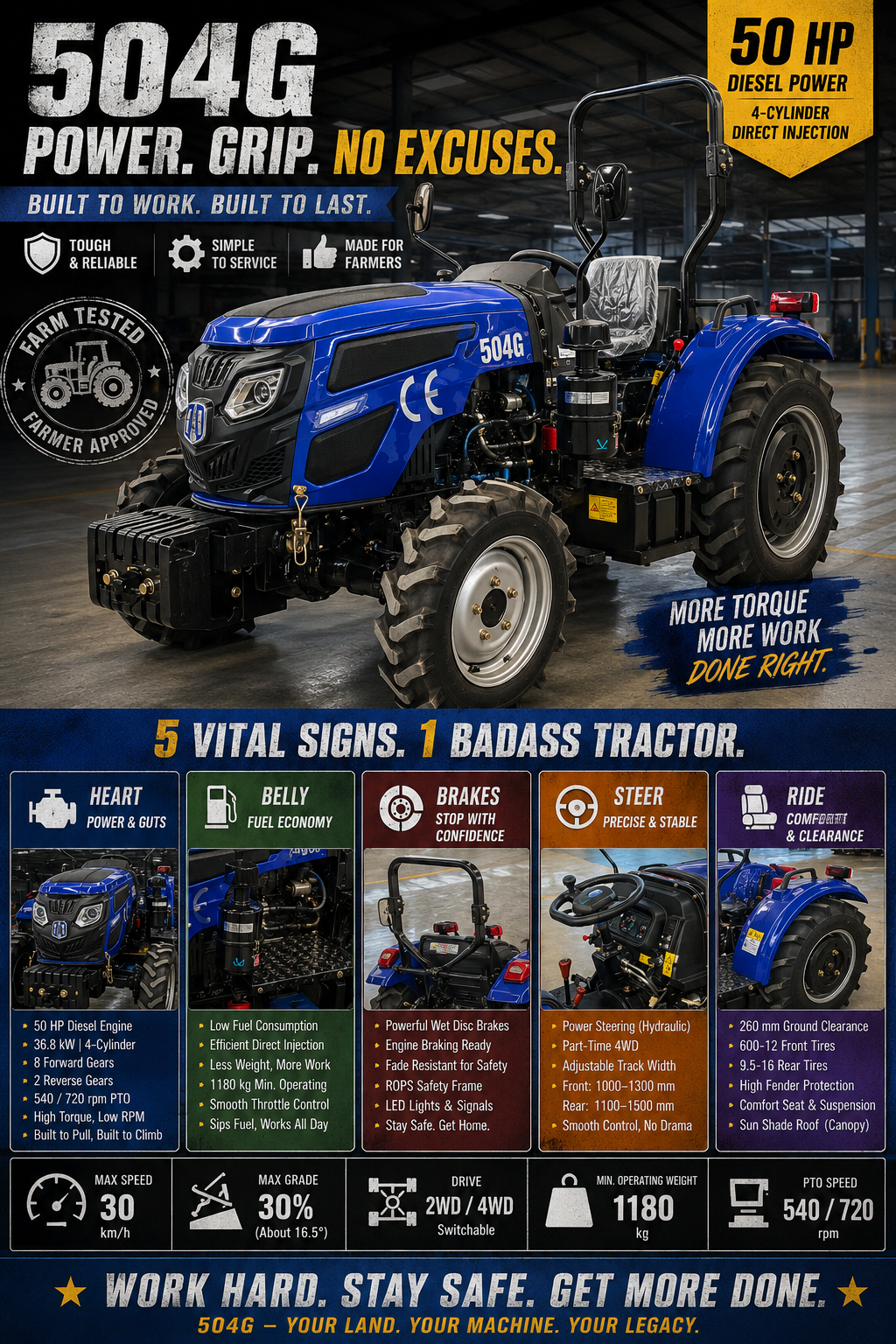
What Makes a Good Tractor? – Build Your Own Damn Rating System, Fam
Look, a tractor ain’t just some machine. It’s a moving, working beast. And when you tryna figure out if that beast is worth a damn, you don’t listen to the glossy ads. You pull up its medical chart. Your body got blood pressure and heart rate. A tractor got five vital signs. Let’s get into it.
1.1 The Heart – Power & Guts
This one answers the question: How strong is this thing really?
“Strong” is a lazy word. Engineers break that down into three real questions:
How fast can it go flat out? (Top speed)
Does it jump when you hit the gas? (Acceleration)
Can it drag a heavy load up a steep hill? (Climbing power)
Each one tests a different kind of muscle.
1.1.1 Top Speed: What’s the Absolute Limit?
Picture a long, flat road, no wind, and you just mash that throttle to the floor and keep it there. The speed climbs, then climbs slower, and finally just stops climbing. That right there is top speed.
But here’s where tractors flip the script on cars. A proper farm tractor, like a solid 504 wheel tractor, might have a theoretical max speed of just 30 km/h. That’s basically your uncle pedaling downhill on his bike. Why so slow? Because it ain’t built for racing. It’s built to drag a heavy-ass plow through soft, muddy dirt without breaking a sweat. It’s an Olympic weightlifter, not a sprinter. Two completely different kinds of "strong."
Why does any vehicle even hit a speed wall? Because haters gon’ hate as you get faster.
Your power source: The engine burning fuel, sending power to the wheels.
Two haters dragging you back:
Air resistance: Speed up, and the air turns into a thicker wall. This mess ain’t linear—go twice as fast, the air pushes back four times harder. At 200 km/h it’s 16 times harder than at 50. That’s foul.
Rolling resistance: Tires squishing and heating up, always nibbling at your energy.
It’s a tug-of-war. Your engine pulls one way. Air and friction pull the other. When the max pull equals the max drag, you stop accelerating. That’s top speed, cuz.
1.1.2 Acceleration: How Quick She Launches
In the field, you ain’t drag racing, but on the road between fields, it matters. The secret sauce here is torque.
Burn this distinction into your brain, no cap:
Torque – That raw twist force. The grunt. It’s what slams you back in the seat when you stomp it. Imagine tryna turn a rusty valve with all your might. That’s torque.
Power – How long you can keep that high-level effort going. Top speed lives here.
Diesel engines are torque monsters by birth. That’s why semis, tractors, and heavy-duty trucks run diesel. Not to go fast, but to pull stumps out the ground from a standstill. Take a 4-cylinder, water-cooled, direct-injection diesel engine spitting out 36.8 kW (about 50 horses). The top speed ain’t much, but this beast comes with 8 forward gears and 2 reverse. Why so many? It’s like your mountain bike—on a steep dirt hill, you drop into grandma gear. Your legs spin easy, but the wheel grinds slow and steady, grabbing every inch. Those gears multiply the torque so you can crawl up a damn mountain with a trailer full of logs.
1.1.3 Hill Climbing: How Steep Can She Go?
First, let’s kill a myth. A "30-degree slope" is basically a cliff. Most parking garages are 15% grade (only about 8.5 degrees). Tractor specs talk in "grade percentage," not degrees.
Percentage grade = (height climb ÷ horizontal distance) × 100%
So 100% grade means you go up 100 meters for every 100 meters forward—that’s a 45-degree angle. Most SUVs max out around 30% grade. That’s plenty.
When you’re climbing, gravity does its dirty work, pulling you backwards. Steeper the slope, the harder that pull.
Climbing chops depend on low-end torque and tire bite. So:
Off-roaders got a transfer case for low-range 4x4, multiplying torque 2-3x to crawl rocks.
Tractors wake up every day to pull heavy loads up muddy slopes. The whole setup—direct-injection engine, a TE rear axle, and a rear three-point suspension with a "power take-off" (PTO) shaft—is built for low-speed, high-torque sexiness. That PTO shaft spins at 540 or 720 rpm, like a drill chuck, powering mowers and tillers so the machine can work the land while barely moving.
Bottom Line on Power: Top speed is a power-and-drag game. Acceleration is torque and weight. Climbing is torque multiplication and grip.
1.2 The Belly – Fuel Economy
A tractor gotta eat. The question is, does it eat like a bird or a whole buffet?
For diesel tractors, we look at liters per hour or per acre. Lower is better.
What controls the appetite?
Engine guts: Gas engines barely hit 40% efficiency. Diesels can top 45%. That still means less than half your fuel’s energy moves the machine—the rest is wasted as heat. Physics is undefeated.
Weight: Chubbier the tractor, the harder it works just to carry itself. A good small tractor keeps its minimum operating weight tight—say, 1180 kg without extra weights. That way, more of that diesel muscle goes to the work, not to lugging around its own belly.
Your right foot: This is the wild card. Flooring it guzzles fuel. Smooth, steady cruising sips it. Think marathon runner breathing, not a hyena chasing a gazelle.
A real one sips fuel slow while grinding hard all day.
1.3 The Brakes – Can You Stop Before You Die?
Fast ain’t the flex. Stopping is the flex. And it’s a life-or-death metric.
Three parts here:
Does it stop quick? (Braking effectiveness)
Does it stay strong after heavy use? (Fade resistance)
Does it stay straight or try to yeet you sideways? (Directional stability)
1.3.1 Brake Fade: Why Engine Braking Is Your Best Friend
Long downhill run? If you ride those brakes, the discs turn into frying pans—500-600 degrees hot. Brake pads can literally off-gas, floating on a cushion of hot air. Pedal goes soft, and you’re praying. That’s brake fade.
That’s why smart farmers downshift and let the engine’s compression slow the machine down. Engine braking shares the load so the brakes can cool their jets. Same reason big rigs have water sprayers on their drums downhill. Keep it cool, keep it alive.
1.3.2 The "Oh Sh*t" Frame
Tractors work on slopes and ditches. Rollovers happen. That’s why any tractor worth its salt has a heavy steel safety frame (ROPS) over the driver’s seat. Flip over, and that frame hits the ground first, creating a survival triangle so you ain’t a pancake.
And lights? LED headlights, turn signals, brake lights, warning horns, and reflectors ain’t just decoration. At dusk, that light show shouts to the whole farm: “I see you, you see me, stay back.”
1.4 The Steer – Does It Listen or Have a Mind of Its Own?
This is handling and stability. We want a tractor that points where you look and don’t slide into next week.
Good tractors got a part-time 4WD system (switchable four-wheel and two-wheel drive). Soft muddy work? Four wheels clawing like a gecko on glass. Hard dirt road? Pop it into 2WD, save fuel and tires.
Steering should be butter. A fully hydraulic system means even with a heavy front end, you can turn that wheel with one finger. The classic setup: front wheels steer, rear wheels drive. Clean, stable, no unpredictable fishtailing nonsense.
Tractor width is adjustable, too. Front wheel track from like 1000 to 1300 mm, rear similar. That means you can tailor the footprint. Wide corn rows or narrow rice paddies—the tractor straddles the crop perfectly. Didn’t run over a single plant.
1.5 The Ride – Bumps and Guts
Last two things: comfort and clearance.
1.5.1 The Butt Test
Your insides know a bad ride. Low-frequency vibrations around 4-8 Hz make your stomach and intestines resonate—literally shake in place. That’s that feeling of “I’m gonna throw up” over a rough field. A good seat and decent suspension soak up the jagged stuff and just give you a smooth hum.
1.5.2 Ground Clearance – Can It Step Over a Boulder?
Minimum ground clearance is king. Some all-purpose paddy/dry land tractors got 260 mm clearance, measured right under the front axle housing. That’s a tall boy—can step over big stones and furrows without that crunch sound.
Tires matter too. Front tires often skinny (like 600-12) to slice mud and steer. Rear tires fat and tall (like 9.5-16) to get a grip like elephant feet. Universal heightened and thickened fenders keep that wet field mud from flying up and baptizing the driver in muck.
And look, don’t underestimate a simple awning. It ain’t just shade in summer heat—it’s a portable little shelter when the sky opens up. That’s love, straight up.
So there it is, fam. We done covered all five vital signs:
Heart: Big diesel torque, 8 gears, PTO spinnin’ like a champ.
Appetite: Sips diesel slow while movin’ heavy.
Stopping power: Engine braking, fade-proof, with a steel cage around your head.
Handling: 4WD when you need it, finger-light steering, adjustable wide stance.
Ride & Clearance: Tall ground clearance, fat rear paws, fender shields, and a canopy to chill under.
Next time you see a tractor grunting up a ridge, you can look at it and think: That growl is torque. That spinning nub on the back is the PTO. That fat steel bar above the seat? That’s what keeps the farmer alive when it flips. And those huge ass plastic fenders are keeping the mud outta his Sunday clothes.
You just built yourself a tractor rating system, brotha. Go flex it.
Contact With Us

Please enter what you want to find
Send Your Inquiry Today
*We respect your confidentiality and all information are protected.