
How a Tractor Gets a Mind
Aight, chief engineer, listen close. Last chapter we ripped that tired diesel heart out and dropped in a clean electric one. But a heart ain't enough. You need a brain. You need nerves. A tractor that's really built for tomorrow don't just roll and pull—it sees, it thinks, it decides. That machine out there in the field is waking up, and what we're about to walk through is the moment iron stops being dumb and starts being aware.
Today we go deep, right inside that iron skull. We're gonna tear apart the whole four-layer stack—how it senses the world, how it makes decisions, how it talks to other machines, how it acts on those decisions. Nothing gets skipped. Every piece of tech gets cracked open and looked at from the inside.
Before we touch a single wire or chip, we gotta answer one question. When you say a tractor is "smart," how smart are we talking? The steering wheel turns itself? The driver hops off and walks away? Or there's nobody in the field at all, just machines working under the moon while the farmer sleeps?
The industry doesn't guess at this. ISO put out standard 18497 for ag machine automation safety. SAE's J3016 lays down those L0 to L5 self-driving levels. And China is drafting its own national standard—"Automation Classification for Agricultural and Forestry Tractors and Self-Propelled Machinery"—so every player knows exactly which rung they're standing on.
But farm automation has a twist that highway automation doesn't. Out there in the dirt, there are no painted lane lines. No high-definition map. The field boundaries can shift from season to season. And the machine is always deep-coupled with its implement—when the tractor turns, how that plow or planter moves behind it is what decides whether the job comes out clean or sloppy. So ag grading doesn't just ask "can it drive itself." It asks "can it do the work right by itself."
We're not reading the standard word for word. Let's walk this ladder in plain talk, every rung burning clear.
Level One: Assisted Steering. The machine holds the line, you handle the turns. This is where the revolution is happening right now, today, in fields across the world. You drive to the headland, tap a button, and the steering wheel comes alive—the machine takes over, tracking a straight line so true that the side-to-side error stays under two and a half centimeters. Your hands are free. Your feet are free. You're not staring at the front wheels burning your brain out—you're watching the implement bite the soil, checking the job quality, thinking about the next field. But when you hit the end, you grab that wheel and turn it yourself, then tap again and the machine locks into the next row.
This solves the oldest, most exhausting pain in farming. A human driving eight hours straight, locked on keeping the wheels on a line, brain tense, one second of drift and you're overlapping—wasting seed, wasting fuel, wasting money—or you're skipping strips of land entirely. Assisted steering hands that hardest grind to the machine. The driver becomes the headland manager, the overseer. The stress peels away.
Level Two: Cooperative Operation. Now you're not alone out there. One person in a lead tractor, and two or three unmanned machines rolling behind or beside, covering different swaths together like a formation of birds cutting across the sky. The leader broadcasts its path and speed through V2V—vehicle-to-vehicle communication—and the followers hold formation automatically.
There are two ways to run this formation. Master-slave is the leader barking orders and the followers obeying—simple, sharp, works great in open fields. Distributed is every machine thinking for itself, negotiating the formation together through consensus algorithms—tougher to crack but resilient when comms get spotty. Right now in agriculture, master-slave gets it done.
Three things make this sing. First, real-time communication so the followers aren't chasing ghosts of where the leader was fifty milliseconds ago. Second, obstacle detection so a follower doesn't dumbly plow into a person who stepped into the path. Third, formation algorithms—model predictive control, delay compensation—keeping those machines in lockstep like they're bolted together with invisible steel. One skilled driver running three or four machines. That's one person doing the work of a whole crew. With farm labor shrinking everywhere on this planet, this right here is the bridge between today and full autonomy.
Level Three: Full Autonomy. Nobody in the field. The tractor runs completely on its own senses—navigating, planning, deciding. It doesn't just detect "something ahead" and stop. It knows if that's a small rock it can roll over or a corn stalk it must save. It knows if that's the field boundary or a pallet of supplies left by the crew. It decides the headland turn strategy, adjusts working speed on the fly, lifts and lowers implements, handles faults without panic. One operator on a remote screen watches multiple machines, only stepping in when a machine raises its hand and says "I need a human."
L4—full unmanned inside a mapped field with defined boundaries—is happening right now in test plots and early commercial farms. Korea's Daedong showed an L4 AI tractor at the end of 2025 that uses visual AI to read the field and the implement, planning to hit the market soon. L5—full unmanned anywhere, any field, any condition, zero human backup—that's the moonshot. And it's not just a tech problem. The whole world is still fighting over who's responsible when a fully autonomous machine makes a choice and something goes wrong. The law hasn't caught up to the machine yet.
To walk by itself, to dodge, to know exactly where it stands on this earth—the tractor needs senses. Five senses, just like you and me, but built from steel and silicon.
RTK Centimeter Positioning – The Answer to "Where Am I?"
GNSS—GPS, BeiDou, GLONASS, Galileo—satellites up there screaming signals down at the earth. The receiver catches at least four and triangulates its position from the time delays. But regular GNSS is meter-level. Two, three meters of error. For walking down the street, fine. For planting seeds where row spacings are measured in centimeters, three meters of error means you're dumping seeds into last year's grave.
Enter RTK—Real-Time Kinematic. You put a base station on the ground at a known fixed point. That station knows exactly where it truly is. It listens to the satellites, calculates the error between "where the satellites say I am" and "where I know I am," and broadcasts that correction in real time over radio or mobile network. The tractor's receiver grabs it and locks in—centimeter precision. Under two and a half centimeters. That's the width of your thumb.
But the tractor also needs heading—which way am I pointing. GNSS alone can't hold that angle steady when you're crawling through a field. So the IMU steps in—Inertial Measurement Unit, gyroscopes and accelerometers. This is the tractor's inner ear. You close your eyes and walk across a room, you don't fall over because your inner ear keeps balance. When the tractor loses satellite signal under trees or beside a hill, the IMU holds it steady for those critical seconds, and visual SLAM kicks in—the cameras build a map on the fly and keep that centimeter-level lock alive through the dead zone.
LiDAR and Vision Fusion – The World Becomes a 3D Sculpture
GNSS and IMU tell the tractor where it is and what posture it's holding. But what's around it. That rock. That power pole. That person who just stepped into the field.
This is where the sensor suite goes to work. LiDAR fires millions of laser pulses every second. Each pulse bounces off a surface and returns, and the time of flight gives an exact distance. Millions of points form a point cloud—a live, three-dimensional sculpture of the entire world around the machine. Picture a bat screaming into the dark and seeing with sound, except this bat screams with light.
Then the cameras come in, running deep learning models for semantic segmentation. Every pixel gets a label: ground, crop, rock, human, dog. The LiDAR says "object at two point three meters, hard surface, roughly forty centimeters tall." The camera says "that's a dog, not a corn stalk." Fuse those two data streams together and the machine doesn't just detect—it recognizes.
And there's another set of eyes on board. Multispectral cameras capture near-infrared bands that your eyes can't even perceive. Healthy crops explode with near-infrared reflection. Stressed crops go dark. The NDVI—Normalized Difference Vegetation Index—turns into a crop health map that shows exactly where the plants are hungry or thirsty. Thermal cameras watch leaf temperature—thirsty plants heat up from stress. The tractor sees the invisible. It reads the field in spectrums you and I can't even access.
SLAM—Simultaneous Localization and Mapping—weaves all of this together. The machine builds a map of its environment and finds itself inside that map at the same time, every second. Laser SLAM for precision down to two centimeters. Visual SLAM for when the light gets tricky. When GNSS drops, SLAM grabs the wheel and says "I got this." Multi-sensor fusion, deep learning semantic recognition, SLAM positioning, multispectral crop monitoring—four technologies working together lock down the full perception loop. The tractor is no longer blind metal. It has awakened.
Now it sees the world. Now comes the real question: what is it going to do about it. Which way. How fast. That thing ahead—go around or stop.
Navigation Control – How a Machine Walks a Perfect Line
The auto-nav system is doing one thing, over and over, a thousand times per second. Where am I right now. Where should I be. What's the error. Fix it.
The oldest, toughest tool in the box is PID—Proportional, Integral, Derivative. You know this from your own life. You're in the shower, the water's cold, you twist the knob toward hot—that's Proportional, reacting to the error right now. You twist a while and it's still not hot enough, you twist a little more—that's Integral, accumulating past error to push harder. You feel the heat coming and you back off before you get scalded—that's Derivative, anticipating the future. PID is that shower dance turned into mathematics, and it's running on millions of tractors right this moment.
Then there's Pure Pursuit—an algorithm that drives the way a human does. You pick a target point a certain distance ahead of the vehicle, and geometry draws an arc that constantly brings the vehicle toward that point. Simple, elegant, perfect for low-speed field work and smooth headland turns.
And then the heavyweight—Model Predictive Control, MPC. It doesn't just look back at past errors like PID. It looks forward. It uses the tractor's dynamic model to predict where it's going to be in the next few seconds, and it optimizes the control command right now so the future is already corrected. On slopes, in mud, in side-slip conditions—MPC holds the line when simpler methods start to wander. If PID is driving while looking in the rearview mirror, MPC is driving while reading the road ahead.
Once the control command is calculated, how does the wheel actually turn. Two ways. Hydraulic steering puts electro-hydraulic proportional valves on the existing steering circuit—raw power, bulletproof reliability, built for big machines doing heavy work. Electric steering wheel bolts a motor right to the steering column—clean, simple, perfect for the electric age where everything runs on signals instead of oil.
Path Planning – Drawing the Perfect Route Across the Dirt
The tractor knows where it is and how to steer. But what path should it follow. Which route covers every square meter without wasting a single step.
Two classic patterns rule the fields. Circling mode spirals from the outside in, like a hawk circling its prey, perfect for irregular fields and combine harvesters. Shuttle mode goes back and forth like a typewriter carriage, row after row, perfect for rectangular fields and planting or tillage work.
But real autonomous path planning goes deeper. The algorithm weighs field boundaries, terrain slope, every obstacle, the implement width, the turning radius—and it generates the mathematically optimal path. Minimum turns. Minimum overlap. Minimum skips. Some research splits the field into convex polygon zones, fills each zone with back-and-forth lines, then uses graph search algorithms to find the perfect traversal order between zones.
And then there's the headland turn—the moment that eats time if you get it wrong. A fifty-acre field running shuttle pattern needs eighty to a hundred turns. Every wasted second per turn adds up to real money by the end of the day. So the machine picks its turn style automatically. The Ω-turn is a big smooth bulb arc, no tire scrub, but it needs space. The fishtail turn is a quick reverse flick with the tightest footprint—surgical precision. The U-turn is the hairpin, right in between. The autonomous system reads the available headland space and picks the best turn, every single time.
And now drones join the workflow. A drone flies the field first, marks the boundary with GPS, captures multispectral images to identify every obstacle and boundary detail. Then the software generates the route. The tractor follows coordinates laid down from the sky. Drone scouts, tractor executes—the path planning moved from the ground to the heavens.
One smart tractor is impressive. But the real transformation happens when the machines start talking to each other. When the whole farm becomes one thinking network.
ISOBUS – The Universal Language of the Field
For decades, this was the dirty secret of agriculture: a John Deere tractor couldn't talk to a Claas implement. A Kubota terminal couldn't plug into a New Holland planter. Every brand spoke its own private language, and the farmer was locked in a tower of Babel. If you wanted to run a mixed fleet, you were in for a headache.
ISOBUS—ISO 11783—shattered that wall. One standard, one protocol, one language. Any tractor, any implement, any brand—plug it in and it just works. The Universal Terminal shows the implement's controls and status right on the cab screen. The Task Controller loads the prescription map and records every action back to the cloud. AUX-N lets joysticks and buttons in the cab directly run the implement's actuators. It's the USB-C of farming. One cable, one language, everything talks.
ISOBUS is what makes variable rate application real. The prescription map loads through the terminal. The Task Controller reads the GPS position and the prescription simultaneously. As the tractor rolls, the controller tells the implement: this exact spot, this exact amount. Without ISOBUS, that whole chain of communication falls apart.
V2V – Machines Whispering to Each Other at Millisecond Speed
Multiple tractors rolling together in formation. The leader broadcasts position and speed. The followers receive and hold the pattern. But here's the challenge—communication delay. The data takes tens to hundreds of milliseconds to travel from one machine to another. In that blink, the leader has already moved several meters. A follower chasing a ghost position will drift out of formation.
MPC-based delay compensation solves this. The follower uses a vehicle motion model to predict where the leader truly is right now, despite the delay, and adjusts its control command before the error grows. The formation holds tight, millisecond by millisecond.
And the next frontier is cross-brand teamwork. The FieldDataSync project led by the Technical University of Munich is building manufacturer-independent wireless data transfer. No brand lock-in. No shared platform required. Machines from different manufacturers sharing coverage maps and work status in real time, at the field scale, coordinating their moves like they came from the same factory floor.
5G Remote Driving – The Operator Moves to the Cloud
Now stretch your mind a little further. 5G—huge bandwidth, ultra-low latency, rock-solid reliability. A tractor in the field, driven by an operator sitting in a control center miles away. Steering, throttle, brakes—all electronic signals traveling through the 5G pipe. Live video feeds stream back so the operator can see exactly what the machine sees. The operator sits at a simulator cockpit and runs three machines at once.
This isn't for everyday plowing—not yet. It's for disaster zones, hazardous material fields, and as the safety net when full autonomy hits a wall it can't climb. If the AI encounters a situation it can't handle, the human dives in from the cloud and drives the machine out of trouble. It's the backup that makes full autonomy safe enough to deploy.
Edge Computing – The Local Brain That Never Sleeps
All these sensors—LiDAR, cameras, radar—are vomiting data. Hundreds of megabits per second, sometimes over a gigabit. You cannot send all that to the cloud and wait for a reply. The network delay alone would let the tractor crash into an obstacle before the "stop" command ever arrived.
So every smart tractor packs an edge computing unit—a local brain. GPU chips and AI accelerators crunching point clouds and running neural networks right there on the machine. Obstacle detection in tens of milliseconds. The cloud handles the big picture—efficiency analysis, job scheduling, prescription map updates—but the split-second decisions happen right at the edge, in the dirt, where the action is. The local brain reacts. The remote brain reflects.
For ten thousand years, farming was "spread it everywhere and hope for the best." Same seed rate, same fertilizer rate, same chemical rate across the whole field. But the land isn't uniform. High spots are poor. Low spots are rich. Certain corners flood every year. Certain ridges turn to sand. One bowl for all means the poor spots starve, the rich spots overeat and fall over, the wet spots rot.
Precision ag flips the whole script. Where needs more gets more. Where needs less gets less. The data calls every shot.
The Prescription Map – The Field Gets a Full Body Scan
Step one is giving the field a complete physical. Satellite spectral imaging. Drone multispectral flights. Soil sensors poking the ground. Last season's yield maps pulled from the combine's memory. All of it fuses into one prescription map—a pixel-by-pixel instruction sheet. This exact square meter needs twelve point three grams of nitrogen. That square meter over there needs eight point seven. Every inch of the field gets its own prescription, its own private recipe.
The logic behind the map is straightforward. Multispectral reflectance data inverts into soil organic matter estimates, chlorophyll concentration, water stress indicators. Combine that with years of yield history, run it through an agronomic model, and out comes the prescription—grams per square meter, seeds per meter of row. The output is formatted in ISOBUS-compatible files and loaded onto the tractor.
Variable Rate Execution – Filling the Prescription, Exact to the Drop
The map loads into the tractor through the ISOBUS terminal. The Task Controller reads the GPS position and the prescription simultaneously. As the tractor rolls across the field, the controller commands the implement: this spot, this amount, right now. Electro-hydraulic valves or electric motors spin the metering discs to the exact speed needed. John Deere's ExactRate system does this row by row, turning broad-acre broadcasting into surgical point-by-point delivery. Massey Ferguson's MF Rate Control runs the same concept—prescription in, precise application out.
And then there's spraying. PWM—Pulse Width Modulation. Nozzles switching on and off dozens of times per second. The duty cycle—the ratio of on-time to off-time—sets the exact flow rate. Meanwhile, LiDAR or ultrasonic sensors scan the tree canopy in real time. Where there's canopy, the nozzle fires. Where there's empty space between trees, the nozzle shuts off instantly. Spray only the target. Pesticide savings of thirty, fifty, even sixty percent. That's money back in the farmer's pocket and less chemical load in the soil.
The loop doesn't close when the application stops. During the job, the machine records the actual applied amount at every GPS point. After the job, it generates an as-applied report and sends it back to the farm management system. That report is both a quality record for traceability and the base data that feeds into next season's prescription map. The field learns. Every pass makes the next pass smarter.
Digital Twin – Farm the Whole Field in a Virtual World First
This is the frontier. You build an exact digital copy of the farm inside a computer—a digital twin. Before a single wheel touches the real dirt, you run the whole operation in simulation. Which prescription map gives higher yield, A or B. How much fuel does the optimized path save over a full season. The virtual world tests a thousand scenarios and picks the winner. Then the real machines go out and execute the proven best plan. And as they work, they feed data back to the twin, making it smarter for the next season. The farm becomes a living, learning system—a loop that tightens every year.
When you explain this to a customer, don't drown them in jargon. Hit them with the truth in three lines. Assisted steering stops you from overlapping and skipping—saves fuel and seed. Cooperative operation is one person running a whole crew—saves labor. Precision ag is giving every single plant its own custom meal plan—more here, less there, because the data said so.
So let's stand back and look at what we just built.
Automation levels gave us the ladder—from a wheel that holds itself straight to a field that runs itself with nobody in it.
Sensing gave it eyes and ears that see beyond human sight. RTK positioning down to the centimeter. LiDAR painting the world in laser light. Cameras that recognize a dog from a corn stalk. Multispectral eyes that read crop health invisible to any human who ever walked a field.
Decision and control gave it a brain. PID, Pure Pursuit, MPC—algorithms that translate error into action, that predict the future and steer before the mistake happens. Path planning that draws the perfect route across the dirt. Headland turns picked automatically for speed and precision, every time.
Communication gave it a voice. ISOBUS letting every brand speak one language. V2V letting machines whisper formation commands in milliseconds. 5G letting a human dive in from the cloud when needed. Edge computing making sure the brain thinks at the speed of danger, not at the speed of a cell tower miles away.
Precision ag gave it purpose. Every plant gets exactly what it needs—no waste, no starvation, no excess. Prescription maps, variable rate execution, PWM spraying, digital twins—the whole field becomes a finely tuned instrument that plays better every season.
For a hundred years, the tractor was muscle. It pulled, it dragged, it lifted, it sweated diesel and made noise. But look at it now. It sees. It thinks. It decides. It talks to other machines. It learns from every pass and gets better next season. The iron bull grew a mind. The field isn't just dirt anymore—it's data, streaming in real time. Every seed, every drop, every gram placed exactly where the math says it belongs.
From Module One when we first fired up that engine just to get it running, through brakes and steering and transmission and hydraulics and PTO, through the electric heart transplant, and now through this—the waking up of the mind—this machine went from dead metal to living intelligence. It stands at the edge of the field, scans the ground with a thousand sensor eyes, and decides for itself how to do the job better than any human ever could


Real quick recap: our tractor started as a naked iron lump that could barely putt‑putt. Now she's a full‑blown beast—chassis locked, brakes grippin', steerin' sharp, transmission slick, hydraulic arms liftin' heavy, PTO spinnin' power out to every tool you hang off her. She runs, she stops, she hauls, she plows, she plants. A straight‑up universal iron bull.
But the story ain't over, not by a long shot. Diesel ruled these fields for over a hundred years. Now? Batteries and silicon chips are bangin' on the farm gate. This chapter, we steppin' outta gears and hydraulic oil to look at the tractor's future heartbeat—electrification. This ain't just yankin' the fuel tank and droppin' in a battery. Nah, this is a full gut‑renovation from where the energy comes to how it gets to the ground.
Listen, that diesel engine is a war hero. But she got three fatal flaws nobody can fix, and that's what's pushin' the whole ag world to hunt for a new path.
Flaw One: Efficiency slammed against a physics wall. A diesel's thermal efficiency at its one sweet spot can hit maybe 45%. Sounds decent, right? But in real fieldwork, that engine is always coastin' at low load—turnin' at the headland, waitin' for the grain cart, light transport. In those moments, efficiency drops under 20%. You put a tank of fuel in, and only two, maybe three tenths of it actually become useful work at the wheels. The rest? Poof. Heat and smoke, gone with the wind. It's like hirin' ten workers and only two are sweatin' while the other eight stand around gaspin' for air. Bad business, man.
And think about the curve—diesel efficiency looks like a sharp teepee. You gotta be right at the peak or you fallin' off fast. A tractor in a real field might spend less than a third of its day on that peak.
Flaw Two: Emissions won't quit, and the aftertreatment keeps gettin' more expensive. EU Stage V, US Tier 4 Final—every year the rope gets tighter. To pass, you gotta bolt on a DPF to catch soot, SCR that sprays urea into the exhaust to kill NOx, and EGR to recirculate gas. You know the headache? That DPF clogs up and needs a "regen" cycle to burn the trapped soot clean. If the regen ain't controlled right, raw diesel slips past the rings into the oil pan and thins out your engine oil—kiss your bearings goodbye. SCR means you're buyin' and haulin' diesel exhaust fluid, and on a big tractor that's another real cost every season. And the dirtiest moment for diesel emissions ain't at full throttle—it's low speed, high load: exactly when you're startin' a pull, deep plowin', or crawlin' up a hill. That's the tractor's main job. So the rules get tighter, the exhaust hardware gets pricier, and the whole game gets less worth playin'.
Flaw Three: Control is way too crude. A diesel spits out mechanical torque. You gotta run it through a whole parade—clutch, gearbox, driveshaft—just to manage speed and load. You got more gears? Still steps. First gear 2.8:1, second gear 1.9:1—you always stuck somewhere between the steps you actually need. Clutch can be smooth? It's still slippin' and wearin' every time you launch, a little bit of its life scraped off. And response? You stomp the throttle, fuel sprays, burns, pushes the piston, torque travels through flywheel, clutch, gearbox, driveshaft to the wheels—hundreds of milliseconds of lag. When you need centimeter‑level precision for precision seeding or variable‑rate fertilizing, that lag makes tight control real hard.
These three bullet holes together forced the whole industry's hand. But electrifyin' a tractor ain't like slappin' a big battery in a car. A tractor faces brutal, long‑hour, heavy‑load work in the dirt—completely different weight class than a passenger car. So ag electrification takes a step‑by‑step, scene‑by‑scene path.
Since pure electric can't yet wrestle the real heavy fieldwork, let the diesel and electric motor shack up together. That's your hybrid tractor.
Core logic in one line: Let the diesel do only what it's good at—steady output and high‑speed cruise. Everything it sucks at—launch, speed change, low‑speed high‑torque—throw all that to the electric motor. Three basic setups. Let's hit the real differences, and break down the physics on each.
Parallel Hybrid: Diesel and electric motor can drive the wheels solo or together. The key mechanical piece is a power‑split device—usually a planetary gearset. Diesel hooks to one input, motor/generator to another, wheels to the output. The physics is exactly the planetary gears from our transmission chapter: sun gear, planet carrier, ring gear. Lock different pieces, get different ratios. But here it ain't for shiftin'—it's for blendin' two power sources.
Run the modes: launch, where diesel is pitiful, the motor pushes alone and the diesel can nap or just spin a generator. Accelerate or climb, both diesel and motor punch together through the power‑split. Highway cruise, diesel direct‑drive—pure mechanical gears, no electric conversion loss, peak efficiency. Braking or slowing, the motor flips into generator mode and sucks kinetic energy back into the battery.
Upside is each covers the other's weakness, and you keep diesel's efficient direct‑drive cruise—that's non‑negotiable for tractors that also haul on roads. Downside is the control brain is complicated: when to use oil, when to use spark, when to blend, and exactly what ratio—all that needs a heavy control strategy. Plus the planetary gears themselves have some mechanical drag. Parallel is the most mature hybrid tractor setup because it's closest to the traditional drivetrain, smallest change.
Series‑Parallel Hybrid (Power‑Split): Adds another generator so the diesel can fully decouple—engine RPM and wheel RPM completely unshackled. The diesel just locks at its peak thermal efficiency RPM and hums there, strictly makin' electricity. Wheels are driven purely by electric motor. This is basically CVT philosophy baked into the powertrain's DNA: engine sits at its sweet spot, vehicle speed changes all handled by the electric side—same goal as a CVT, but using electrons and planetary gears instead of cones and a steel belt.
But there's a physics cost you can't dodge: energy goes diesel → mechanical → generator → electrical → maybe battery → motor → mechanical. Two full conversions. Generator around 95%, motor around 95%, multiply 'em you're around 90%. Add battery charge/discharge losses, you're lookin' at 10‑15% total conversion tax. A parallel setup at highway direct‑drive has none of that. So series‑parallel shines where you're constantly starting, stopping, varying speed—diesel stays efficient the whole time—but on long steady cruises it's actually thirstier than parallel. In cars this is mature—Toyota's THS is classic series‑parallel—but in a tractor where load jumps wild (plow hits a hard spot, then soft, then rocks), the control strategy is way nastier than in a car.
Series Hybrid (Range‑Extender): Simplest of the three. Diesel never touches the wheels. Its only job is to spin a generator, electricity goes to battery or straight to the drive motor. Layout is flexible—you can stuff the diesel‑generator anywhere there's room, no mechanical shaft path needed. Downside is heaviest conversion tax: burn fuel → spin shaft → make electricity → maybe store in battery → pull from battery → spin motor → spin wheels. Every arrow is a little energy bite taken out. Total efficiency under heavy load can't match parallel or series‑parallel. But for steady‑load fieldwork—constant‑speed tilling, constant‑speed seeding—the control simplicity is actually a strength. No complex power‑split brain required; the diesel just sits there dronin' at its happy RPM makin' juice. Another hidden win: zero mechanical link between diesel and wheels, so theoretically you can delete the whole conventional drivetrain—clutch, gearbox, U‑joint driveshafts—chop mechanical complexity and maintenance way down.
Right now, parallel and series‑parallel rule the hybrid tractor world, series stays with smaller specialty machines. Fendt's e100 Vario prototype leans series‑hybrid, with a small diesel just generatin' while electric motors do all the drivin'. John Deere's SESAM concept explored both pure electric and hybrid paths early.
One line for your export customer: "Hybrid means the diesel does steady generator duty or direct highway cruise—all the dirty jobs, launch, speed change, low‑speed grunt, get thrown to the electric motor."
If hybrid is shacking up, pure electric is a clean break—rip out the diesel, gearbox, clutch, the whole parade, and drop in batteries, inverters, and electric motors. This is the most hyped path and the most brutal challenge. Let's crawl inside a pure electric tractor and crack open its heart, its blood, its temper, and its bottlenecks one by one.
We spent a whole chapter on the diesel's "attitude"—only strong in that narrow high‑RPM alley, soft as noodles below it, so you need a complex gearbox to translate. An electric motor don't got that problem at all.
The torque curve on an electric motor is the stuff engineers dream about: from the very instant it hits zero RPM, it can dump out max torque, and hold that torque all the way into mid‑high speeds. No idle needed. No half‑clutch slippin' to launch. No shifting. You press the pedal deeper, it pushes harder—linear, precise, millisecond response.
The physics tells you why: a diesel relies on burning fuel to push a piston; at low RPM the burn time is long, heat loss is high, torque suffers. An electric motor runs on magnetic fields—stator coils get AC current, create a spinning magnetic field, and the rotor with permanent magnets or induced current gets dragged along. How strong the field, how strong the torque—independent of speed. So at zero RPM you already got max torque locked and loaded, held steady through the "constant torque region," then into the "constant power region" where torque drops some but power stays flat. The whole curve is smooth like an ironed bedsheet.
Plain talk: a diesel is an ox that has to get runnin' before it can pull. An electric motor is a cheetah that launches full force the second its paw twitches. Every situation a diesel hates—dead‑stop launch, heavy climb, low‑speed deep plowin'—that's exactly where the electric motor eats for breakfast. The first time a diesel driver steps into an electric tractor and hits the pedal, what shocks 'em most ain't the quiet—it's that immediate "foot down, tractor moves, no waitin'" directness. That diesel lag—stomp, wait half a beat, torque finally builds—just gone.
Real numbers: Case IH's Farmall 75C Electric, rated 74 horsepower, can punch out instant peak torque of 320 Newton‑meters. That's more peak twist than a lot of same‑size diesels can only manage when they're screamin' at their peak RPM—and the motor don't need to "hunt" for it. It's right there at 0 RPM. When that Farmall 75C hooks to a heavy mower in muddy ground and launches from a dead stop, it's almost silent, smooth as silk, zero jerk. Driver barely feels a thing.
Motor's amazing, but it can't make its own food. Its food is the battery. That battery decides how heavy your tractor can work, how long it runs, and what the price tag says.
Which Battery? – LFP vs. NMC
Same as electric cars, lithium‑ion is king, but two roads split hard. Ag cares most about safety—a battery fire in a dry field full of straw or oil is a nightmare—so nearly all pure electric tractors run lithium iron phosphate (LFP). The physics: LFP's crystal structure is super stable. You can puncture it, crush it, it barely heats up. Thermal runaway temperature is over 270°C. NMC (nickel manganese cobalt) packs more energy density but its thermal stability is worse—runaway around 200°C. Trade‑off: LFP's energy density is 150‑180 watt‑hours per kilo; NMC can hit 200‑260. Ag takes the safety trade every time.
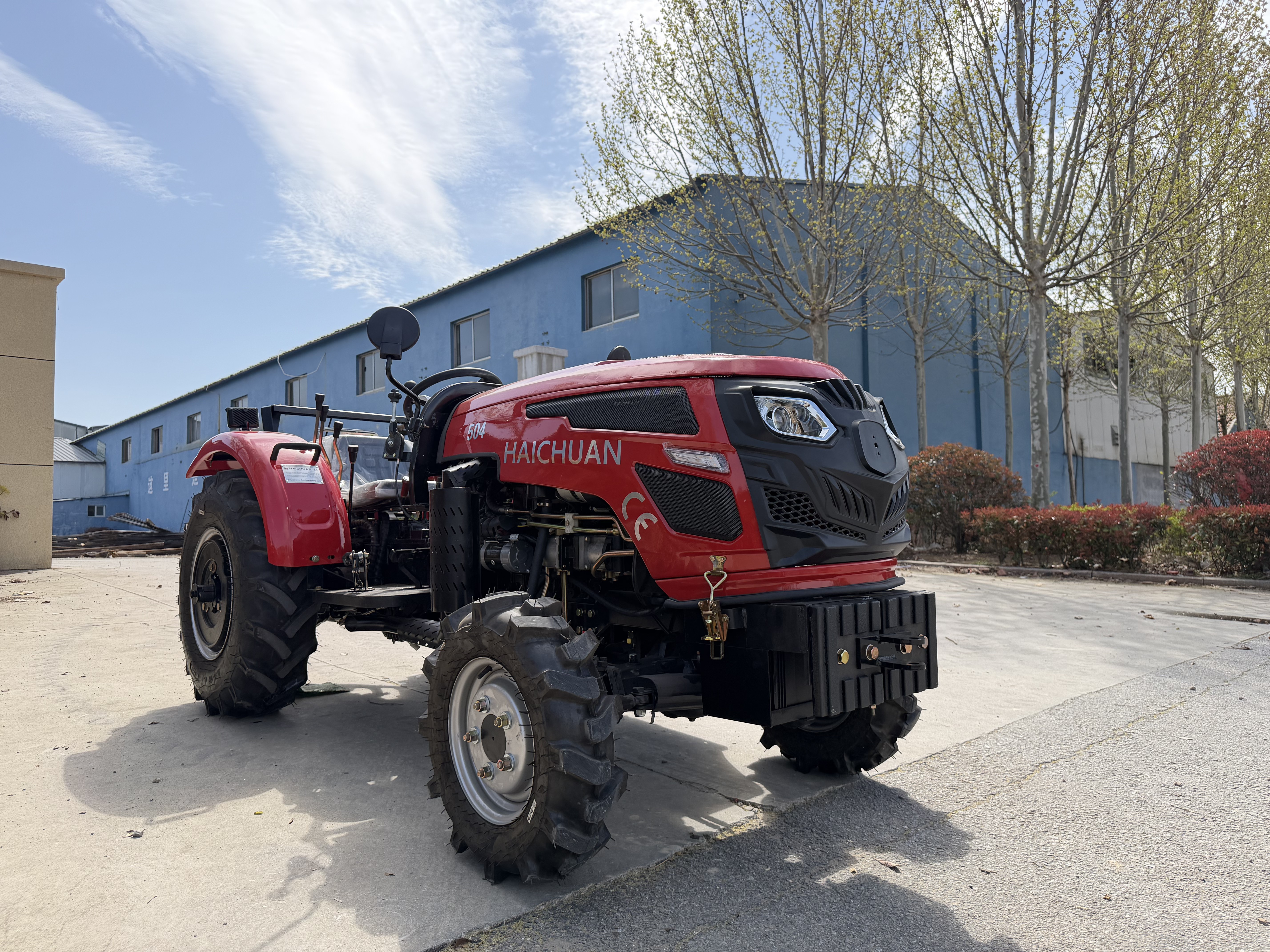
Almost every electric tractor on the market is LFP. Over in China, Weifang Haichuan Heavy Industry is pushin' hard into pure electric, and they're deep in the LFP game. Their electric tractor lineup runs LFP battery packs with IP67 sealing, engineered for zero‑below cold starts and high‑temp field days, with a dual‑motor setup that splits drive and PTO power so each runs at its own best efficiency. They're attackin' mid‑range fieldwork—orchards, pastures, greenhouses—with a whole product ladder from compact 25‑horse models up through bigger 50‑horse electric rigs that can act as mobile power stations in the field, chargin' drones and handheld electric tools right off the tractor's battery. Haichuan's play is the same core logic as the big names: use the motor's instant torque to make the machine feel alive, strip complexity out of the drivetrain, and let the battery double as a jobsite energy hub.
Out in the West, John Deere's SESAM concept and E‑Power prototype carry high‑capacity lithium packs from Kreisel, with SESAM packin' around 150 kWh—LFP‑based but still in prototype stage.
What Does a Battery Pack Actually Look Like? – Not a Brick, a Whole System
Folks picture a battery as one big steel brick where the engine used to sit. Reality is way more layers:
Cell: The smallest unit. Multiple cells get bundled into a module.
Module: Cells plus structural frame and cooling plates.
Battery Pack: Multiple modules sealed inside a dust‑tight, waterproof shell. Haichuan's packs hit IP67—total dust protection, can sit a meter underwater for half an hour and stay dry. That means a sudden thunderstorm or workin' in flooded mud won't kill your pack.
Battery Management System (BMS): The brain. Watches every single cell's voltage, temperature, and current in real time, blocks overcharge, over‑discharge, overheating. When a pack catches fire, nine times out of ten the BMS failed its job.
Thermal management is just as critical. Batteries heat up when they discharge—current pushin' through internal resistance turns some energy straight to heat. LFP likes 15‑35°C. Freezin' winter morning, the electrolyte gets sludgy, lithium ions move slow, and your usable capacity tanks. Blazin' summer noon, the battery ages faster and risks thermal runaway. So you need active thermal management. Haichuan's electric tractors are built to run stable in ‑20°C cold, which means they got battery heaters and cooling loops keepin' the pack in its happy zone year‑round.
Batteries keep improvin', but one physics fact still stands: diesel's energy density is around 12 kWh/kg. The best LFP today is 0.15‑0.18 kWh/kg. That's a 70‑80x gap. The energy stored in carbon‑hydrogen chemical bonds is just fundamentally denser than the energy stored by lithium ions shuttlin' in and out of a crystal lattice.
A 100‑horsepower tractor deep‑plowin' burns about 80‑90 kWh of axle power per hour. Eight to ten hours a day means 640‑900 kWh total. Diesel: a 200‑liter tank (around 2000 kWh of energy) gets you through 6‑8 hours easy. Battery: at 160 Wh/kg, a 640‑900 kWh pack weighs 4 to 5.6 metric tons. That's already the weight of the whole tractor itself. And that 5 tons of battery is crushin' your soil—soil compaction is the silent yield killer, blockin' air and water from roots. Plus, draggin' all that extra weight around burns more energy just to move the tractor, which means you need even more battery. It's a nasty loop.
So for now, pure electric tractors cluster between 25 and 130 horsepower. Heavy deep‑tillage electrification is waitin' on solid‑state batteries to maybe break the 400‑500 Wh/kg barrier, but that's still 5‑10 years from showroom floors.
Diesel fills up in three minutes. Batteries take hours. The physics again: fillin' a tank is just movin' liquid—energy already packed in chemical bonds, pump does the work. Chargin' is an electrochemical reaction—lithium ions gotta physically shuttle through electrolyte and intercalate into the anode. Rush it too hard, the battery heats up, plates lithium metal, or catches fire.
Typical pure electric tractor fast‑charges from 20% to 80% in around 40‑45 minutes. But in the middle of a field, there ain't no fast charger, and the rural grid usually can't push the 50‑100 kW those chargers pull.
Workarounds in play: battery swap (Deere's SESAM had a quick‑swap system, but you need standardized packs across brands); machine‑to‑machine charging (Haichuan's electric tractors can act as mobile power banks, chargin' drones and electric shears right in the field, makin' a whole electric work chain); solar self‑generation (Fendt talks about farms makin' their own green power via rooftop solar to charge the tractor, closin' the carbon loop). All still niche, none at scale yet.
We spent five whole modules on clutches, gearboxes, differentials—the beautiful precision of the mechanical age. On a pure electric platform, the whole picture shifts:
Gearbox gets massively simplified or just deleted. The motor's speed range is huge and it makes max torque at zero. No need for six, twelve gears to translate a narrow diesel band. A simple two‑speed AMT or no gearbox at all is plenty.
Clutch basically vanishes. No half‑clutch slippin' needed. Pedal controls torque directly, naturally smooth.
Differential can be replaced by electronic diff. Put a separate hub motor on each wheel, run an algorithm, and you get millisecond‑level speed difference control—no physical differential gears needed.
PTO gets its own independent motor. Traditional PTO power snakes all the way from the engine through clutch, gearbox, shafts—long path, big losses. Pure electric just puts a dedicated motor on the PTO. Spins when you want, stops when you want, totally decoupled from the drive motor.
The whole tractor becomes a mobile power station. A diesel tractor makes mechanical power—shafts and gears. Hard to use for anything else. An electric tractor makes electrical power—not only drives the wheels and PTO, but can directly feed electricity to drones, electric shears, water pumps, lights. It's a rolling jobsite energy hub.
This is why pure electric ain't just "swap engine for motor." It's a ground‑up rebuild of the whole power architecture.
Hydrogen fuel cells are still an electric drive at heart, just without the heavy battery. Simple chemistry: hydrogen gas meets oxygen from air inside the fuel cell stack, electrochemical reaction makes electricity and water. Electricity runs the motor, water is the only tailpipe emission. You get the drive quality and zero emissions of pure electric, plus way higher energy density than a battery, and refuelin' as fast as diesel.
But farm use hits three walls. One, hydrogen is expensive. The cheapest "grey hydrogen" comes from natural gas—still pumps out carbon, misses the clean point. True zero‑carbon "green hydrogen" from renewable electrolysis costs 3‑5 times more. Two, storing hydrogen is a pain. Hydrogen at room temp is a super‑light gas; to store useful amounts on a machine, you gotta compress it to 700 bar (700 times atmospheric pressure). The tanks are big, heavy, and pricey. Three, zero fueling stations. Building out hydrogen production, transport, storage, and pumps in rural areas is a money pit with no bottom.
New Holland's T6 Methane Power tractor burns biomethane captured from ag waste—combustion, not fuel cells—a practical bridge that uses existing engine tech. Hydrogen fuel cells in ag are still in the test phase. Heavy trucks might get there first.
So let's park on the field bank and run this down.
Diesel's got three bullet holes—efficiency capped by physics, exhaust cleanup gettin' too expensive, and control way too crude for what modern ag demands. Three electric roads are open, and each has picked its lane.
Hybrid lets diesel and electric motor share the load. Parallel and series‑parallel lead the way, keepin' diesel's energy density and highway efficiency while dumpin' the jobs diesel hates onto the motor. It's the most practical bridge for heavy fieldwork right now.
Pure electric throws the diesel and the whole drivetrain out the window. Torque behavior is naturally superior, the drive feel is silk, maintenance drops hard, and it's born ready for smart controls. But battery energy density and charge speed are still the iron gate—for now it lives in mid‑size pastures, orchards, greenhouses, and light municipal work. When solid‑state or next‑gen batteries break through, pure electric walkin' from small horses to big horses is just a matter of time.
Hydrogen looks perfect on paper—dense energy, fast refill, clean exhaust—but hydrogen cost and the near‑zero refueling infrastructure keep it in the lab for ag. Burnin' biomethane in a regular engine might be the smarter first step


Whats the PTO ?
Yo, check it, chief engineer! Last chapter we gave this iron bull a set of hydraulic arms—strong enough to lift a heavy plow like it's a bag of feathers, smart enough to feel the dirt and keep the depth right. Now she can carry implements on her back. But some tools ain't just about bein' carried. A rotary tiller got blades that gotta spin fast to slice soil. A mower's disc gotta whirl to cut grass. A seed drill's plate gotta turn steady to drop seeds. A baler's gotta pack straw into tight squares. A harvester's drum, fan, and header all gotta spin. These implements got their own working guts inside, but they don't make their own power. They need a blood transfusion from the tractor.
That's where one of the most magical shafts on a tractor comes in—the Power Take‑Off, the PTO. The name says it all: Power, Take, Off. You takin' the engine's power and handin' it over to the implement hangin' off the back or the front. Think of it as a spinnin' iron finger stickin' out the tractor's rear end, just whirlin' and whirlin', ready to push whatever hooks up to it.
Before we dive into the tech, let's spend two minutes seein' where this shaft came from. This story is a perfect picture of "necessity kicks the door open."
Back in 1905, a Frenchman named Albert Gougis built his own tractor. He hit a headache: how do you make the baler's knotter mechanism spin while the tractor is pullin' the baler forward? His fix was rough but it worked—he ran a chain off the engine crankshaft, through some universal joints, back to the baler, with a separate clutch controllin' it. That meant even when the tractor stopped, the baler could keep workin'. Think about that—1905, cars were still a rare sight, and this French brother was already figurin' out how to let a tractor "power" an implement while rollin'.
Around 1906, engineers from International Harvester over in America took a trip to France, saw Gougis' setup, and somethin' clicked in their heads: "We need that." But between the idea and reality, time had to pass.
Finally, in 1918, IH put the first real PTOs on their 8‑16 model—only 50 of 'em. The designer was their chief engineer, Edward A. Johnston, so folks later called him the father of the modern PTO. By 1921, you could special‑order a PTO on models like the 15‑30, and by 1922 it became standard on some.
Everything else followed natural. In 1925, floods hit rice crops in the southern US, and PTO‑driven rescue equipment saved the day—the whole industry saw what this thing could do. Right after, in 1926, the American Society of Agricultural Engineers (ASAE) locked in 540 RPM as the first standard PTO speed. From that year on, every rotary implement in the world—no matter who built it—had to match 540. You cannot overstate how big that was. Without that standard, a John Deere tractor might not spin a New Holland mower. The whole ag world would be a pile of iron that don't fit together.
Later, in the 1950s, IH came through again with the independent PTO—now the PTO didn't need the main clutch no more. Stop the tractor to shift, the implement keeps hummin'. Then, as bigger implements demanded more, engineers added a second standard: 1000 RPM, for them big hungry beasts. From a chain and a few U‑joints to today's electro‑hydraulic independent PTO—this road took over a hundred years.
A shaft stickin' out the back of the tractor, reachin' into the implement. It's a splined steel bar wrapped in a safety shield, spinnin' fast.
How fast? Almost every tractor PTO's got two standard speeds: 540 RPM and 1000 RPM. These numbers ain't random—ASAE nailed down 540 back in 1926, and 1000 came later when big‑power equipment showed up. These days, many tractors run a dual‑speed PTO, switchable between the two.
What's the difference? Let me put it on a bicycle for you.
540 RPM is like your low gear on a hill climb—pedals spin fast but the rear wheel turns slow, packed with torque. It's for mid‑size tractors runnin' rotary tillers, mowers, smaller harvesters. The shaft end has 6 rectangular splines, and the shaft diameter is 35 millimeters.
1000 RPM is your high cruising gear on flat ground—pedals ain't churnin' as hard but the wheel flies. That's for big‑horsepower tractors and them power‑eatin' monsters—heavy‑duty power harrows, wide rotary tillers, silage harvesters. The 1000‑speed shaft end has 21 involute splines, much finer than the 540.
When you explain it to a customer, one line makes it click: "540 is heavy work, low speed. 1000 is light work, high speed. You run a mower? 540. You run a big silage harvester? 1000."
Some tractors also have a 540E (economy) mode—the engine hits 540 PTO speed at a lower engine RPM, so on light jobs you save fuel, sometimes 20 to 30 percent less. Like ridin' a multi‑speed bike—same speed, higher gear takes less effort.
The most common spot is out the tractor's back, called a rear PTO. Most implements—tillers, mowers, spreaders, balers—hang off the back, so rear PTO is standard equipment. Squat down behind any tractor, you'll see that splined shaft starin' back at you.
Big tractors often stick another one up front—a front PTO. The beauty there is combination work: front‑mounted mower, rear‑mounted baler, one pass through the field, cuttin' and balin' at the same time, double the output. Snowblowers and sweepers that need to run off the front also use it. The front PTO shaft end is different—usually 6 splines, 1000 RPM.
Some smaller tractors got a PTO on the side—a side‑mounted PTO—mainly for stationary work like drivin' a water pump or a feed grinder.
Picture it: a big tractor, rear tiller spinnin', front mower mowin', side PTO pumpin' water—three PTOs workin' at once. One machine doin' the job of a whole crew. That's why they call a tractor the "universal power unit."
PTO control comes in three flavors, and they represent three leaps from clumsy to slick.
Non‑independent PTO is the oldest, simplest. One sentence nails it: tractor moves, PTO spins; tractor stops, PTO stops. The power is tapped right after the main clutch and before the gearbox, tied tight to the tractor's movement. Like ridin' a bike—feet stop, wheel stops. The big headache? You get to the headland, gotta stop and turn—the PTO cuts out. Tiller blades stop, spreader disc stops. Turn around, start again, and that patch in the middle got missed. Mostly gone now, only some small‑horsepower machines still use it.
Semi‑independent PTO is one step smarter. It uses the dual‑stage clutch (remember that "double buckle" from the clutch chapter?) to split control. Push the clutch pedal halfway—only the drive wheels disconnect; the PTO keeps spinnin'. Tractor stops, tiller's still chewin'. Push the pedal all the way to the floor—then the PTO stops. Like a bike with two separate brakes, front and rear, each mindin' its own business.
Independent PTO is the boss level. Its power doesn't go through the main clutch at all. It takes a dedicated path straight from the engine, with its own clutch—usually a wet multi‑disc pack bathin' in oil—controlled by its own button or lever. What that means? Startin', stoppin', shiftin', reversin' the tractor—the PTO don't care, it spins right on. Or you can kill the PTO and keep the tractor rollin'—finish mowin' a field, shut off the mower, and drive to the next field without the mower runnin' dry. These days, big tractors use electro‑hydraulic independent PTO. Driver taps a button, the hydraulic brain handles everything.
One line to lock all three: non‑independent—tractor stops, PTO stops; semi‑independent—tractor stops, PTO can still run, but you gotta start the PTO before you take off; independent—each minds its own business, no draggin' each other down.
How fierce is a spinnin' PTO? 540 RPM—that's 9 turns every second. A steel bar the thickness of your finger sweepin' past your face nine times a second—you can't even see it, just a blur. If a sleeve, a glove thread, long hair gets caught—you don't wanna think about it.
So PTO guarding is some of the strictest safety rules in all of ag machinery. International standards run the show: Europe's EN 12965:2019 details the design and build of PTO driveshafts and their guards. ISO 500‑1:2014 sets dimensions, safety, and master shield size for rear‑mounted PTOs. ISO 5674:2024? That one's about testin' the guard's strength and wear resistance—your guard better survive the torture lab, no crackin', no wearin' through on impact.
A proper PTO system's got three layers of safety:
First layer: Master shield. That big metal or hard plastic shell right where the PTO shaft comes out of the tractor—covers the root completely so you can't touch the spinnin' stub from above, left, or right. Stand behind the tractor, you normally can't even see the connection point—the master shield hides that danger spot.
Second layer: Driveline guard tube. The PTO driveshaft is wrapped in a plastic tube—corrugated or smooth—that spins freely. It ain't soft plastic you can crush with your hand; ISO 5674 tests it for impact, wear, and weather‑aging. Even if you lean against it, that guard tube don't spin with the shaft, cuttin' the risk way down.
Third layer: U‑joint shields on both ends. At each end where the driveshaft meets the U‑joint, there's a bowl‑shaped guard coverin' the spinnin' yoke—same tough plastic, same requirement to handle shock and wear.
One big thing: guards ain't install‑and‑forget. Sun, rain, mud, dust, friction—the guard tube ages, cracks. Once it cracks, it can't isolate the spinnin' shaft no more. You gotta swap it out.
We talked U‑joints back in the differential chapter—now they show up again in the PTO system, doin' the exact same job.
The tractor and implement ain't connected by a straight iron bar. When the tractor turns, the implement turns too—suddenly them shafts got an angle. Plus, the implement rides up and down on the three‑point hitch, so distance and height keep changin'. So a PTO driveshaft's got a cross‑type universal joint at each end, and a telescoping splined sleeve in the middle.
This setup works just like the main driveshaft: U‑joints handle the angle changes, the splined sleeve handles the length changes. No matter how the tractor turns, the implement lifts, or the ground bounces, that PTO shaft keeps spinnin' smooth, handin' power right into the implement's guts. In the PTO world, shaft spline choice, U‑joint angle limits, safety guards—all under tight standards—because this shaft is the most exposed, most visible high‑speed spinnin' part on the whole tractor.
The three‑point hitch can carry implements; the PTO can drive 'em. But some implements don't need carryin' or drivin'—they just need to be dragged, like trailers, wide pull‑type seeders, heavy disc harrows.
That's where the oldest, simplest connection on a tractor comes in—the drawbar.
It's a thick horizontal steel bar stickin' out the back, with a hole in it. You drop a pin through the hole and through the implement's tongue, and you're hooked. No hydraulic cylinders, no sensors—pure mechanical steel. Back in the day, tractors had no three‑point hitch; everything was pulled off the drawbar.
Two main types:
Fixed drawbar: The bar don't swing side‑to‑side. Simplest, toughest, great for pullin' a trailer down the road. But it's got a clear weakness: limited up‑and‑down swing. Hit big rolling ground—like crossin' a field ridge—and that rigid bar can bind up. Like pushin' a box over a threshold with a stiff rod—both ends get jammed.
Swinging drawbar: The bar can swing left and right through a small arc, and some adjust up and down. Big advantage: tighter turns, more flexible hookup, and it gives in all directions so rough ground don't fight it. Better for fieldwork—pullin' wide seeders, heavy disc harrows that need room to turn. But it's more complex to build and needs tighter tolerances.
General rule: big tractors run a swingin' drawbar, small and mid‑size run fixed. Horses for courses.
Aight, chief engineer, let's squat down and run it back.
If the hydraulic hitch gave the iron bull a muscle arm, then the PTO taught it how to send its soul outside its body—pushin' the heartbeat of the engine through a high‑speed spinnin' shaft into a dead iron implement and bringin' it alive.
The PTO's journey—from one Frenchman's chain and U‑joint idea in 1905, to the ASAE lockin' 540 RPM as a global standard in 1926, from the clumsy "tractor stops, PTO stops" days to today's electro‑hydraulic independent control—took over a hundred years.
Today you see tiller blades chewin' soil, spreader discs flingin' fertilizer even, balers packin' straw into tight blocks, harvester drums shellin' corn clean—behind every single workin' implement, there's a PTO shaft you can't even see, spinnin' steady, silent, nonstop. It don't rest, don't slack, don't complain. Long as the engine's turnin', it delivers every bit of that power.
From the drivetrain's clutch, through the gearbox's trainin', the U‑joints' bendin', the differential's clever splittin', then locked tight on the three‑point hitch and brought to life by the PTO—that's when a tractor truly becomes the "universal machine" in the field.
Next , we steppin' outta diesel and gearboxes to look at the iron bull's future—electrification, smart tech—swappin' this hundred‑year machine a brand‑new heart. Keep walkin' that field bank with me!


The Iron Bull's Mighty Arm
Yo, chief engineer! We done built the whole runnin' gear—chassis, brakes, steerin', transmission. This tractor can roll, turn, stop on a dime. But right now? She's a naked bull. Can't do no fieldwork. We gotta make her carry the heavy stuff—plows, harrows, tillers, seeders—strapped to her back or dragged behind, and she gotta lift 'em, drop 'em, finesse 'em like you usin' your own arm.
That's where the tractor's one‑of‑a‑kind magic comes in: the hydraulic hitch system. Today we crackin' it wide open, see how this iron bull grows muscles and smart hands.
You might be like, "Man, why don't you just tie a rope to the plow and pull it?" Bruh, if it was that easy, granddaddy woulda never needed a mule. Haulin' a plow through dirt is a whole different beast from pullin' a wagon.
First, diggin' in and liftin' out: The plow gotta bite into the ground, and it gotta pull out clean. At the end of the row, you gotta hoist that whole rig up in the air just to turn around. If you don't, you draggin' a heavy steel blade sideways through the soil, carvin' a trench you didn't ask for.
Second, keepin' the depth steady: Under that dirt, it ain't all the same. Hit a hard patch, the plow rides up like it's hittin' a speed bump—too shallow. Hit a soft sand pocket, the plow nose‑dives like it's fallin' through a trapdoor—too deep, and the engine chokes. You need somethin' that feels that change instantly and adjusts on the fly.
Third, you need brute strength: A moldboard plow bitin' through soil can grab over a hundred kilos of resistance. You think a driver's arm gonna lift that? That's like a toddler tryin' to bench‑press a fridge. You need a hidden giant hand that tosses heavy implements around like toys.
A rope and a couple strong farmhands can't handle that mess. But a good hydraulic hitch? With a few iron rods and some oil, it does the job so smooth it's like a magic trick.
Remember Pascal's Law from the brake chapter? Sealed fluid, pressure same everywhere, small force turns into big force. The hydraulic hitch uses the same "oil‑powered muscle."
This muscle crew got three main homies:
Hydraulic Pump: Engine spins it, it sucks oil from the tank, pressurizes it, and shoves it out. Think of it as the heart, or better yet, a bicycle pump—but instead of air, it's pushin' oil, and it just keeps pumpin' and pumpin'.
Hydraulic Cylinder: This right here is the actual arm. A thick steel tube with a big piston inside, and a rod stickin' out. When that high‑pressure oil rushes in, the piston gets shoved out smooth and strong—liftin' thousands of pounds like it's nothin'. Picture a giant syringe: you push water in the back, the plunger slides forward. Except this syringe is the size of your leg and strong enough to lift a truck.
Control Valve: This is the brain and the switch. It decides where that high‑pressure oil goes—send it to the cylinder to lift the implement, let it drain back so the implement drops by gravity, or lock the oil path so the implement hangs there in the air, frozen. It's just like your shower faucet: twist left for hot, twist right for cold, shut it off in the middle. The valve routes the oil.
These three workin' together, the driver just flicks a little lever with one finger. The valve shifts, high‑pressure oil screams into the cylinder, and that heavy plow floats up in the air light as a feather—easier than pickin' up a pair of chopsticks.
Hydraulics is the muscle, but how you gonna hang the implement so it's stable and clever? That's the three‑point hitch. This is the most classic tractor design ever—simple like usin' three fingers to pinch and hold a tool steady.
Walk around to the back of the tractor, you'll see two thick iron arms (the lower links) stickin' out from both sides of the rear axle, and a third arm in the middle up top (the top link). These three points form an upside‑down triangle:
Two lower links: Hook to the implement's left and right bottom. They handle the pullin' and the liftin'. The hydraulic cylinder pushes right on these arms to raise 'em or lower 'em.
One top link: Hooks to the very top of the implement, length adjustable. Its job? Keep the implement's posture steady—no rockin' back and forth, no floppin' around.
Once you lock those three points, the implement is strapped to the tractor like it grew there. No wigglin' side to side, no flippin' over. And that triangle shape? Super stable. You ever seen a camera tripod? Three legs spread out, the camera don't move a hair. Three‑point hitch is the same deal.
Even slicker: the three‑point hitch shoves the weight of the implement and the plowin' resistance right onto the tractor's rear wheels. That's like free extra weight pushin' them tires down for more grip. It's like when you push a heavy wheelbarrow—you lean forward, plant your body weight on the handles, and suddenly you got traction. So when the plow's on, the rear tires bite harder into the dirt, and slippin' becomes way less of a problem.
Now we got strength, we got a solid hookup. The hardest job left: how you control the depth of the plow?
Say you gotta plow a field at 30 centimeters deep. If the ground was flat as a table, you'd just drop the implement to 30 cm, lock the height, and cruise. But real dirt got roots, rocks, hard clay, sand pockets. The implement's height gotta follow the ground and the resistance second by second, or it'll either pop out of the ground or dive in and choke the engine.
The soul of the hydraulic hitch lives in two completely different kinds of smart: Draft Control and Position Control. Let's use a couple everyday scenes to nail it down.
Draft control cares about resistance. It don't care what height the implement is at—it only cares how much muscle that implement is eatin' up in the dirt.
Picture this: you pushin' a walk‑behind lawnmower across the grass. When the grass is short, it's light and easy. Suddenly you hit a thick, tall patch, and the mower bogs down—you feel it pushin' back hard. What's your gut reaction? You instinctively lift the mower just a little, so the blade takes a smaller bite and you can keep movin'. Once you're past the thick spot and it gets light again, you ease it back down.
That's exactly what draft control does. A sensor "feels" the resistance on the implement. When the plow hits hard dirt, resistance spikes—that signal races to the control valve, and the system lifts the plow a tiny bit (shallowin' the cut) so the engine don't overload and stall. Once you're past the hard patch and resistance drops, the system lowers the plow right back down to keep your target depth.
The whole time, the driver's hand ain't movin'. The hydraulics act like an arm with a sense of touch, micro‑adjustin' up and down based on the "feel" in the dirt. You'll hear the engine hummin' steady, and the field comes out even—depth might dance a centimeter or two, but overall it's consistent, and the machine stays protected.
One line to lock it in your head: Draft control works by muscle. Resistance goes up, I lift a bit. Resistance drops, I press a bit.
Position control cares about height. It don't care if the dirt's soft or hard—all it cares is exactly how high the implement is, and it locks it there like a pit bull.
Think of an elevator. You press the button for the 3rd floor, that elevator parks at the 3rd floor. Don't matter if ten people step in (more weight, more resistance)—it stays glued to that spot. You press 1, it goes to 1. The height is absolute.
Out in the field, say you ain't pullin' a plow—you got a rotary tiller on the back. The tiller blades spin fast and slice the soil; you don't need resistance feel, but you gotta keep the cuttin' depth exact, so every pass the soil is tilled the same thickness. You just set a height on the panel (say, drop 15 centimeters), the system lowers the tiller to that exact spot, and locks the oil. Hard dirt, soft dirt, don't matter—that tiller hangs at that exact height and chews through it. The upside is precision. The downside? It don't protect the engine like draft control—hit a super hard spot, the tiller just plows through and might overload.
One line: Position control works by the ruler. I said 15 centimeters, you get 15 centimeters, no matter what.
Nowadays, high‑end tractors ain't makin' you choose. Electronic Hydraulic Control (EHR) blends both together: you set a target depth, and you set a max resistance limit. Normally, it runs precise position control. But if resistance jumps past your red line, the computer instantly switches into draft control mode, lifts the implement just a hair to save the engine. Once resistance drops, it slides right back to precision position mode. It's like hirin' an old‑timer farmer who watches the plow and the ox at the same time.
For example, John Deere's EHR system shows you slip rate, depth, and resistance right on the screen in real time, and the driver tweaks it with a dial next to the armrest. And over in Weifang, Haichuan Heavy Industry puts electro‑hydraulic lift systems on some of their bigger tractors—force‑and‑position combined control, set depth and sensitivity by pushin' buttons. For you folks in export, when you're demo‑in' to a customer, you don't gotta yank mechanical levers and explain complex feedback. One screen does all the talkin'.
Aight, chief engineer, let's squat at the edge of the field and run this back.
The tractor can carry heavy implements and do real farm work not by brute force, but by hydraulic finesse and that three‑point hitch stability. The muscle team—pump, valve, cylinder—lets the driver lift a thousand pounds with one finger. The three‑point hitch hugs the implement tight and shoves extra weight onto the rear wheels for grip. And draft control and position control? One works by feel, dodgin' trouble and savin' the engine; the other works by the ruler, holdin' depth exact for clean work. Together they give the iron bull smarts and strength.
One little lever, a few iron arms, a belly full of hydraulic oil—and this machine grows a powerful arm with touch, judgment, and explosive lift.
Next chapter, we gonna plug in an "external power outlet" for this iron bull—the Power Take‑Off (PTO). While she's carryin' implements, she'll also spin their blades, chains, and fans with her own heartbeat. We're makin' the whole machine come alive! Keep walkin' that field bank with me!

Latest News
Official information, learn about the latest developments of SHANGLONG.
Contact With Us
Please enter what you want to find
Send Your Inquiry Today
*We respect your confidentiality and all information are protected.