

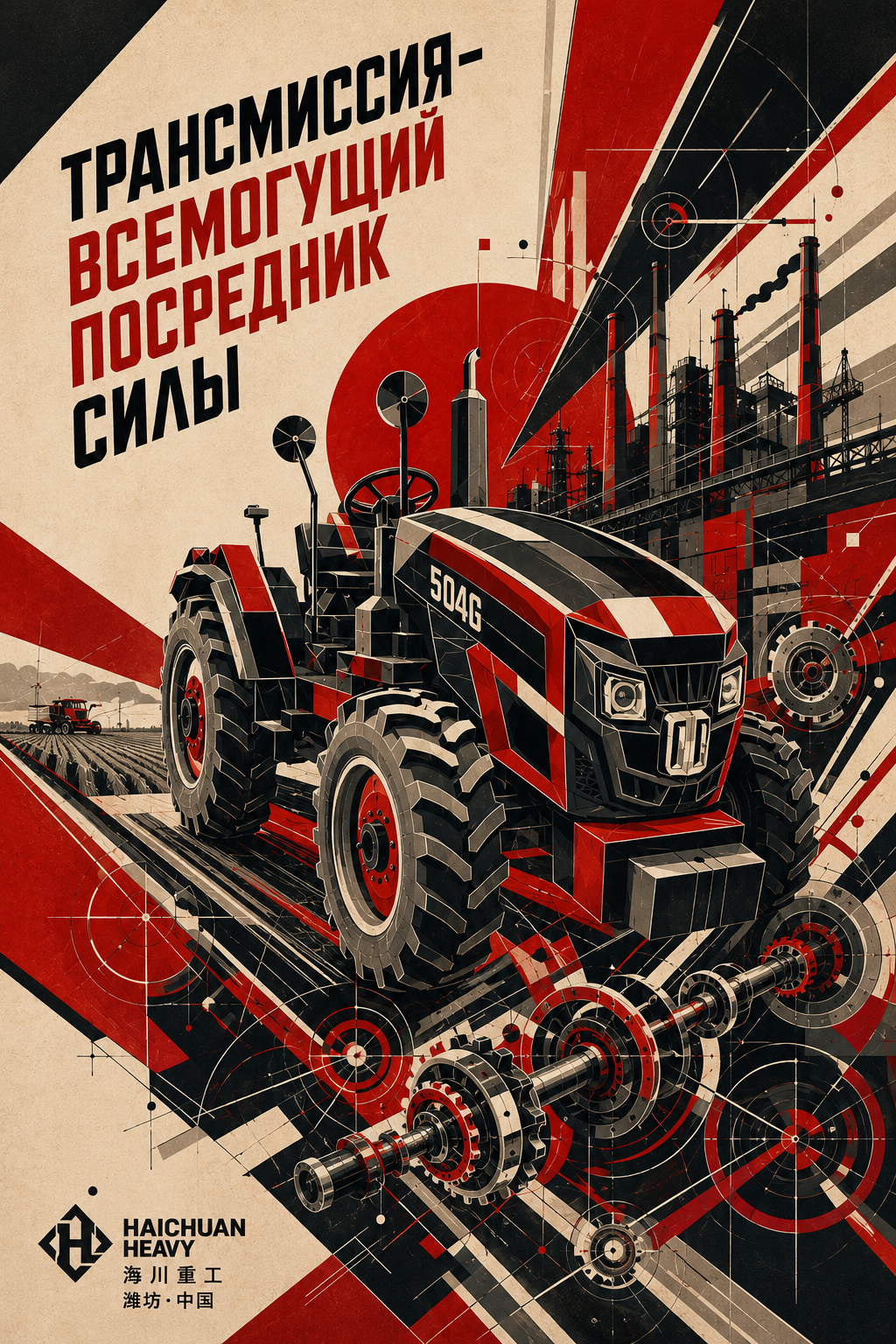
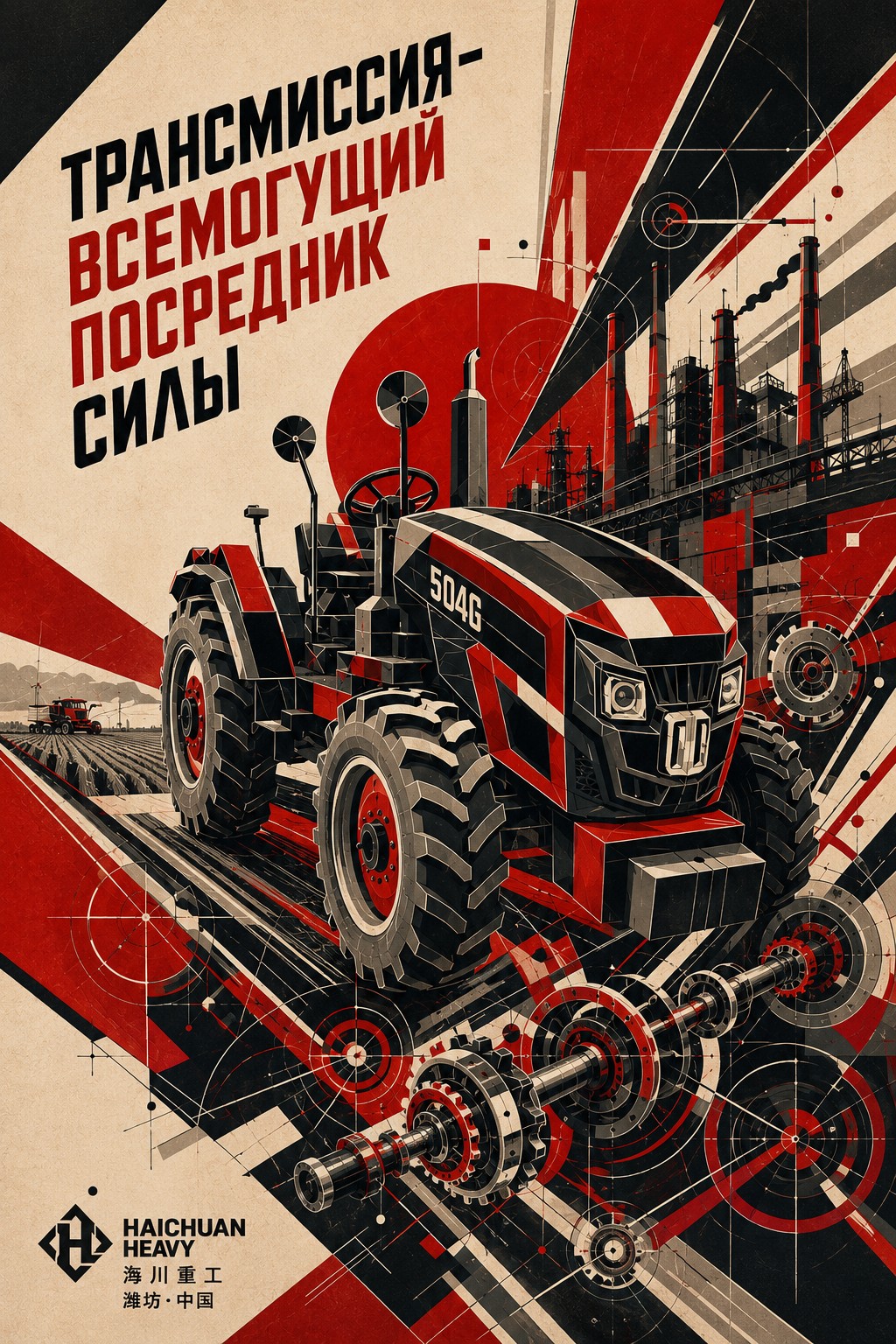
 Why We Need a Middleman – Drivetrain Overview
Why We Need a Middleman – Drivetrain Overview
Yo, check it out, chief engineer. We got this diesel engine rumblin' like a beast, and four big ol' tractor wheels with brakes and suspension all hooked up. You might be thinkin', "Man, this easy! Just grab a solid iron shaft, weld one end to the engine and the other to the wheels, done deal!"
But let me tell you somethin'—if you actually do that, the second you fire up this tractor, she gonna act like a stubborn mule that just got whipped. Either she choke and die with a clank, or she shoot off like a rocket and kiss a wall.
Why that happen? Today we gon' break down this "middleman"—the transmission system—and get all the way into the dirt with it, you feel me?
4.1.1 The Engine's "Attitude": A Strongman That's Real Picky
To get why we need a transmission, first we gotta understand this diesel engine's attitude. You think it's like a water buffalo that just pulls steady? Nah, brother, you way off.
You ever see them kids' toy bamboo dragonflies? You twist up a rubber band, let go, and that propeller goes vroom for a hot second—strong, but only for a blink. A diesel engine kinda like that, except it can keep goin'. But here's the problem: it's only strong like a bull when it's spinnin' fast and happy. The moment you slow it down, it turns into a weak kitten, can't even stand up, and just gives up the ghost on you.
Let's take this tractor out to the field and see what kinda headaches we run into:
Scene One: Loaded Start. You got a whole trailer full of corn hooked up, tires squished down, sittin' still on soft dirt at the edge of the field. The engine is sittin' there goin' putt-putt-putt at idle—it's gotta spin at least six, seven hundred RPM (that's the idle speed), or else it'll choke out. But the thing is, at idle, its strength is pitiful, ain't much more than a kitten scratchin'. You think you can drag a whole load of corn with that? Forget about it! So what you gon' do?
Scene Two: Steep Climb. Aight, you finally got that trailer rockin', cruisin' along the field ridge, and BAM—a big ol' irrigation slope hits you. Wheels push against it, and the resistance comes on like a wall. The engine starts strugglin', chug-chug-chug, RPMs droppin'. And here's the messed-up part: this diesel got a nasty attitude—when the RPMs drop, its strength don't pick up, it actually drops too! Less strength, RPMs drop faster—it's a death spiral, man! Couple seconds later, she coughs and dies right there, leavin' you stuck on the slope.
Scene Three: Haulin' Down the Road. Aight, now you took the plow off, empty machine on a country cement road, engine screamin', feelin' good. But the engine's happy zone is real narrow—it likes hangin' around two thousand RPM. Push it higher, it sounds like it's gonna crack the water tank, drinks fuel like it's water, and shakes like it's comin' apart. But you just wanna cruise at twenty, thirty miles an hour—how you gonna do that without killin' the engine or draining the tank in three minutes?
See? The engine's a one-subject genius: it only works good in a tiny high-RPM lane, but our tractor gotta do everything from startin' in mud, pullin' loads up hills, to haulin' down the road—all kinds of conditions. That's the core problem right there.
This engine headache, really, it's a mismatch between the diesel's torque curve and what the wheels need. So how we fix it? One way is to make that engine push out big torque even at low RPMs—like how Fendt did with their "iD Low-Engine-Speed Concept." Regular diesels get their peak torque above 1500 RPM, but Fendt tuned theirs to have a rated speed of only 1700 RPM, with the sweet spot between 1100 and 1400—way lower. One model kicks out 1680 Newton-meters at just 1200 RPM. Pair that with their VarioDrive transmission, and you can creep from 0.02 kilometers per hour (that's slower than a snail crawlin') all the way to 50, stepless, without ever shiftin' gears. Engine don't gotta scream.
4.1.2 The Transmission's Three Field Chores
To solve this whole mess, the "middleman"—the transmission system—grabs a hoe and steps onto the field. On our tractor, it's got three main chores to handle:
Chore One: Slow Down, Torque Up – Turn "Fast and Weak" into "Slow and Strong"
This is the transmission's most basic farmhand skill. Let me hit you with a country kid's example:
You ever see the chain and sprockets on the back of a walk-behind tractor or a three-wheel farm truck? Up front you got a small sprocket, in back you got a big chainring. The little one spins a bunch of times for the big one to turn just once. But what you get in return? You push that little sprocket with one finger, and that big chainring can drag a whole sack of fertilizer!
That's "slow down, torque up." You take the engine's "spinnin' crazy fast but weak as a noodle" energy, run it through some gear combinations, and turn it into "slow and steady, strong as an ox" power at the wheels.
Same deal: engine spins fast (couple thousand RPM) but weak. The transmission and final drive in the drivetrain act like them sprockets—they "reduce" that high RPM down to low wheel RPM, and at the same time multiply that twistin' force (torque) by dozens of times. Suddenly that kitten scratch from the engine turns into iron bull strength that can rip through hard soil with a plow.
Now, how exactly does this reduction happen between gears? That's where the transmission "tech ladder" comes in. When you doin' foreign trade, the customer ain't gonna ask "how many horsepower" first—they gon' ask "what transmission config?" Because that right there decides the price and who you sellin' to.
Bottom rung: manual sliding gear transmission. You just slide gears back and forth to engage 'em. Simplest, cheapest, but you hear that grrrrind every time you shift—normal business. Step up: manual synchromesh transmission. It uses a synchronizer ring to match gear speeds before they engage, so shifts are way smoother—this is the workhorse in mid-low horsepower tractors globally. Next level: power shift. You don't even touch the clutch to shift; hydraulics do the switchin' for you, power never cuts out. When you deep plowin' and can't stop, that's real efficiency. Top shelf: CVT (Continuously Variable Transmission). Like turnin' the volume knob on a radio, it changes ratios smooth across the whole range, so the engine can just chill at its most fuel‑sippin' RPM.
Let me give you a concrete example: Haichuan Heavy Industry, out of Weifang, Shandong. They make four‑wheel‑drive tractors in the 45 to 200 horsepower range, and their transmission setups span from basic to mid‑range. Entry machines use an 8F+2R manual sliding gear transmission—simple, tough. Mid‑range models step up to synchromesh, so shift quality jumps. Some higher‑spec machines use a wet multi‑disc clutch with electro‑hydraulic proportional valve control to achieve power‑shift and power‑shuttle without breaking torque. Wet multi‑disc setups dissipate heat better and last longer than traditional dry single‑plate clutches, and the proportional valve automatically adjusts clutch engagement pressure based on load, so starts and shifts are smoother.
Chore Two: Park and Wait, Reverse to Unload – Let Her Rest and Back Up
The engine can't just stop whenever; if she dies, you out there with a crank handle sweatin'. But when you get to the end of the row, you gotta stop to load seed, unload fertilizer, right? Maybe stop on the field bank and shoot the breeze with the neighbor? You gonna keep your foot on the gas the whole time so she don't stall?
That's where the clutch in the transmission comes in like a superhero. Think of it like an "iron handshake" between the engine and the wheels. Normally, that handshake is tight, and power flows to the wheels. You stomp the clutch pedal, that handshake opens up—engine just sits there goin' putt-putt-putt mindin' its own business, wheels stay put. When you ready to roll, you ease off the clutch, that iron handshake gently grabs hold again, and the tractor pulls away smooth.
And get this: once a diesel starts, its crankshaft only spins one direction, like a one‑way street. Never gonna reverse itself. But you gotta back up to dump fertilizer, right? Turn around at the headland? Inside the transmission, they use a little gear called an idler gear to flip the output shaft's direction—without makin' the engine run backwards, the tractor just backs up obediently. A whole lot easier than teachin' an old ox to walk straight backwards, I'm tellin' you!
Now, that iron handshake—the clutch—looks simple, but there's tech inside. The clutch disc is a wear item, man; it gets thinner and thinner, and the pedal gets lower and lower. The driver gotta keep adjustin' to a changin' feel. How you fix that? There's a technology called self‑adjusting clutch. Inside the pressure plate, they pack a mechanical compensation mechanism. Every time the disc wears a tiny bit, the mechanism automatically takes up the slack, keepin' the perfect gap between the release bearing and the pressure plate. The result? Pedal height and effort stay almost the same through the whole life of the clutch. French company Valeo has this SAT (Self‑Adjusting Technology) across a lot of their agricultural clutch line, coverin' most European tractor models. It's purely mechanical compensation—no external hydraulics or electronics needed. When you talk to a customer, you can sum it up in one line: "Does the clutch pedal feel the same after a year of work as it did on day one?" A regular one sinks lower and lower; a self‑adjustin' one don't.
Chore Three: Differential Action – Let the Left and Right Wheels Do Their Own Thing
You ever notice when a tractor turns, the outside wheel draws a big ol' arc, the inside wheel draws a small one—the outside wheel travels way further. If the left and right wheels are welded together on a solid axle, they gotta spin the same speed. So when you turn, the inside wheel overshoots, the outside wheel can't keep up, and the tires scrub and scrape on the ground—eats tires like they're pancakes, wastes diesel, and might even twist the axle shaft till it snaps!
That's when a clever little device called the differential steps in (we'll tear that apart in a later chapter). It lets the left and right wheels "do their own thing" in a turn—one faster, one slower—no fightin', no tire scrubbin', so the tractor glides around the corner smooth. That's another key member of the transmission crew.
But the differential got a built‑in weakness: it's too fair. The moment one wheel loses grip—say the left wheel drops into mud and spins free, while the right sits on hard ground—the differential sends all the power to the slippin' wheel, lettin' it sling mud like crazy, while the wheel with actual traction gets nothin'. That's the "differential dilemma": when you need grip, it stabs you in the back.
How we bust that? Engineers came up with the differential lock. You hit that diff‑lock switch, and a pin goes clack, lockin' the left and right axle shafts together into one solid unit, forcin' both wheels to spin together. Now whichever wheel has grip, the power goes to the ground, and your tractor crawls out the mud. Once you free, you unlock it, and the differential goes back to its smooth‑turnin' self.
Traditional diff locks are manual: you see slippin', you reach for the switch, lock it; you free, you unlock it. But anybody who's ever been stuck knows, in the time between the wheel startin' to spin and you reactin' to hit that switch, you done dug a hole deep as a washbasin. So they invented automatic differential locks—sensors watch steerin' angle, speed, and hitch status, and the system decides itself when to lock and unlock. Straight line? Locked for max traction. Turn the wheel? It instantly unlocks so you corner smooth. Hit a certain speed? Unlocks to keep you safe. New Holland's TerraLock™ system runs exactly that logic—driver just drives, lockin' is all on the sensors and solenoid valves. When you talkin' to a customer about diff locks, you can ask 'em straight: "So, the ground y'all work on—does it get nasty?" If they say when the rains come, the fields turn to soup, then you can lay out that TerraLock logic. 'Cause it ain't about makin' you scramble for a switch; it's about not givin' you a chance to mess up in the first place. That right there is a real talkin' point.
4.1.3 Wrap It Up: The Transmission Is the "All‑Purpose Bossman" of Power
Aight, chief engineer, let's sit on the field bank, have a smoke, and sum this thing up.
The engine is a one‑trick pony—it only runs wild in a narrow, high‑RPM furrow, and that's the only place it got muscle. The tractor, though? She's an all‑around farmhand—gotta start from standstill in the mud, pull a plow deep, climb hills, haul on the road, and back up at the headland.
The transmission system is the all‑purpose bossman that connects the two, and he got three big enforcers under him:
Transmission (Gearbox): Handles "slow down, torque up," turns the engine's fast‑weak into the wheels' slow‑strong, and takes care of reverse.
Clutch: Handles the "soft connection," lets you cut or feed power anytime, start without stallin', and stop to chat without killin' the engine.
Differential: Handles "conflict resolution," lets left and right wheels spin different speeds, so turnin' don't fight or eat tires. Add the differential lock, and you can force 'em to sync when slippin', gettin' you unstuck.
Without these "middlemen," the engine is just a hunk of iron on a frame makin' noise. With 'em, the engine turns into a real iron bull that can haul heavy loads over hills, plow fields, and move back and forth just how you want.
Next time, we gon' tear into that first middleman—the clutch—and see how that "iron handshake" uses a hard connection to work like a soft switch. Anything you don't get, holler at me right here on the field bank!
→ How a Tractor Stops?
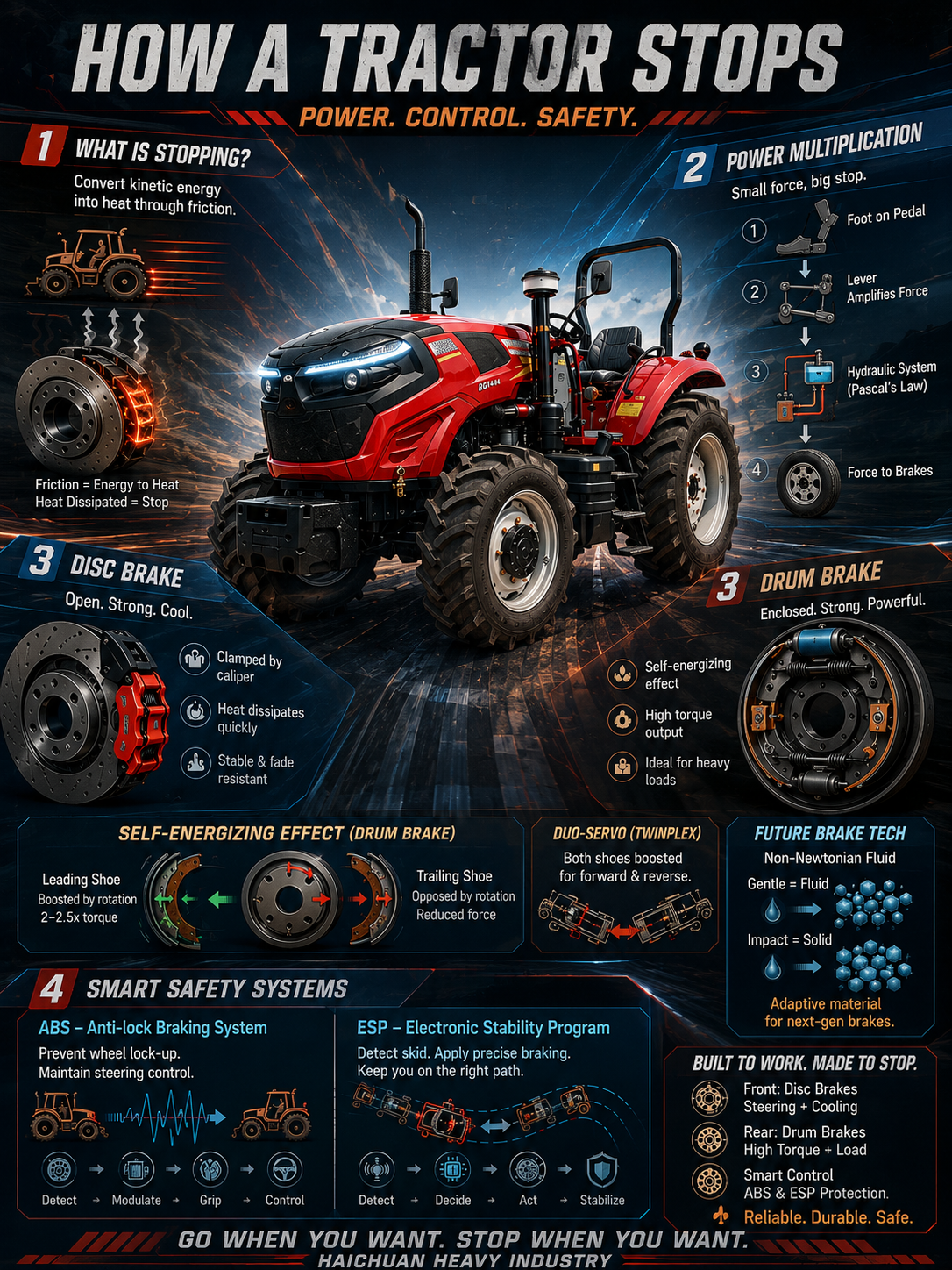
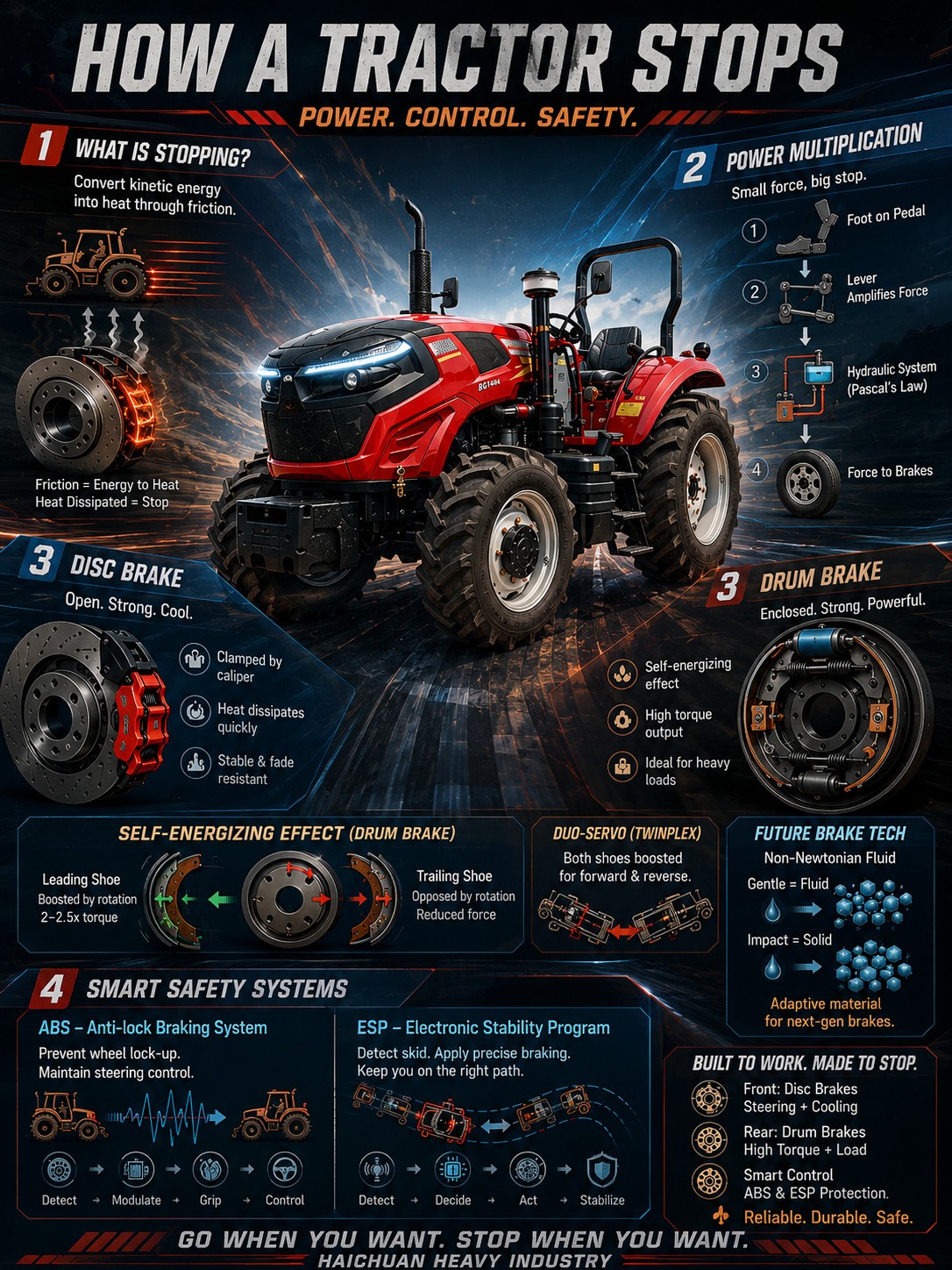
How a Tractor Stops?
Picture this, man. You on your bike, flyin' down a steep hill, wind in your eyes, and all you thinking is, "Stop! Stop right now!" So you grab them brake levers with your fingers and squeeze.
Look at that—just a light squeeze with two fingers, and that fast bike slows down smooth. That right there? That's a beautiful magic trick of force multiplication, brother.
Now, our tractor, she's hundreds of times bigger than that bike, and the "push" she got when she movin'—the momentum—is straight-up scary. But the idea is the exact same thing: the driver just press one pedal with his foot, and that heavy machine come to a smooth stop. The secret behind all that? The braking system. And today, we gonna open up that magic trick all the way, break it down piece by piece.
3.2.1 What "Stopping" Really Means: Fighting That "Go" Energy
First, we gotta understand what it means to stop a vehicle. Remember in Module 1 we talked about how a car moves? It's all about the friction the ground gives the tires. Now to stop, we gotta do the opposite: create a huge, backward-facing resistance to cancel out all that forward "wild energy" the machine built up.
That wild energy—physicists call it kinetic energy or inertia. And to make this big fella slow down nice and steady, we gotta find a way to burn off that energy quick. And the simplest, most boss way to do it? Friction.
You ever rub your hands together real fast? They get hot, right? That's friction making heat. So a vehicle's brake is like a super-efficient "kinetic-to-heat" converter machine. It takes that forward energy and—shooop—turns it into glowing red heat on the brake discs, then the wind carries that heat away. Once the kinetic energy is gone, the machine stops. Simple.
Aight, so friction is the game. But here come the real question: how does the little bit of force from the driver's foot turn into the massive friction needed to grab a multi-ton iron beast? That's when our two big homies step into the ring: the lever principle and Pascal's Law.
3.2.2 The "Small Force, Big Stop" Relay Race: From Your Foot to the Brake Shoes
This is like a relay race of power, but it ain't just passing a baton—it's multiplying that power at every stage, bruh.
First Leg: The Brake Pedal and Lever—Simple But Strong First Step
When you push that brake pedal, you kickstarting a small lever. Think of a nail clipper or a bottle opener—they all use levers. You put a little force far from the pivot point, and right near that pivot, you get a huge force. The brake pedal the same way: the pivot is the shaft, your foot goes on the long end, and after it works, the force already multiplied a few times before it even leaves this first station.
Second Leg: The Hydraulic System—Pascal's Magic Multiplication
Now, this the coolest, most magical part of the whole system. The force leaves the pedal and goes to push a piston inside a tube filled with brake fluid. And that right there taps into one of the greatest discoveries in physics—Pascal's Law.
This law sound fancy but the idea is straight-up beautiful. Let's do a little experiment, man:
Take a syringe with no needle, fill it with water, and cover the tip with your finger. Now push the plunger. You feel that strong pressure against your finger, right?
Now, imagine we made that syringe all crooked, super skinny on one end and super fat on the other. You push the skinny end with just your pinky finger, and the fat end could lift a whole watermelon, man! That's if the fat piston's area is way bigger than the skinny one's.
That's Pascal's Law right there: inside a sealed-up liquid, pressure you put in travels everywhere without losing no strength.
Pressure is like "force spread out over an area." You take 1 kilogram of force on a 1 square centimeter area, pressure is 1. Send that same pressure to a fat 100 square centimeter piston, and boom—you got 100 kilograms of force! Your force just multiplied 100 times, like magic.In the braking system, the brake pedal pushes the "skinny piston" (called the master cylinder), and the pistons that press the brake shoes are the "fat pistons" at each wheel (called wheel cylinders). Through that network of precision pipes and the amazing brake fluid, the tiny tip of your toe turns into a divine force that can lock a wheel in place.
3.2.3 Battle of the Two Brake Masters: Disc vs. Drum
Alright, the power made it to the wheels. Now who's the final boss that gets in a fistfight with the wheel to make friction? In the brake world, there are two dominant schools, like Shaolin and Wudang in kung fu movies, each with its own killer moves: disc brakes and drum brakes.
1. Disc Brakes: The "Iron Palm" – Simple and Raw
What it look like?
Walk up to a tractor's front wheel (you see this on many modern vehicles), and there's a shiny metal disc bolted to the wheel hub—that's the brake rotor. Straddling that rotor like a clamp is the brake caliper.How it work?
Inside that caliper sits those "fat pistons" we talked about and two pads, like two palms, called brake pads.
You hit the brakes, that hydraulic fluid shoves the pistons, and they slam those two pads—BAP!—onto the spinning rotor from both sides. Just like you pinch a spinning top with two fingers—stops right then and there.What's its superpower?
Mantra: Heat Dissipation! This is the disc brake's biggest flex. The rotor and pads are out in the open air, like a dude sweating from a run, cooling off in front of a fan. Heat leaves fast.
Deep Inner Strength: Power and Fade Resistance! Because it cools so well, you can give it repeated hard stops without it overheating and losing power, which is crucial when you need brakes a lot.
2. Drum Brakes: The "Iron Wall Body" – Deep and Strong
What it look like?
Now walk around to the back wheel of a tractor or look at big trucks—you might see a big, black, iron shell, shaped like a drum. That's the brake drum. It's like a frying pan turned upside down and spinning with the wheel.How it work?
Inside this sealed "drum" are two half-moon-shaped brake shoes, curved like eyebrows, with friction material stuck on them. One end of each shoe is anchored, and the other end contacts the wheel cylinder.
Step on the brake: the fluid goes into that tiny wheel cylinder and pushes the two "eyebrows" outward, pressing them hard against the spinning drum's inner wall. It's like using a clothing prop rod to press a shirt tight against a suitcase from the inside.What's its superpower?
Mantra: Sheer Strength! The drum brake has a slick design trick called "self-energizing" effect. Basically, once the shoe touches the spinning drum, the drum grabs it and pulls it tighter, like it's putting itself in a chokehold. So, for the same applied force, a drum brake gives you way more stopping power than a disc. That's why heavy-duty trucks and tractor rear wheels still use 'em—they need that monster grip to hold back heavy loads.
[Let's Dive Inside The Drum: The Self-Energizing Effect, Source of the Drum Brake's "God Strength"]
Okay, chief engineer, we're gonna crawl right inside this dark brake drum and peep the physics magic. So what's this "pulled in tighter" business really about?First off, meet two new friends: the leading shoe and the trailing shoe. Open up a drum brake, and these two half-moon shoes ain't identical twins; one's the leader, one's the follower. That's the heart of the self-energizing secret.
Imagine this, man. You on your bike again, goin' fast. Now, if you wanted to stop with the laziest move possible, what would you do? Would you stick your foot straight down? Nah. You'd stick your foot forward, along the direction the wheel is spinning, and wedge it into the spokes. (Yo, don't really do this! Dangerous! Just picture it.)
If you did that, something magical happens: the spinning wheel itself grabs your foot, pulls it deeper into the gap between the frame and wheel, and jams it tighter and tighter. The bike stops quick. You didn't use much muscle—the spinning wheel did the work for you.
That is the whole idea of the drum brake's self-energizing effect: let the spinning drum itself help you press the brake shoe harder.
Okay, back inside the drum. The wheel cylinder pushes both shoes outward to contact the spinning drum. Because the drum is spinning, the instant contact happens, it creates huge friction. That friction doesn't just resist—it acts like an invisible hand, dragging each shoe to rotate a tiny bit in the direction the drum is spinning.
And now, the two shoes' fates split:
Leading Shoe: This one gets dragged by friction in the same direction the drum is turning, just like your foot got pulled deeper into the wheel. The leading shoe gets wedged tighter into the space between the drum and the fixed anchor pin. Pressure skyrockets, and the braking force becomes way bigger than the cylinder's initial push. This "pressing itself harder" is called self-energizing—so it's the leading shoe. On the front line, it can produce 2 to 2.5 times the braking torque of the trailing shoe!
Trailing Shoe: The other shoe, poor fella, gets dragged by friction in the opposite direction of the drum's turn. It's like the drum is pushing it away right when it tries to make contact. The pressure doesn't rise—it actually falls. That's called self-deenergizing, so it's the trailing shoe.
Same drum, same cylinder force, but just because they're on different sides, one gets a divine power-up, the other gets its power drained. This clever design using friction's direction lets the drum brake take a tiny hydraulic push and multiply it by the drum's own speed into a monster grip, like grabbing a bull by the leg.
And that ain't even the fanciest part. Engineers thought, "We can do better." They invented the duo-servo (twinplex) brake, an advanced self-energizing design. Here, the leading shoe doesn't just get strong itself; it connects to a sliding "link" (adjuster strut). When that leading shoe gets pulled in and shifts, it uses that link to push its body against the other side's trailing shoe, forcing that trailing shoe hard against the drum too.
You feel what that means? It's like a tug-of-war: the first guy pulling (leading shoe) doesn't just pull with all his might—he also wraps the rope around the second guy's (trailing shoe's) waist and yanks, doubling the whole team's power. With this slick linkage, whether the wheel is spinning forward or in reverse (like when you throw it in reverse on a steep hill with a load), it automatically figures out who's the "point-man leading shoe" and sends the force there, keeping the braking power smooth and strong.
That's the drum brake's secret strength, man: it ain't just using hydraulic fluid, it's brilliantly using the friction force itself as an amplifier, setting off a chain reaction of power.
Fatal Weakness: Afraid of "Internal Injury" (Heat Fade)! But you know what they say: what makes you strong also makes you weak. It's strong, but all that friction happens inside a sealed drum. Heat got nowhere to go. You brake too much, too hard, the inside temp shoots up, the friction material starts to weaken, maybe even gets glowing hot and soft, and your braking power falls off a cliff. That's the dreaded heat fade.
[Future Brake Magic Liquid: Using Non-Newtonian Fluid to "Keep Cool Naturally"]
That heat problem comes down to one thing: the drum can't get rid of heat. So what's the fix? Some smart engineers thought of a radical solution: "What if the brake shoe material could keep itself cool?" But how—friction always makes heat, right? Well, here come something that sounds wild but is actually in your kitchen: non-Newtonian fluid (also called a shear-thickening fluid).Don't let the name scare you off, bro. Non-Newtonian fluid ain't mysterious. You ever do that experiment? Grab a bowl of cornstarch, mix in just a little water till it's a gooey paste. Stir it slow and gentle—it flows like smooth cream soup. But then you suddenly smack it hard with a spoon or punch it? That goo instantly turns rock-hard, your fist can't even go in. That's called shear thickening: you're gentle, it's a liquid; you hit it hard, it instantly "switches face" and becomes a stubborn solid.
Why that happen? Let's picture it another way. Imagine a packed dance hall, everybody slow dancing, flowing past each other. Easy to move through. But somebody yells "FIRE!"—everybody panics and rushes the door at the same time. Suddenly it's a logjam, shoulder to shoulder, and that doorway becomes hard as a wall. The molecules in cornstarch goo are the same: gentle movement lets them slide past; a sudden impact makes 'em jam together, and they lock up to resist the hit.
Brake engineers eye this weird behavior and think: what if we put this non-Newtonian fluid material into the brake pads?
Regular braking, you gently press—the pad material stays soft, smooth, you don't feel nothing. But in an emergency, you stomp that pedal, the massive impact instantly hits this smart material, and its molecules hear a "battle stations!" whistle. They instantly lock arms and turn from soft liquid to rigid solid. This change takes less than a thousandth of a second, and it's completely reversible—you let off the brake, the impact goes away, the molecules go back to their slow dance, and the material's a soft liquid again.
You see the beauty of it? The genius part is: it's magic that uses the impact itself to fight the impact. Bigger the hit, the harder it gets, the stronger the braking force. And because the "hardness" is a physical state change, not a brake pad desperately gritting its teeth against high heat, it avoids the whole "gets hot, gets soft, fails" trap of traditional material from the ground up.
This tech is still in labs and patents for now. But it opens a window: one day, tractor drum brakes might keep that "self-energizing" beast strength and totally ditch the heat problem. A perfect example of using physics magic to beat a physics curse.
3.2.4 "Brake Failure" Savior: The Mind-Reading of ABS and ESP
So now we got powerful brakes. But in a panic situation, that power can sometimes cause big trouble.
Picture the most dangerous scene: your tractor's loaded heavy, you see danger ahead, panic, and stomp that brake pedal through the floor. What happens?
If the wheels lock up from that massive force and stop spinning, they start sliding on the ground instead of rolling. And that's trouble!
First: Steering Wheel Becomes Useless! Front wheels lock up? No matter how you spin the wheel, the tractor goes straight like a giant eraser, totally ignoring you. All you can do is watch it crash.
Second: Might Not Stop, Might Roll Over! Sliding friction on the ground is way less than that peak "just about to skid" static friction. And worse, if the rear wheels lock first, the back end will swing out like a wild pendulum—easy to jackknife and flip.
To stop that nightmare from happening, smart engineers invented the "ABS" – Anti-lock Braking System. It's like a magical foot that can tap the brakes dozens of times per second.
ABS handles it for you. It uses sensors to watch each wheel's speed nonstop. The moment it senses a wheel about to lock up, it instantly tells the hydraulic system to "ease off, press, ease off, press" real fast on that wheel's brake. This keeps the tire at that sweet spot—the "just about to slip, but still gripping" limit—which is exactly where the friction is the strongest, man! So not only do you stop in the shortest distance, but more importantly, you can still steer while panic braking, and dodge the danger!
Smarter than ABS is its big brother: ESP – Electronic Stability Program. If ABS helps you stop without losing control, ESP is a higher-level "anti-skid" god skill.
Say you take a wet curve too fast, feel the rear end sliding out, or the front end pushing wide. Before you can even react, the ESP system already "predicted" the danger using steering angle, throttle, and each wheel's speed. It will cleverly and precisely apply a tiny bit of brake to just one specific wheel—like the left rear or right front. It's like an invisible hand giving a slight, corrective tug just as the machine starts to break loose, instantly snapping the body back onto the path you wanted.
You don't feel the thousandths-of-a-second calculations and actions. You just feel the machine suddenly got smart, following your thoughts steady. That's the modern vehicle's mind-reading trick.
3.2.5 Wrap Up: Picking the "Battle Boots" for Our Tractor
Alright, chief engineer, let's sum it all up. This tractor's braking system is one beautifully planned relay race:
Your foot (first leg, weakest)
→ Lever pedal (first multiplication)
→ Pascal's hydraulic magic (second and core multiplication—hundreds, thousands of times)
→ At the wheel, disc or drum brakes (the final executors) duke it out with friction
→ ABS/ESP (the smart brain) standing by, making sure nobody loses control.
So, how do we pick for our tractor?
Front wheels: Need to steer, need to cool down—gotta use disc brakes for safety.
Rear wheels: Carry heavy loads, need monster force to hold back cargo and pull plows—we can trust drum brakes to be the strongman. If we want to beat that heat fade weakness, we can even step up to more advanced "wet brakes" (soaked in oil, they cool and last longer).
And just like that, the "how to stop" problem for our workhorse that handles business is solved. You feel more at ease now, right? Goes when you want, stops when you want—that's a good machine.
Next time, we'll tackle the "where you goin'" problem, see how that steering wheel makes this big fella turn obedient. Take a break, and if anything don't sit right, you just holler at me!
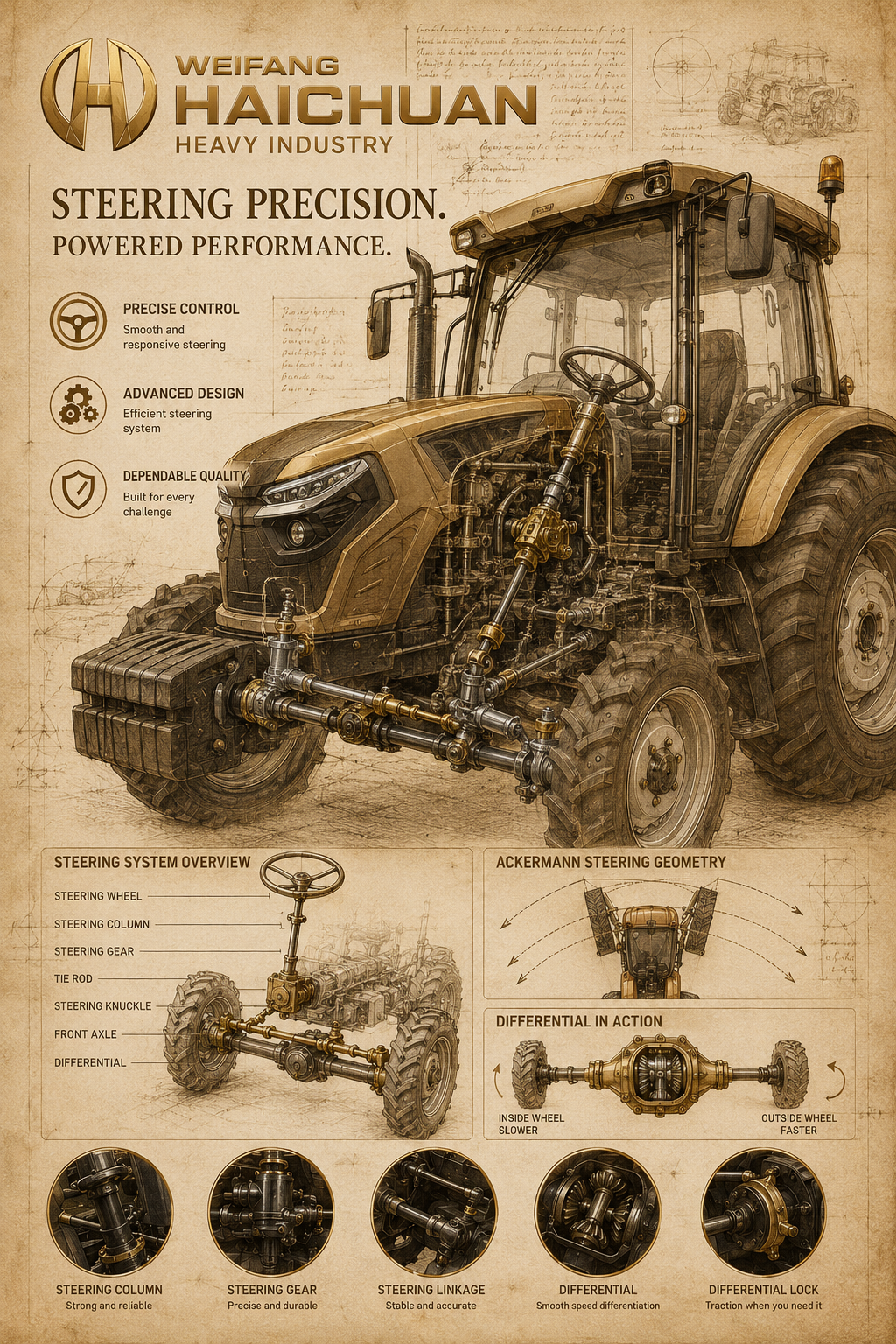
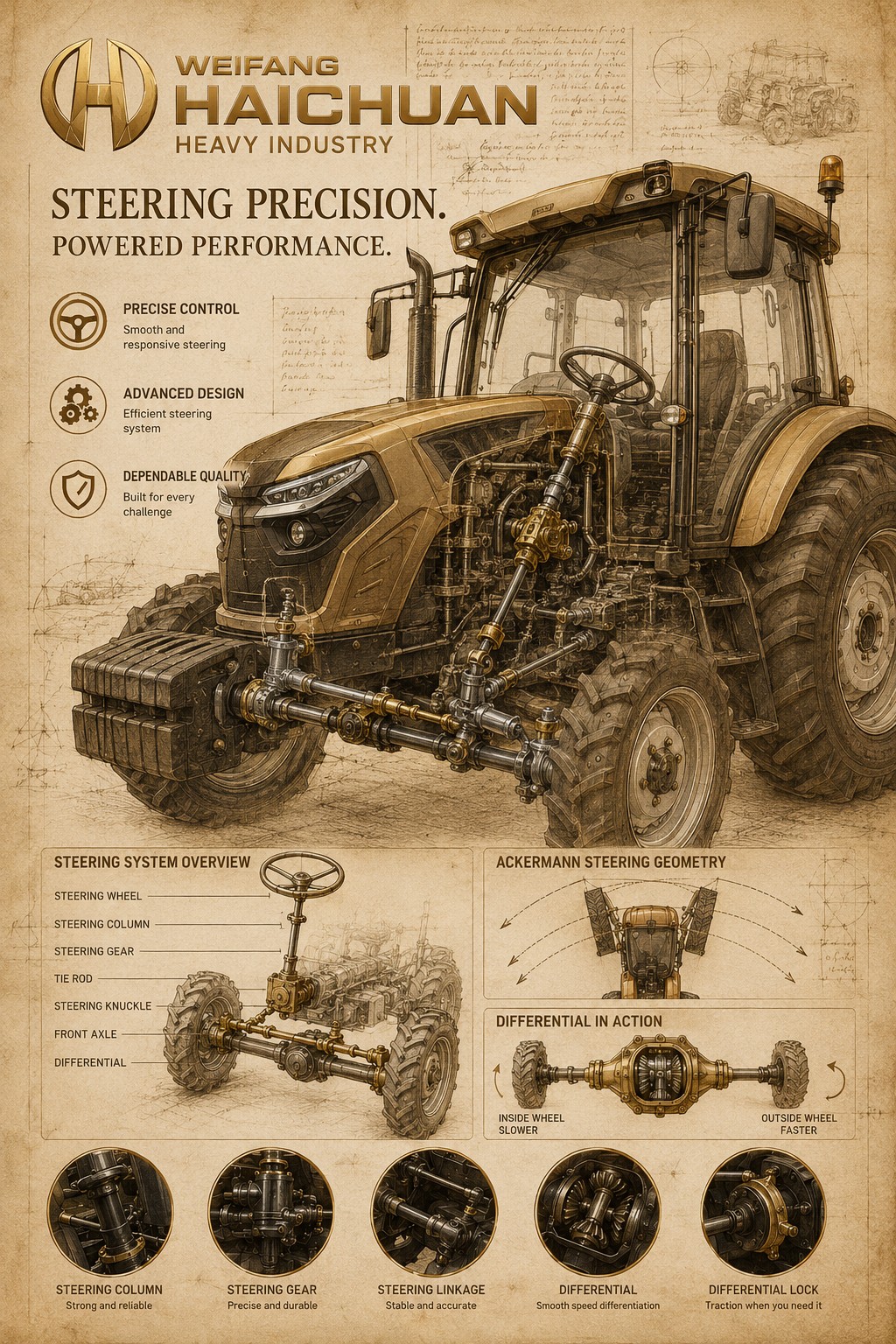
→- The Tractor Steering System — How the Hell Does Spinning That Round Thing Make the Iron Bull Turn?
The Tractor Steering System — How the Hell Does Spinning That Round Thing Make the Iron Bull Turn?
So you pull up to the end of the row. You lift the plow, but that disc harrow's still draggin' behind, clangin' and bangin'. Time to spin it around.
You just rub that steering wheel with both hands, and this whole heavy-ass rig—we talkin' tons of steel, flesh, and sweat—swings around smooth as butter. You ain't even breakin' a sweat, and the iron bull don't put up a fight, not one bit.
How, though?
What you holdin' is just a plastic-wrapped steel hoop with some worn-out shiny leather on it. But this hoop? It's connected to metal rods, gears, hydraulic lines, all twistin' and curvin' its way down until it's poking at the two front wheels. Those wheels barely tilt, and the whole damn machine follows suit.
If you strip it all the way down, it ain't rocket science. But when you crawl underneath and trace that steering column all the way to the tires, you’ll see there's more to the story. So today, we ain't goin' nowhere. We're posted up under the front axle, like we sittin' around a fire, chattin' about one thing and one thing only — why does the beast turn when you flick your wrist?
1.1 The Dumbest Way: One Solid Bar Pushing Both Wheels
Now, if you’s an impatient blacksmith back in the day, trying to build your first steering setup, you’d do it the simplest way possible — straight, no chaser.
You take one solid axle, hook both front wheels onto it. This axle is one piece—no joints, no give. Right in the middle, you weld a vertical pipe straight up toward the sky, then slap a steering wheel on top.
You turn the wheel, the whole axle turns with it. Left wheel tilts left, right wheel tilts left—same exact angle. You turn right, both wheels lean right in unison. Clean and simple, right? Looks tough as hell.
But the moment you drive that thing out to the field? It all falls apart, bro. Real talk.
Think about what happens when you're takin' a turn. Not even at speed, just a slow, lazy right-angle turn at the field's edge. Peep the tracks those two front tires leave in the dirt.
The inside wheel draws a tight little circle. The outside wheel draws a wide-ass loop. Big circle means more distance; small circle means less. It's like runnin' laps back in grade school—the kid on the inside barely jogs, while that tall kid on the outside has to sprint to keep up.
But that dumb, beefy solid axle don't know any of this. It's one piece; it can't give different speeds to each side. It forces both wheels to spin the exact same amount at the exact same time.
Now you got drama.
The inside wheel only wants to cover its short path, turn just a few rotations. But the solid axle says, "Nah, you gon' keep spinnin'"—dragging it, making the rubber scrub the ground, squealing like crazy. The outside wheel is starvin' for more rotations to cover its long path, but the axle already gave it all it got, so it just gets dragged along, scrubin' too.
And a farm field ain't no smooth-ass paved road. One wheel might be sinkin' into soft, worked soil while the other's riding up on a hard, packed ridge. Grip difference is wild already. Add that solid axle into the mix, and now your steering wheel starts fighting back. You feel it in your arms—the front end ain't turning smooth; it’s pushing sideways like some invisible giant is wrestling you for control.
One turn, and you've ground rubber off the tires, churned up dirt, and left wobbly, messed-up plow lines. Fight it too hard, and your arms will feel like they 'bout to fall off.
So here’s lesson number one, the big dog rule: When you turn, the inside wheel and outside wheel absolutely cannot spin at the same speed. The outside wheel gotta hustle faster; the inside wheel gotta chill slower—that’s the only way you get a clean, smooth turn.
1.2 How to Let Each Wheel Do Its Own Thing — The Differential, That Sly Old Hustler
After hearing that, you’d be like, "Man, that’s easy. Just saw that damn solid axle right in half—two separate half-shafts. Left half for the left wheel, right half for the right wheel. Let 'em spin on their own, don't bother each other."
That idea's solid, no doubt... but you only solved half the puzzle. You gave 'em freedom, but you ain't delivered the power yet.
The driveshaft coming from your engine's gotta hand off that twisting force to your two new half-shafts. If you just connect it any old way, that torque—that force—is sneaky, man. It always picks the easiest path.
Picture this: Left tire's jammed against a hard dirt ridge—heavy, refusing to turn. Right tire's dangling in a mud pit, zero resistance. You send power in, and all that force just dips straight to the right wheel that ain't puttin' up a fight. Left wheel stays frozen. One's spinning, one's doing nothing. You stomp the gas, mud flies everywhere, but the tractor don't budge an inch.
That's like you trying to carry a heavy bucket of water with a partner who’s got no backbone. You over here breaking your back, and that fool over there lets the bucket tilt to his side—water spills everywhere, and you just wasted all that effort.
So what you need is a joint that not only allows 'em to spin at different speeds, but also smart enough to split the torque—to force some power to both, no matter what. Freedom to differ, but still deliver the strength. That right there? That’s the job of the differential.
What's a differential look like? Don't overthink it. You crack open that housing, it's just a bunch of gears. Think of it as a gear-made "mediator," a smooth-talking middleman.
Power from the transmission's tail-end spins the big bowl-shaped differential case. This case is like a drum, with a bunch of small "spider" gears inside. These spider gears are meshed simultaneously with the gears at the ends of your left and right half-shafts.
When you're rolling straight on flat ground, both wheels feel the same resistance. The big case turns, and those spider gears? They chill. They don't spin on their own; they get pushed by the case as a whole unit, dragging both half-shafts along together like they're welded solid.
But the moment you crank the steering wheel and start turnin'? That's when the magic happens.
The inside wheel's loaded up by the tractor’s weight and takin' a tighter line. It feels heavy, binds up, and its half-shaft slows down, reluctant to turn. The outside wheel, freed from that squeeze and cruisin' the big arc, wants to spin faster.
Now those spider gears that were just loungin'? They can't be lazy no more. They're biting into two gears goin' different speeds now. They're forced to start spinning on their own. When those spiders rotate, they literally take the "stolen" rotation speed from the slow inside wheel and hand it over as a bonus to the fast outside wheel.
Whatever the inside wheel loses in speed, the outside wheel gains—transferred clean by those little spider gears.
You didn’t have to do a thing. This gear family just born with that attitude: If both sides resist equally, they play fair and push both evenly. If they resist differently, they play favorites—steering speed and force toward the easy side. It's a natural-born, crooked player... but it plays crooked exactly right.
During that slow, lazy turn at the field's edge, this differential is your MVP. You feel it in the steering wheel—smooth, the tractor's front end cooperating, both tires quiet, nobody scrubbing, nobody fighting. The dirt at the headland only shows clean tire tracks, no churned-up mud ridges.
But this old hustler can switch sides and become a straight-up traitor.
You've been stuck before, right? Left tire on hard, dry ground with tons of grip—you wish you could blast all the engine's torque to it so it can yank you out. Right tire? Sittin' in sloppy mud, spinning free, zero resistance.
The differential, with its favoritism, sends ALL the engine's torque straight to that mud-slinging slacker. The good tire on dry land? Gets absolutely nothing. The harder you hit the gas, the faster that free tire spins, throwin' mud to the sky, while you don't move a single inch.
This is like knowing your buddy's unreliable, but your accountant still gives him all the money. You just smack your leg cussing, but it's useless. Don't worry—we got a way to deal with this later. Right now, we're laying the foundation, solid.
1.3 It Ain't Just Speed — The Inside Wheel Gotta Turn Tighter Than the Outside
Alright, the speed difference problem? Differential got that handled. But turning's got another catch.
Draw it in the dirt with a stick: Tractor’s making a sharp turn. The inside wheel's path is small as a washbasin. The outside wheel's path is wide as a barn door. Not only are their speeds different—the sharpness of their turn is different too.
That inside wheel, tracing the tiny circle, needs a sharper angle—gotta lean in more. The outside wheel on the big, gentle loop? Its turning angle can be smaller, just a little tilt.
If your linkage is a dumb one-piece setup making both wheels lean the exact same angle, you still got problems. Even if the outside wheel's angle feels perfect, the inside wheel's angle ain't enough. It's still scrubbing sideways a little, not clean. Way better than that solid-axle mess, but still not butter.
So, the ideal situation when you crank the wheel: The inside wheel has got to turn a few degrees sharper than the outside wheel. Inside leans aggressive, outside leans chill.
How do you achieve that? Through a geometry hustle using a few iron rods. This trick got a textbook name: Ackermann steering geometry. Sounds all professor-ish, but stripped down, it’s just a trapezoid-shaped linkage—narrow up front, wide in the back.
Crawl under that front axle and look. The steering arm from your steering box pulls a long tie rod. That tie rod connects to two steering knuckle arms. Peep the setup: The tie rod isn't a straight rectangle parallel to the axle—nah, it forms a trapezoid, with the front tie rod shorter than the virtual line in the rear, or the knuckle arms angled to create that narrow-front, wide-back shape.
When you spin the steering wheel, the steering arm pushes or pulls that tie rod, which then drags the steering knuckle arms. Because of that trapezoid geometry, when you push, the inside knuckle arm gets yanked through a longer travel; the outside one moves less. Result? The inside wheel automatically leans in those crucial few extra degrees more than the outside.
You ain't doing math. The factory locked in the lengths and angles of those rods; they just born with that favoring nature. You just turn the wheel, and this linkage silently figures out the angle difference for you.
One day, find a flat spot, park, and crank the steering wheel all the way to full lock. Hop off and squat dead center in front of the tractor. You'll see it: The inside wheel, pointing into the turn, is tilted harder, giving you the side-eye. The outside wheel tilts more gracefully. The inside wheel ain't broken—it's purposely crooked. Without that extra lean, during tight turns, the inside tire would still be suffering, and your front end would push dirt sideways, wasting fuel and leaving messy, scrubbed-up mud ridges at the end of your rows.
1.4 How Your Wrist Strength Moves a Thousand-Pound Wheel?
So now the underground setup is clear: the differential in the middle handling speed differences, the trapezoid linkage at the ends handling angle differences. But ain't nobody told them what to do yet. This whole system lacks one chain—the force path from your hands to those parts.
You're sitting up in the cab, rubbing that steering wheel with both hands. All you got is wrist and arm power, but those front tires, buried in a foot of soft soil, are heavy as hell to turn. So what now?
You need a force chain hooked under the steering wheel to take that small twist you put in, then multiply it stage by stage, until it becomes big muscle that can muscle around a thousand-pound assembly.
This chain has a few stations. Let's trace it top to bottom.
Up top, right in your face—steering wheel connected to the steering column. The column is just a long steel tube inside a metal shroud, straight down from the dash to the floorplate. You twist the wheel, the column twists too. It's loyal: its only job is transferring that twist. But on a tractor, it does more. Sometimes you grab that wheel to pull yourself up—so this column gotta be strong like a flagpole. You can hang your whole body weight on it, and it better not bend.
Where the column punches through the floor, it mates with a burly iron box—looks like a roundish housing. This chunk of iron is the steering gear.
What’s the steering gear do? It's a force lever, a muscle amplifier.
Your wrist torque, even with all your might, ain't directly budging those front wheels. The wheels ain't just heavy from their own weight; they're sunk into soft ground with dirt pressing hard against the sidewalls. You need something that takes your "fast and light" twisting effort, and turns it into "slow and heavy" pushing effort.
The steering gear is that converter. You spin the wheel several full rotations, and down below, the wheels only tilt a few degrees. You put in small force over a long distance; it spits out large force over a short distance. It’s like shifting your mountain bike to the big granny gear for a steep climb—your legs spin like crazy, many rotations, and the rear wheel barely makes one lazy revolution, but it's light af, and you make it up the hill.
A classic steering gear used in tractors is called the recirculating ball type. The name kinda tells the story. Inside the housing, there's a big threaded screw-like shaft, with a nut riding on it—but between them sits a bunch of ball bearings rolling in grooves. When you turn the steering wheel, the screw turns, and those steel balls roll, pushing the nut up or down. Rolling balls means minimal friction; so even on a big, heavy machine, the wheel don't feel brutally stiff. And the balls circulate—roll to the end, then loop back through a return tube, endlessly flowing. The feel, old heads say, is slick—not gritty.
This steering gear takes your many wheel rotations and turns 'em into a single, direct, linear push. This push is then handed off to the next station—the steering linkage.
The push rod (or Pitman arm) from the steering gear hooks straight into that trapezoid linkage we spent all that time on. Steering gear pushes, the tie rod moves sideways, the linkage deforms, the inside wheel automatically gets its extra degrees, the outside wheel gets fewer—and then the linkage twists the steering knuckle (steering knuckle), which rotates the whole wheel assembly neatly.
Your whole process of turning the tractor, broken down, is an assembly line:
Hands rub the steering wheel. That twist travels down the steering column, untouched. The steering gear receives this high-speed, low-force twist, and inside its oil-bathed housing, processes it into low-speed, high-force push. That push goes through the tie rods to the front axle, handed to that geometry-calculating linkage. The linkage, according to its factory-set nature, sorts out the inner and outer angles, then twists the steering knuckles. Knuckles tilt, those big-ass tires tilt too.
And the whole time this is happening, that differential sitting dead center of the front axle? It stays out of your steering business. You're turning; it's inside that black housing, silent, automatically sorting out the speed difference between inside and outside wheels. Everything's in harmony.
1.5 But What if the Iron Bull Gets an Attitude, Steering Wheel Not Listening?
This steering system is the only language you and this iron bull speak to each other. If something's off, you're like a mute riding a blind horse, and that's no joke. Knowin’ how it works when it's right? That tells you what’s up when it starts moaning for help.
Let's start with steering wheel slop. You’re turning the wheel a half-turn left and right, but the tires down low ain't even paying attention. Too much free play. Driving a tractor with this on a straight road, you feel like a rookie driver, constantly correcting, and the plow lines wiggle like a snake. Most likely, the gears inside the steering gear are worn after years of service, got gaps now. Or a tie rod end ball joint is bone dry, worn loose. Feels like that old iron yard gate with rusted hinges—you push it forever, it just rattles, don't move where you tell it. Find that free play fast; adjust or replace. 'Cause if you're hauling down the road, your confidence is shot.
Next: The turning suddenly gets heavy as hell. Feels like you ain't stirring butter, you're churning frozen lard. First thing, check the easiest fix—front tire pressure. Low air, tire spreads out flat, tryin' to twist that giant footprint takes a ton of effort. Pump 'em up to spec. If it's still heavy, start thinking about the hydraulic power assist. Big modern tractors got hydraulic power steering; we got a whole chapter for that later. But just remember this: If the hydraulic oil's leaked out, or the pump ain't turning, the entire weight of the front end drops smack onto your arms. Do a headland turn like that, you'll sweat through your shirt, arms sore for two days. It ain't you gettin' weak—your helper went on strike.
Another thing: Pulling to one side on a straight path. Road's flat, but you let go of the wheel, and the nose drifts off slowly. Don't immediately blame the steering gear. Hop out, kick the front tires—see if one's lower than the other. One high, one low, you're runnin' with a limp, bound to drift toward the soft one. Pressure's good? Then get on flat ground, use a string or tape measure on the front tires. There's a factory-set angle called toe-in, set with instruments. If you recently slammed into a big rock at the field's edge or bottomed out in a dry ditch, that alignment might've shifted. Toe-in out of whack means the tires are fighting each other—one wants to go left, one wants to go right. Your steering wheel's the referee in a tug-of-war, and the moment you loosen your grip, it leans toward the stronger side. No magic fix here: measure it, look up the spec in the manual, and adjust it back.
The stuck-in-the-mud saga—gotta pull that out special. Time to untie that knot we left earlier.
You stuck. One wheel's spinning like crazy, other frozen solid. You're fully seein' that differential's traitorous, favoritism nature. Only one thing can tame it now—a rough, no-nonsense partner: the differential lock.
What's a differential lock? Let me break it down. It's a device that straight-up murders the differential's ability to let those spider gears mediate.
It's either a beefy dog clutch pin or a pack of clutch plates that get mashed together. Normally, it stays out the way, quiet. You get stuck. You glance at the dash; one wheel's slinging mud like a fountain, the wheel on hard ground ain't doing nothin'. Reach down in the cab and yank that lever—some tractors you stomp a pedal. That pull? That shoves the diff lock home.
What's it do? It locks those sneaky little spider gears directly to the big case. They can no longer spin by themselves—they're seized. Once they can't freespin, they bind the two half-shafts tight, forcing them to rotate as one solid unit again—speed difference totally eliminated.
Boom, you just recreated that old solid axle from way back. But now? You need that solid-axle energy. The slacker wheel spinning in mud can't steal all the power no more, 'cause the locked shaft drags it along, forcing it to turn the exact same as the good wheel with grip. The good wheel on dry land finally gets its share of torque. Both wheels dig together, and the tractor lurches free with a roar. You basically took an iron bar and tied those two lazy brothers together: you work, we all work; you rest, we all rest.
But never forget: differential lock is for getting unstuck. The second you're free and back on solid ground or normal working soil, release that handle immediately. If you don’t, you can't turn, and forcing it could twist a half-shaft like a pretzel or chew your tires down to the cords.
Last thing: When you're doing a tight turn at the headland, steering wheel almost at full lock, sometimes you hear a sharp squeal—REEEEE. Don't trip. That ain't the linkage rubbing. That's the hydraulic power assist system shouting, "I'm maxed out!" The oil's pushed to the cylinder's end, deadheaded, nowhere to go, screaming through the pressure relief valve. When you hear it, don't keep forcing it. Ease the wheel back a hair, let it breathe, save the hydraulic pump from blowing. That's the iron bull whispering to you—you gotta understand its language.
We've done a whole lot of talkin' now. So next time you climb into that cab and put your hands on the wheel, it should feel different. You ain't just touching a bare round hoop. You can feel that steel column underneath, straight through the floor, connected down to that recirculating ball steering gear bathed in oil—taking your circles and turning 'em into tiny wheel angles. You feel the calculated trapezoid linkage rods, that narrow-front-wide-back hustle, running all the way to the knuckles. And in the axle's center, hidden from view, that differential's quietly spinning its spider gears, faithfully delivering the speed split; and the diff lock is right next to it, ear cocked, ready for your command to disarm that crooked hustler in a heartbeat.
You move your hand, and all these parts come alive. Down in that dark, greasy space, gears press gears, rods push rods, transmitting your wrist's intent all the way down into the dirt, carving out a beautiful turn. Next time you're spinning around at the field's edge, pat that steering wheel—you already know what's good.
→  LOCKED BACK, SEESAW FRONT: A RAW-ASS BREAKDOWN OF THE TRACTOR’S FRAME & SUSPENSION
LOCKED BACK, SEESAW FRONT: A RAW-ASS BREAKDOWN OF THE TRACTOR’S FRAME & SUSPENSION
A tractor sittin’ by the field, got a plow hitched up behind it. Its four wheels tall and big, covered in deep chunky tread. Its body ain’t no slick streamlined shell — nah, it’s a bare, thick, raw-ass skeleton hangin’ out for everybody to see.
Why it built like dat? Why it don’t need to squat low and look pretty like a sedan?
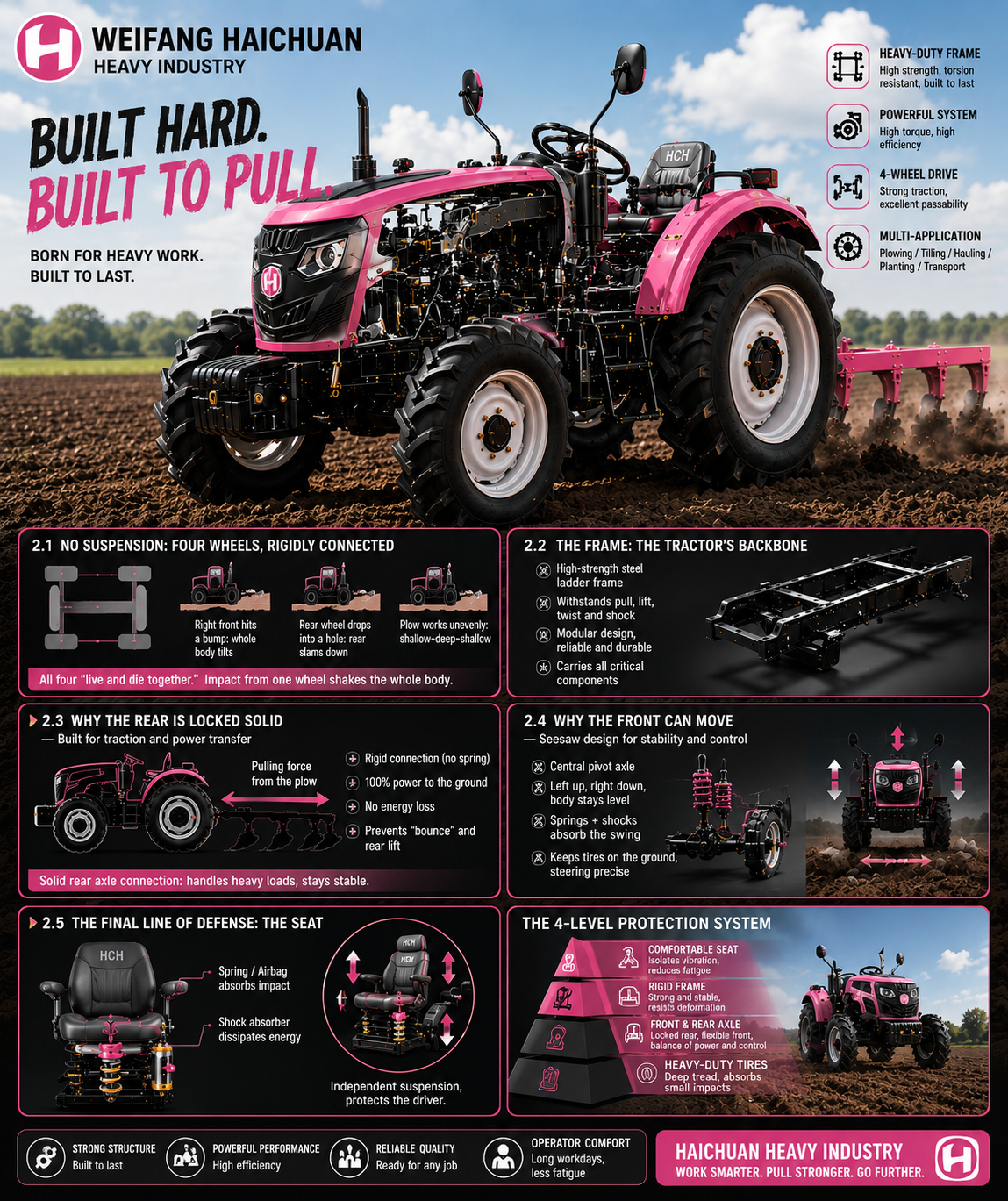
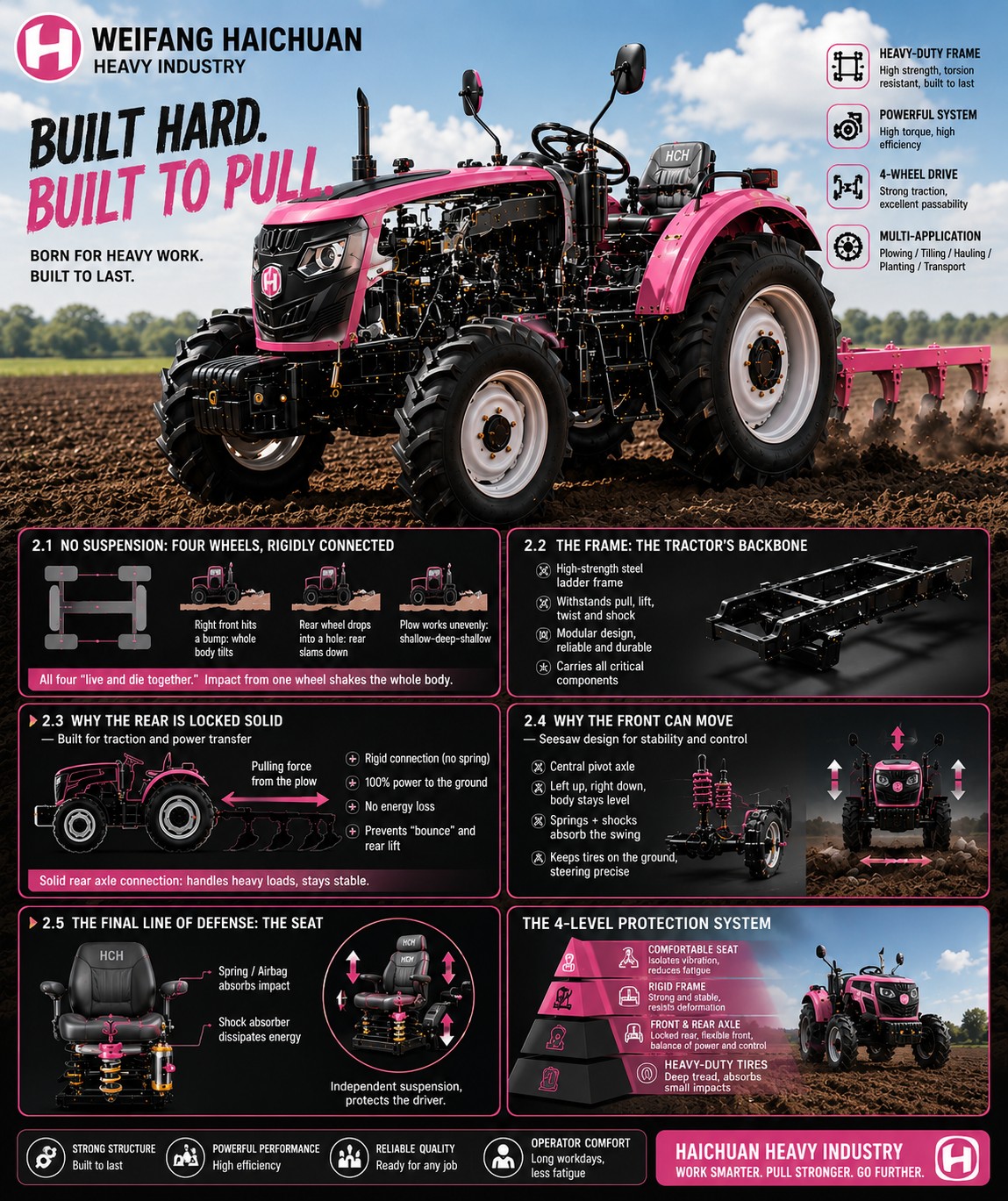
To answer that, you gotta crack open two basic structures: one, the frame. Two, the suspension.2.1 Four Wheels Welded to a Iron Bar — A World with No Suspension
‘Fore we talk about the real machine, let’s do a lil’ paper experiment, ya dig?
Take a piece of paper, draw a rectangle iron frame — that’s your body. Draw four round wheels, and weld ’em straight to the frame with four thick iron rods. No springs, no joints that can move. That right there is the simplest, rawest tractor ever made.
Now push that thing into the field. The ground ain’t flat, bruh. It’s got hard dirt clods, deep holes, old ruts.
Right front wheel rolls up on a hard chunk of dirt. The clod don’t budge, so the wheel gotta lift. But the wheel and the frame welded together — wheel go up, the right front corner of the frame get yanked up with it, and the whole tractor lean hard to the left. The steering wheel snatches so violent it’ll damn near rip the webbing between your thumb and finger.
Next second, the rear wheel drop into a hole. Welded rear wheel drag the frame slammin’ down — the rear end squat, the nose pop up. The plow hitched behind first stab deep into the dirt, then get snatched back out, leavin’ a trail of shallow-deep-shallow cuts across the field.
Why it beat you up like that? ’Cause all four wheels “live together and die together.” One wheel catch a hit, the whole body gotta catch it too. That’s the consequence of a hard connection. Ain’t no wheel dare move on its own — they locked into one solid chunk by that iron frame.
Now picture you sittin’ on top of that. What it feel like? Your butt straight on a pile driver. Every lil’ rock, every crack in the ground, travel straight from the wheel to your spine, unedited.
That’s the world with no suspension.
2.2 Frame — The Tractor’s Backbone
‘Fore we talk about fixin’ the shakes, let’s look at how a tractor’s bones really built.
A sedan got its skin and bones all fused together — that’s called a unibody. You rip the door off, the whole body might sag, ’cause it’s the shell itself doin’ the carryin’.
The tractor don’t play that game. It use a body-on-frame setup. They built a super heavy, super tough steel ladder frame first — an absolute unit. Then they bolt the engine, transmission, cab, everything onto that frame piece by piece. That outer sheet metal? It just keep the wind and rain off you — it don’t carry no load at all.
Why? ’Cause a tractor ain’t for haulin’ people — it’s for pullin’ plows, pushin’ dirt, liftin’ heavy stuff. When a plow yank it, the force pullin’ straight backwards. When you hang a loader bucket up front and lift somethin’, the force pushin’ up, pressin’ down, twistin’ sideways. You send a regular unibody sedan to do that work, it ain’t lastin’ half a day — the seams start crackin’, doors won’t shut, glass shatter.
So the tractor’s backbone is one giant skeleton made of super thick high-strength stamped steel or heavy channel iron riveted together. Like a weightlifter’s spine — it ain’t just gotta take compression, it gotta handle twistin’ too. All them outside shocks, twists, pulls — they don’t go nowhere else first. They come straight to this backbone to report.
That solid, unshakable beam — that’s the anchor you finna bolt the four legs to. If the anchor move, the legs ain’t worth nothin’.
2.3 Why the Back Legs Got Welded Solid — The Logic of Pullin’ a Plow
Now let’s mount them back legs — the two giant rear wheels. They do all the work draggin’ the plow.
On a tractor, between the rear axle and the frame? Ain’t no spring, homie. The engineers take rows of fat bolts and lock the rear axle housing dead solid to the frame rails and the tail of the transmission. Steel to steel, zero cushion.
In the car world, that’s some barbarian-type mess. But in the field, it’s the most sensible design out there. To understand why, you gotta start with the plow.
The plow in the dirt, bein’ dragged forward. The ground don’t wanna let go — it push back on that plow with a crazy amount of rearward force. That force travel up the draft links to the rear axle, the rear axle shove it to the frame, and the frame brace against it.
Peep the direction. It’s horizontal, pointin’ backwards, and pushin’ right under the rear end. That backward force, combined with the wheel-to-ground contact point as a fulcrum, create a massive twistin’ torque tryna pry the front end up and squat the rear. Same as when you grab a rope tied low to the ground, lean back hard — your heels become the pivot and your upper body wanna flip forward. The plow is basically tryna pry the tractor over.
Now, what if you put a spring between the rear axle and the frame?
The plow yank backwards — the rear axle don’t pull the frame right away, it first squash that spring. The whole body squat down hard. The plow’s pull plus the tractor’s weight pour a ton of energy into that spring. But a spring ain’t a safe deposit box — whatever you put in, it gotta give back. And when it give back, it mix stored energy with the raw torque the engine just sent, and snap back twice as vicious. The nose that just dipped hard now jerk up violently. That jerk can pull the front wheels clear off the ground, and the tractor flip backwards.
Even if it don’t flip, the engine supposed to send all its muscle to the plow, but now a chunk of that power wasted on the “compress-the-spring” dance. It’s like runnin’ a race with sandbags strapped to your legs — you can’t put down full force.
So the engineers made a decision: between the rear axle and frame, ain’t nothin’ allowed to move.
The plow pull the rear axle, the rear axle yank the frame directly, and the frame’s couple-thousand-pound inertia answer straight back to the earth. Force transfer 100% steel on steel — no delay, no power leak. The cost? When the rear wheel smash into a ditch or bump, that impact also transmit 100% bone-straight to the frame, no spring to absorb it. How you pay that cost? We’ll get to that later.Rule for the back legs: hard for hard work — stiff like a bridge pier.
2.4 Why the Front Legs Can Move — The Wisdom of the Seesaw
Back legs welded solid. What about the front ones?
The front wheels ain’t pullin’ no plow. They only got two jobs: hold up the front end, and turn when the steering wheel tell ’em to.
Kneel down by the front and peep this. The front axle structure totally different from the rear. It ain’t one solid chunk of iron — nah. It’s a thick cross-beam, and right in the middle, it’s pinned to the very front of the frame with a big vertical kingpin. That beam can rock around that center pin like a giant seesaw — left side go up, right side go down, and vice versa.
The number-one problem this seesaw solves ain’t comfort — it’s to make sure the front wheels never leave the ground.
Field ground… left side could be a rut eight inches deep, right side a hard dirt mound. If the front axle was a dead solid piece like the rear, the left wheel drop in the hole, the whole left side of the nose crash down with it; the right wheel get pushed up by the mound, the whole nose try to tilt. The scary part: if that hole too deep, the left wheel be danglin’ in the air. One front wheel off the ground — steering useless — on a slope, that’s the prelude to a rollover.
But swap in the seesaw front axle, whole different story. Left wheel drop into the hole, the left half of the beam swing up. Right wheel press on the mound, the right half swing down. The beam tilt like crazy, but what about that center pin connectin’ to the frame? Since left go up and right go down, them two movements meet in the middle and mostly cancel each other out. The pin itself only drop a tiny bit — the tractor body stay mostly level.
The two front wheels like dancers — their feet hittin’ different highs and lows — but that center pin “harmonize” all that movement so the body don’t get twisted around. That keep the steering effective and the tires planted.
Now, between the front axle and frame, it ain’t totally without some give neither. To keep that seesaw from slammin’ into the metal limit stops too violent, they use coil springs and shock absorbers. The spring catch the energy of the harsh swing; then the shock absorber turn that energy into heat in oil and eat it up — so it don’t bounce back.
So the rule for the front legs: move to stay planted — bend and flex. The softness is for stability.
2.5 The Last Line of Defense — A Seat That Moves on Its Own
By now the chassis situation is split clean in two: back legs locked solid, impacts go raw into the frame; front legs flexible, but their big swings still feed force into the frame constantly.
The whole frame still shakin’ — just shakin’ in a more “organized” way than if it had no suspension at all. All them impacts eventually gather right at the mounting point of the seat. So how the driver survive?
You can’t put soft mounts under the engine — that’d leak away the plow-pullin’ force. You can’t hang the frame on springs — that’d kill the torsional stiffness. So the engineers took all the softness they had, and poured it into one humble spot: the seat.
Lift up a tractor seat. Under the cushion, you find a thick coil spring, or an air bag adjustable by pressure. Right next to it, mounted at an angle, there’s a short, stout hydraulic shock absorber — look like a lil’ syringe packed with thick oil.
The frame send the shock to the seat base. The seat base pass that force to the spring. The spring compress, and the driver’s body start sinkin’ down slow. Just when the spring about to rebound, that shock absorber’s tiny piston start fightin’ to push thick oil through a pinhole-sized valve. That sticky resistance swallow up nearly all the upward bounce, turnin’ it into a tiny bit of heat and just lettin’ it fade away.
Down below, the tractor body twitchin’ and shakin’ like a mad bull. Up top, the seat “detached” from all that. It’s like a man ridin’ an enraged bull — the bull gotta buck, but they put a miniature palanquin made of springs and oil right under your butt. The bull’s jerks get soaked up by that palanquin — your spine is saved.
That’s the deepest philosophy of tractor shock absorption: you can’t make the big workin’ system soft, so you build an independent lil’ buffer zone right between the man and the machine — a zone that only serves one person.
Now when you look at a tractor parked by the field, from the front or from the side, there should be four things stacked in your mind like a human pyramid.
At the very bottom: four deep-tread rubber tires — soft — they eat up the tiniest rocks and sharp dirt edges. One level up: seesaw front axle, solid rear axle — they split the two enemies, “keepin’ rubber on dirt” and “transmittin’ brute force.” Above that: that heavy, steady steel beam frame refusin’ to let any twist warp the body. And finally, at the end of all that hardness and shakin’, that self-adjustin’ seat catches it all.
Its suspension and frame ain’t built for comfort — they built so it can bust heavy work in the mud for a lifetime without comin’ apart, without flippin’ over. Every bolt locked down tight, every angle that seesaw swings — underneath all of it, a law of physics holdin’ it down, straight up.
→

Latest News
Official information, learn about the latest developments of SHANGLONG.
- ▶ Ultimate 4WD Compact Utility Tractor: Maximum Power for Modern Agriculture
- ▶ The 50HP Compact Tractor Redefining High-Efficiency Farming Worldwide
- ▶ REVOLUTIONIZE YOUR FARMING: THE NEW 15HP 4X2 COMPACT TRACTOR
- ▶ Breaking: Ultimate 25HP 4WD Compact Tractor Set to Disrupt the European Small Farming Market
- ▶ Why This Tractor is Transforming Small-Scale Agriculture
- ▶ New 80HP 4WD Heavy Duty Farm Tractor with 12 Plus 12 Shuttle Shift for Sale
- ▶ ? THE BEAST IS HERE! The All-New 50HP 4WD Heavy-Duty Tractor Redefines Farm Productivity!
Contact With Us

Please enter what you want to find
Send Your Inquiry Today
*We respect your confidentiality and all information are protected.