

 The Big Knowledge on Wheels — Why Yo’ Whip Wears Them Black Rubber Kicks?
The Big Knowledge on Wheels — Why Yo’ Whip Wears Them Black Rubber Kicks?
You remember how we talked last time? Engine's the heart, but even a beast heart can't do nothing if it can't get the word to the ground. It needs a middleman. And that middleman? Four black, round, rubber things sittin' under your whip.
You probably thinkin', "Man, what's the big deal? Ain't they just rubber hoops?"
Nah, bro. That's where you got it twisted. Those four black hoops? They the smartest, most slept-on, most disrespected, and straight-up greatest invention on the whole ride. Without 'em, even if your car had ten thousand horses, all it would do is scream in place like a hippo throwing a tantrum—ain't goin' nowhere.
So sit back and let me lay down a story about wheels. Real talk.
1.1 A Genius Idea: Why Don't We Just Run in Iron Shoes?
Way back, people rolled on wheels made of iron, or wood. Hard against hard. Tough as nails. But imagine you strappin' on a pair of solid iron boots. How's that feel?
First thing, the bottom of your feet would be screaming. Every little pebble on the road pokes you like a needle, sending shocks straight to your dome. That's zero shock absorption right there. Second, you'd be slipping and sliding. You step on a wet stone, next thing you know, you're flat on your back. No grip. Third, heavy as hell. Can't lift your legs, tired after a few steps.
Then some genius had a lightbulb moment and invented the pneumatic tire. The idea was beautiful—we ain't putting iron shoes on the wheel no more, we giving it a pumped-up leather ball to wear!
See? That one simple thought solved everything:
The bump problem? Let air handle it. Air is the comfiest spring in the universe. You squeeze a balloon, it changes shape but it don't fight back all angry. Your tire rolls over a rock, the air inside gets a gentle squeeze first, softly swallows that shock, then slowly gives it back. Your behind don't feel a thing.
The sliding problem? Use soft skin to grab. A hard iron shoe skates on the ground; soft rubber grabs like your fingertips digging in. Feel a tire—kinda sticky, kinda soft. It can sink into every tiny crack and crevice on the road and hold on tight.
So remember lesson number one: A rubber hoop filled with air is the comfiest, grippiest "shoe" humankind ever came up with. That's why, to this day, your ride's still rocking rubber kicks.
I been doing farm machinery trade for a minute, and I’ve watched whole regions move from iron wheels to rubber. In some rice paddies in Southeast Asia, hand tractors used to roll on nothing but iron. Farmer goes out to work the field, those iron teeth chew up the ridge, and the vibration rides straight up the arms. By forty, a lot of them had serious joint damage. Then they switched to air tires. Same field, same man, but the machine walked lighter, and the body caught a break. Moving from iron to rubber wasn’t just a material swap—it was a whole human-factor upgrade.
1.2 How Much Can This Shoe Do? — Other Shoes Do One Job, This One Does Four
The shoes on your feet only got one job: protect your feet. But your car's "shoes" gotta clock in for four shifts at once. And they gotta be elite at every single one.
First Job: Hold It Down.
You sittin' comfortable, but you ever think about two tons of steel resting on nothing but four palm-sized patches of rubber? Who's holding all that up? That compressed air trapped inside.
And here's the serious truth: if the air pressure gets low, the tire will "kneel down." When it's soft and sagging, the air can't hold the weight no more, so the rubber itself has to take over. It bends, snaps back, bends, snaps back—just like you bending a paperclip over and over. It heats up, gets tired, then one day—BANG—it pops. That's why you check your pressures before a highway run. You ain't looking at some cold number; you checking if your tires can still stand on their own two feet.
Then there's this dangerous myth: when you're overloaded, you just pump more air in to make it handle the weight. Homie, that's backwards thinking. The tire's ply rating and max load are set at the factory by the cord density and body structure. Take a common light truck tire, like a 7.00-16 12-ply—the sidewall will tell you max pressure usually between 450-530 kPa, and max load around 1,500 kg per tire. You pump it past that limit, the cords are permanently overstretched. Their fatigue life drops off a cliff. Then you hit a pothole, and with stress piling up from inside and outside, it's not a slow leak—it's a carcass explosion. In our export warranty claims from the Middle East and Africa, this kind of thing pops up almost every year. Look into it, nine times out of ten, it's bad pressure management.
Second Job: Massage.
We just talked about the air spring. But it’s more like a tai chi master, redirecting energy. Imagine a sharp little rock. If you ran over it with solid steel wheels, it'd be a hard, direct hit. But when the tire hits it? The rubber first "cups" that rock, wrapping it in a thick, fleshy pad, then passes it to the air, and the air turns it into a mild shiver. The tire's like a loyal butler—any sharp, rough hit, it takes with its own body, kneads it smooth, rounds it off, and only then passes it along to the suspension and your seat.
Third Job: Deliver the Message.
This is the holiest mission: talk to the earth, and get a reply. The engine burned all its energy to turn the wheel. The wheel's trying its hardest to spin. But without the tire, just a bare metal rim, you'd just sit there spinning, digging a hole. With the tire, that rubber is gripping the ground dead-on. The wheel wants to turn, but the patch of rubber touching the ground says, "Nah, I'm holding tight." At that standoff, a miracle happens: the tire pushes backward on the dirt, and the earth, being the heavyweight champ, pushes back forward. Your ride moves. Every time you hit the gas, tap the brakes, turn the wheel—it's the tire begging the earth for a favor, asking it to step in. It's the ultimate communicator.
Fourth Job: Lead the Way.
Wherever you wanna go, the tire has to follow. It's constantly fighting inertia trying to kidnap you. In this sense, the tire is the embodiment of your will. You point to the curve, it draws the line.
So see? This black, dirty thing—ain't it a whole lot more than you gave it credit for?
1.3 Cut It Open—It's a Creature with Muscles and a Skeleton
You think it's just a solid rubber tube? Nope. Slice it open, you'll see it's like a living thing: skin, flesh, bones, and an inner waterproof liner. Let's peel the layers.
The Outermost Layer You Can Touch: The Tread
This is the tire's "meat" and its face. A thick layer of extremely wear-resistant rubber. And I'ma let you in on a little tire-industry trade secret: this rubber compound walks a tightrope between soft and hard.You want crazy grip? It's gotta be soft. Soft lets it stick like a gecko's foot, glues you to the road, shortens braking distance. You want long life, tens of thousands of miles? It's gotta be hard, to take the wear. So how they do it? They throw in classified recipes—stuff like silica (sometimes called "white carbon black")—that lets the tire be soft and grippy and still last. Especially on wet roads, that stuff is your "rainy day savior."
The Next Layer, Invisible: The Belt Package
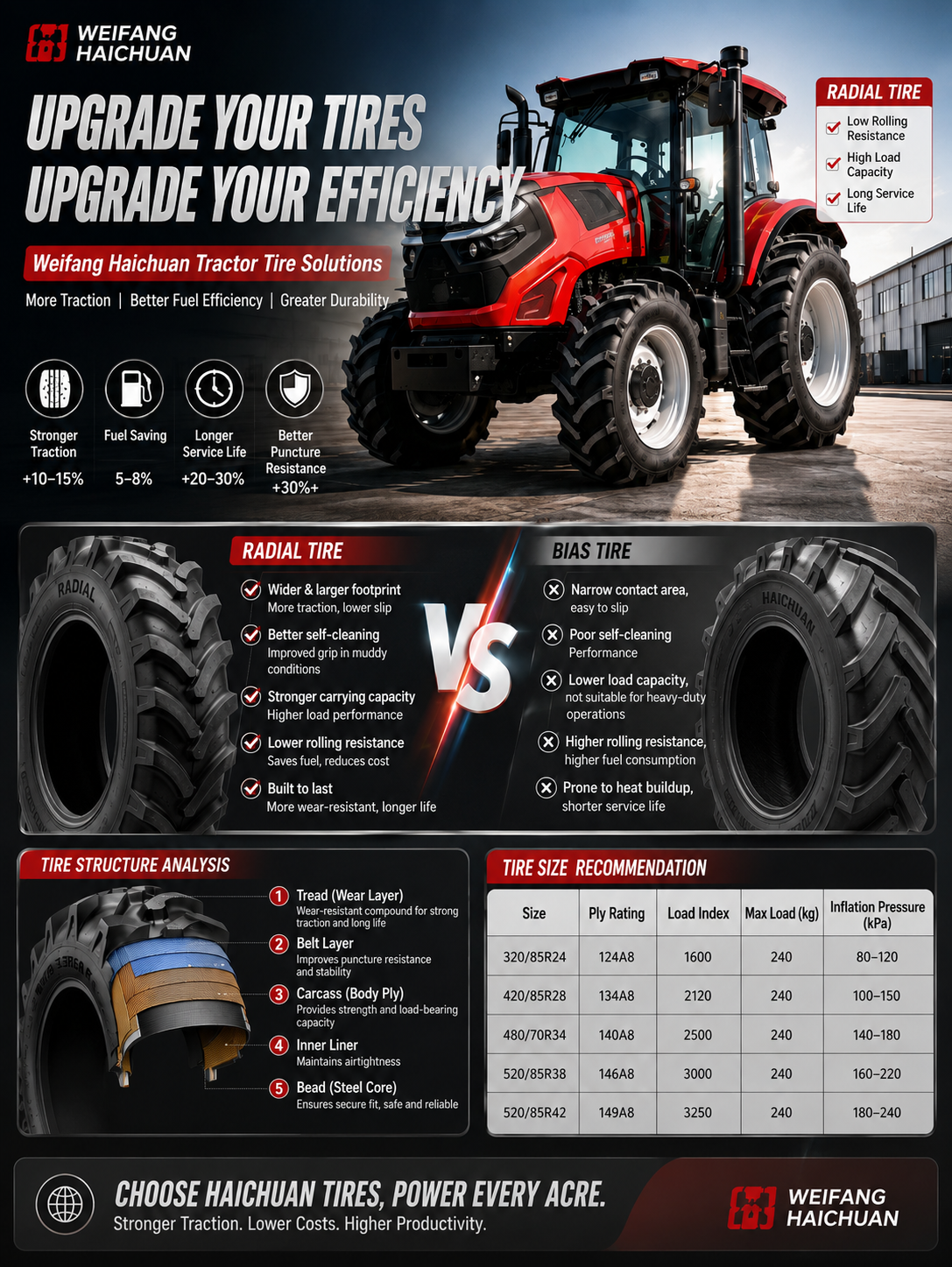
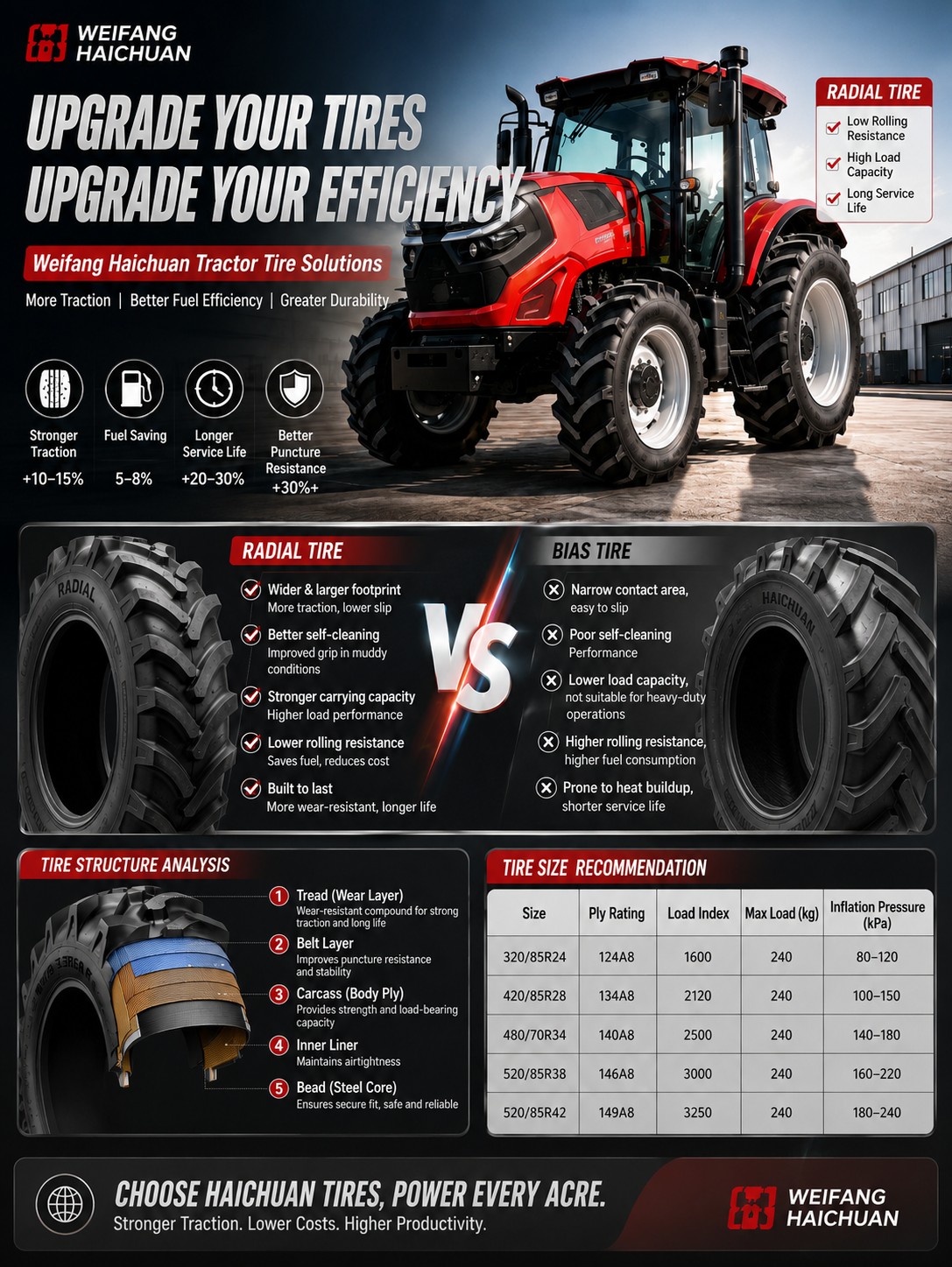
This is the tire's "chainmail," the real secret weapon of a radial tire. It's two layers of mesh woven from ultra-fine steel wire, hugging the tire's circumference like a tight headband. It does two jobs, each one heavier than the last:Keep the tire from flying apart. At high speed, crazy centrifugal force wants to stretch that tire out like a pizza dough into a big donut. This steel belt holds on for dear life, keeping it in shape.
Separate muscle from skeleton. This is the key. Because of this steel straitjacket, the "skeleton" (the casing below) and the "muscle" (the tread above) are completely divorced. That means the tread can lie flat and grab the ground without getting yanked around by the skeleton's movements.
In ag tires, this radial construction is the biggest game-changer of the last thirty years. On bias-ply tires, the cord layers crisscross; when the sidewall flexes under load, it twists the tread right along with it, so you lose ground contact. A radial keeps the tread planted flat with that steel belt, while the sidewall does its own flexing. In the field, same horsepower tractor, radials can get you 10 to 15 percent better traction efficiency than bias. Sizes like 480/70R38 and 520/85R42 are standard on big tractors in Europe and the US—and they’re also what you’ll see spec’d on the rear of those massive machines coming out of Weifang Haichuan Heavy Industry these days. One tire ain't cheap, but you run the numbers on fuel savings and work done, and that upgrade pays for itself within three seasons. The farm managers running big operations, they got that spreadsheet down cold.
Deeper Still, The Real Skeleton: The Carcass Ply
This is the body's foundation. Rows of fiber cords, like the ribs in your chest. How they arranged? Like lines of longitude on a globe—from the North Pole to the South Pole. That's why it's called a "radial" tire.This design is pure genius. See, on old-school bias-ply tires, the skeleton was laid diagonally. Hit a rock, sidewall flexes, the diagonal cords yank the whole tread out of shape, and you lose half your grip instantly. On a radial? The sidewall flexes, but each rib works independently. The tread, held firm by that steel belt, keeps maximum contact. That's why today's cars grip better and last way longer than old cars. It was the single greatest leap in tire history.
The Innermost: Inner Liner
Don't worry about air leaking. Inside is a very thin but super-dense layer of butyl rubber, like a high-end airtight bag, locking every air molecule in. This is the inner tube of a modern tire.The Edge: The Bead
Hard as hell, like the heel counter of your shoe, with steel wire wrapped inside. It clamps onto the rim like your fingers gripping tight, making sure the tire never lets go, no matter what.See that? This one black circle is structural mechanics and material science rolled into one. It’s a precision-engineered industrial product.
1.4 The Secret Code on the Tire—It Tattoos Its Résumé on Its Body
You ain't gotta be scared of those numbers and letters no more. They're just the tire's ID. Let's read it. Take a typical one: 225/55 R17 97V.
225 — How Big the Foot
That's the tread width, 225 millimeters. The width of its footprint. Is wider always better? Nah. Wide is like snowshoes—great grip. F1 dry tires are wide as tank treads to put down huge power without spinning. But wide is also like wearing snowshoes to a poolside: in rain, too much width can't shed water fast enough, and you end up hydroplaning. Plus wider is heavier, costs fuel. So the width your car gets is the engineer's balance point between power, fuel burn, and safety.55 — How Thick the Ankle
That mysterious number is the aspect ratio: sidewall height = tread width × 55%. This decides if your ride is on "air-cushion running shoes" or "thin-soled kung fu slippers."High number like 65 or 70? Thick sidewall, like an air cushion. Soft, comfy ride, sitting on a couch. That's your old Corolla or Maxima, all about soaking up bumps. Low number like 40 or 35? Thin sidewall, like a skin of rubber on the rim. Road feel so sharp you can tell heads or tails on a coin. That's why BMW and Porsche drivers feel connected, point and shoot—but it's also why they feel every crack, and pucker up at deep potholes, 'cause the rim and tire can both get busted.
R17 — What Shoe Size
R means Radial construction. 17 means it fits a 17-inch rim. They gotta match.97V — How Much Weight, How Fast
These are codes. 97 means this single tire can carry a maximum of 730 kg (four of them add up to nearly 3 tons, way more than your car weighs, for safety margin). V says it's rated for up to 240 km/h. Even if you never go that fast, a higher speed-rated tire has a stronger internal build, which means more safety at any speed.Ag tires got their own code language. You see "320/85R38 131A8" on a sidewall, you read it the same way: 320 mm section width, 85% aspect ratio, Radial, 38-inch rim. 131 is the load index (max load 1,950 kg per tire); A8 is the speed symbol for 40 km/h—for a tractor, that’s flying in the field. The size and load/speed rating together are the tire’s full technical ID. If the numbers don't match the machine's specs, you don't run it. This ain't a suggestion; it's the baseline.
1.5 The Imagination of Tread Patterns—Looks Is the Most Useless Feature
Look at the tires on the road—all kinds of wild patterns. None of it is for looks. Every groove is a fluid dynamics equation.
Rainy Day Magician: Longitudinal Grooves
Ever been caught in a downpour on the highway, and suddenly the steering feels light, like you're sailing a boat? That’s hydroplaning—one of the scariest things behind the wheel. What happened? You’re going too fast, and the tire can’t shove the water out of the way. Water builds up between tire and road, forming a razor-thin "water wedge" that lifts the whole car. In that moment, you’re surfing. Steering? Nothing. Brakes? Nothing. The fix? Those deep, wide grooves running around the tire—they’re like the main drainage canals in a city. They slice through the water, channel it, and spit it out the back so the rubber can grab the asphalt again. That’s why every passenger tire pattern, no matter how fancy, must have these lifeline grooves.Mud Shovel: Transverse Blocks
Look at an off-roader or a tractor tire. It's like tank tread, covered in big chunky blocks. These ain't designed for the highway. In loose mud, sand, or snow, they don't just rely on friction; they dig. Each block is like a little shovel, stabbing into the soft ground and shearing the soil for thrust. But the price? On pavement, the noise is like a squadron of bombers, the blocks squirm so cornering’s unstable, and they wear down crazy fast. All trade-offs.Farm tire treads follow a standard code, not random nicknames. R-1 is the universal ag tread—a herringbone pattern. Go-to sizes like 13.6-38 and 18.4-30 run this for general dry and wet field work. R-2 is deep tread, grooves way deeper than R-1, meant for mud and swamp ground. Then there's R-1W, a deepened version of R-1 for folks who also run some road transport. Pick the wrong one, and it ain’t about good or bad, it’s about whether the job gets done at all. Slap R-1 on a perpetually flooded lowland field, the slippage is so high you can’t work. Put R-2 on a tractor doing road haulage, and you’ll scrub the tread off in a few thousand klicks, plus the vibration will shake the driver apart. A serious farm or contractor picks the tread based on soil type, drainage, and roading distance. Every choice is a cost calculation.
Ear Tuner: Variable Pitch Design
You ever notice some tires hum quiet, others just drone? Beyond the grooves, there’s another secret: the beat of the sound. If every tread block were the same size, rolling down the road they’d hit at a steady, even frequency, and harmonize into one huge, boring, brain-drilling howl. Smart engineers mix up the block sizes, randomly shuffling the pattern so it turns that annoying "EEEEEE" into a soft shhhhhh—white noise your ears just tune out.Alright, that's the story of the tire. Now whenever you look at one, you should know: it ain't just a black hoop. It's the workhorse holding up your ride on a cushion of air, a gladiator wrestling physics with rubber, and the one and only connection between your ride and the earth. Straight up.
→ What Makes a Tractor Move?
What Makes a Tractor Move?
You prolly thinkin’, “’Cause it’s got an engine, fool. Diesel fires up, that big hunk of iron rolls out.”
Aight, bet. Let’s run a little experiment.
Jack that tractor up—all four wheels danglin’ in the air. Climb on up, fire it up, drop it in gear, and stomp on the gas. Wheels gon’ spin like crazy, engine screamin’ so loud your chest rattles. But that tractor? Did it slide forward one single centimeter? Nope.
So what that tell you? The engine, by itself, ain’t pushin’ nothin’.
So who’s really movin’ the tractor?
The ground, baby.
That same dirt, gravel, or concrete you walk on every day—that’s what shoves you forward. Sounds upside down, right? Hold that thought. We gon’ start with somethin’ a three-year-old already knows, and peel this whole mystery back layer by layer.
2.1 Take It Back to Pampers: How Did You Learn to Walk?
You don’t remember learnin’ how to walk, but you seen a baby do it. First move they make? They grab a wall or a grown-up’s hand, and they push they foot backwards against the floor.
Think about it. Foot goes back, body goes forward.
Why?
Basic law of the universe right here—Newton’s Third Law. Don’t trip off the name. All it’s sayin’ is: you push on something, that something pushes back on you just as hard, opposite direction.
Test this right now: shove your hand against the wall in front of you. Push hard. Harder. You feel that? Your palm hurtin’? That shove you gave the wall—that’s the “action.” The wall smackin’ your palm back—that’s the “reaction.” The harder you push, the harder it claps back at you. Forces always roll in pairs.
Now put that law on your legs.
You stand on the ground and push your foot backward. Your foot puts a backward force on the ground. Well, “forces come in pairs” says the ground has to throw a forward force back at your foot—same size, opposite direction. That forward force? That’s what pushes you ahead.
The ground pushed you forward, not your muscles. Your muscles just the homies you hire to make the trade happen.
Let’s swap the scene. Now you standin’ in some fresh, rain-soaked mud, tryna walk. You still shove your foot backward. What happens? Foot slides out behind you, body don’t go nowhere, and you ’bout to bust your behind. Same motion—why different results?
’Cause this time, the trade didn’t go through. You tried to give the ground a force, but the ground was too slick, too soft—it couldn’t catch what you were throwin’. You couldn’t get no purchase.
So movin’ forward need two things:
You gotta have the muscle to push.
The ground gotta be able to catch that push and hand it right back.
2.2 Now, Imagine You Are the Tractor
Let’s swap souls. You ain’t a person no more. You a tractor, out in the field getting’ work done.
Your “muscle” is that diesel engine. It makes the pushin’ force. Engineers call it torque—just picture the twist you put into a towel when you wringin’ it out. That twist. A four-cylinder water-cooled diesel, spinnin’ at 2400 rpm, crankin’ out about 50 horsepower—that’s like 50 horses all twistin’ the same invisible pipe at once.
Your “legs and feet” are the whole setup: clutch, transmission, driveshaft, down to the tires. They deliver that twist down to the ground.
The road you standin’ on still the one callin’ the final shot.
Secret to a tractor movin’ is exactly the same as you walkin’. Let’s slow-walk it, step by step.
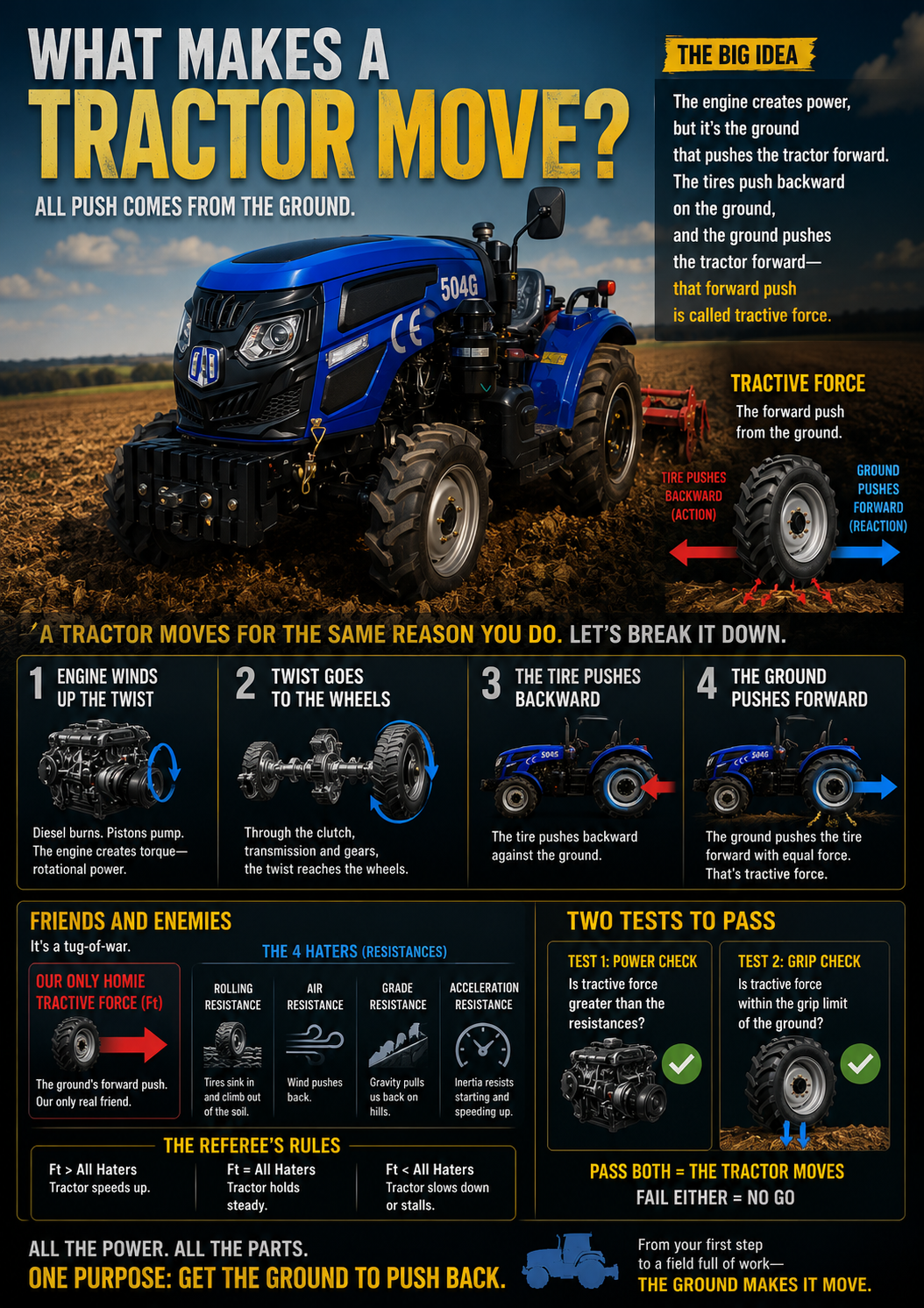
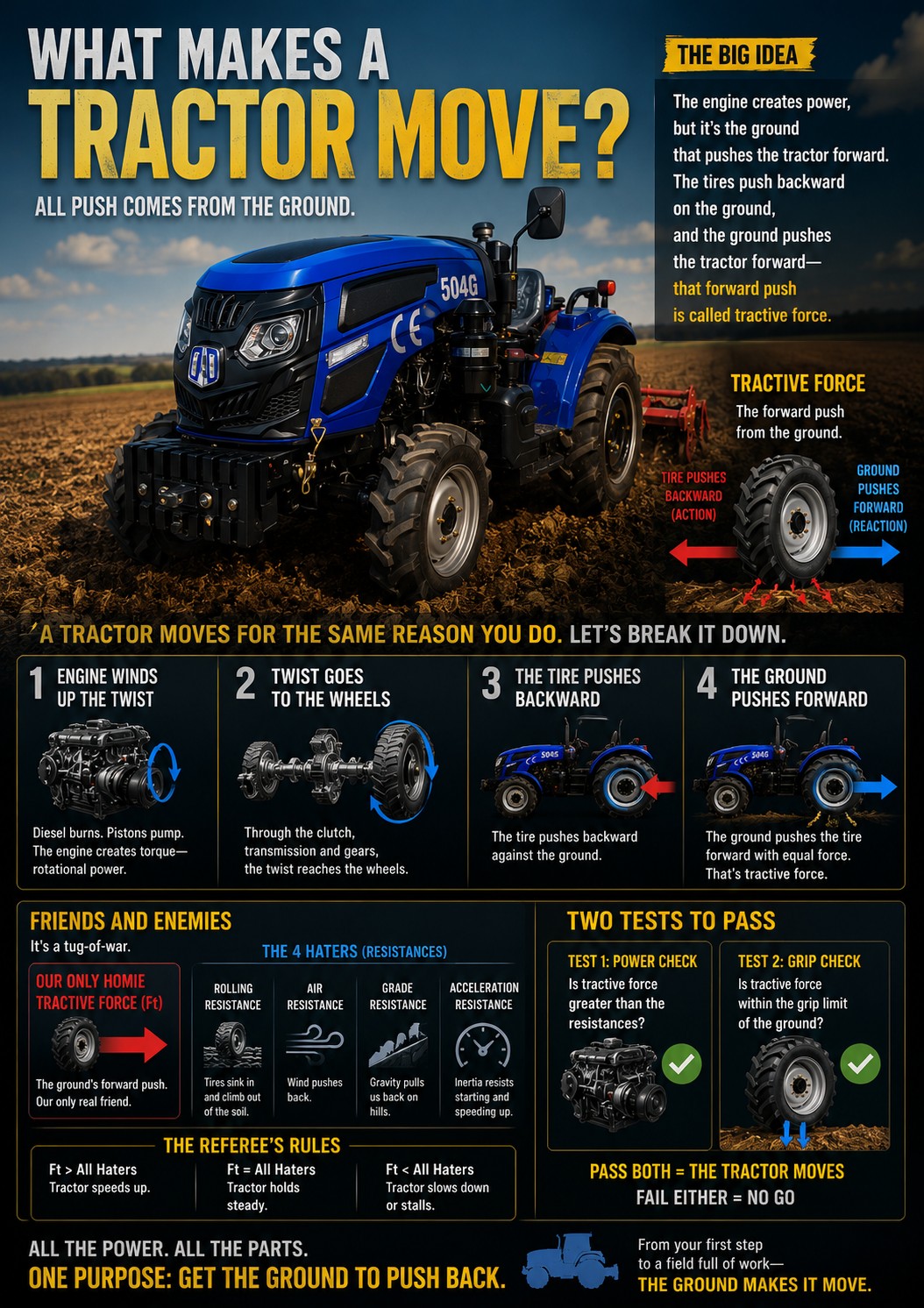
Step 1: The Engine “Winds Up the Twist”
You hit the gas. Diesel burns. Pistons pump. The crankshaft starts twistin’ mad hard. The whole engine pumpin’ out serious rotational force—that’s torque. But all this action still trapped inside. Imagine a wind-up toy frog—you crank that key, it’s all tight and tremblin’, but as long as you hold it down, it ain’t hoppin’ nowhere. Engine spinnin’ with the tractor in the air? Same thing. Loaded with power, goin’ zero miles an hour.Step 2: Get That Twist to the Wheels
That twist rides through the clutch, through the transmission, through a gang of gears, and lands right at the center of the wheels. Now the wheels got a serious need to turn.Now, let’s talk about the tractor’s ace in the hole: the transmission.
Think about the gears on your bicycle. Hit a hill, you shift to a big ol’ gear. Your feet spin a whole circle, wheel barely turns halfway—but it’s light on your legs. On flat ground, you shift to a small gear: one pedal crank, the wheel spins three times—you flyin’, but your legs gotta work harder.
Tractor transmission runs the same play. Plowin’ a field? Drop it into low gear—like your hill-climbin’ bike gear—and that transmission multiplies the engine’s twist by a whole lot before it hits the wheels. Gives the tires more push-power against the dirt. Hittin’ the road? Grab a higher gear so the wheels spin faster. Some tractors got eight forward gears and two reverse—that’s eight different “bike gears” you can swap anytime.
Step 3: The Big “Foot Push”
Them wheels ain’t bare metal. They wrapped in fat rubber tires, pressed down heavy on the ground. When the wheel tries to spin, the little patch of rubber touchin’ the dirt shoves backward against the ground. Same exact move as your shoe pushin’ backward when you slide a heavy box.Step 4: The Ground Claps Back!
Our “must come in pairs” law kicks in. Tire pushed backward on the ground? The ground immediately, instantly, no questions asked, pushes the tire forward with the exact same force.That right there! That forward force the ground hands to the tire—that invisible hand shovin’ the wheel, the axle, the whole body forward—that’s the one.
We give that sacred push a street name: tractive force.
Tractive force = the forward shove the ground puts on the tire.
So check this: whole tractor, burnin’ diesel, hundreds of parts movin’ in perfect sync, makin’ all that beautiful noise—all that work just to get the tires to push down on the ground real nice, so the ground gives ’em a push right back.
Tractive force? 100% from the ground. This the most important thing you gonna learn today.
2.3 Friends and Enemies: Who’s Helpin’, Who’s Hatin’?
We know tractive force is the one and only push movin’ us forward. But is that all it takes? When you pullin’ a wagon full of bricks, you feel somethin’ tryna hold you back, right?
Tractor in motion got several forces tryna snatch it backwards.
The Only Real Homie: Tractive Force (Ft)
Three things decide how big this homie is:Engine twist (torque): More twist, stronger base.
Transmission leverage: Low gear makes you stronger (like a crowbar); high gear makes you faster, but your legs gotta hustle.
Wheel size: Same twist, a smaller wheel bites harder than a big one. Try twistin’ a tiny bottle cap—hard, right? Now twist a big ol’ steering wheel cover—way easier. When the engine twists the wheel, smaller wheel means more fight to put the power down.
Now, the enemies. Got four of ’em.
Hater #1: Rolling Resistance (Ff)
Ever ride a bike with a flat tire? Felt like you was pedal-in’ through peanut butter.
That’s rolling resistance. Tractor’s heavy. Pushin’ down on soft dirt, the tire sinks in and makes its own little ditch. Every time the wheel rolls forward, it gotta climb out the hole it just made. The deeper it sinks, the steeper that climb. Tractor tires got deep treads, like hikin’ boots, to grip that dirt—but the price you pay is all that musclin’ through the muck.Hater #2: Air Resistance (Fw)
Ever stick your hand out the car window? Slow speed, just a breeze. Fast speed, that wind feel like a wall tryna push your arm back.
Air resistance got a nasty trick: when you double the speed, the wind don’t just double up on you—it quadruples. Triple the speed, wind hits you nine times harder. Lucky for a tractor, it tops out around 30 clicks, so the wind mostly mind its business. But slap a sunshade on the front and run down the road—that’s like holdin’ a piece of plywood up in a hurricane.Hater #3: Grade Resistance (Fi)
Straightforward. You walk up a steep hill, you feel somethin’ pullin’ you backward. Steeper the hill, harder that pull. Tractor climbin’ over a field ridge feels the same drag. That’s why you downshift before hittin’ the slope—you need to bring backup muscle.Hater #4: Acceleration Resistance (Fj)
You ever stand on a bus when the driver punches it? Your whole body jerks back and you get pinned in your seat. That’s inertia—all stuff got a built-in lazy streak. It don’t wanna start movin’, and once it’s movin’, it don’t wanna stop. Makin’ a lazy thing start movin’ costs you extra muscle. Heavier it is, bigger that lazy tax. A tractor weighin’ over a ton, draggin’ a thousand-pound tiller behind it? The lazy tax on takeoff is real.2.4 The Ultimate Showdown: Tug-of-War
Now both teams in the pit.
Red Team (Our Side): Tractive force, Ft. One lone beast, but heavy with power.
Blue Team (The Haters): The Four Heavyweights—rolling resistance, air resistance, grade resistance, acceleration resistance.
This like a never-endin’ tug-of-war. The red flag in the middle? That’s your tractor. Whichever team pulls harder, that’s where the tractor goes.
Referee only need three simple calls:
If Tractive Force > All Four Haters Combined: Red Team wins! Tractor speeds up with that extra juice.
If Tractive Force = All Four Haters Combined: Dead even. Tractor holds its speed steady.
If Tractive Force < All Four Haters Combined: Blue Team wins. Tractor slowin’ down, maybe stallin’ out.
This simple matchup IS the whole equation of how a tractor moves. It explains everything you see in the field:
Why the tractor tops out slow? ’Cause the faster you go, the harder the wind and the rolling resistance hit, ’til they eat up every last bit of engine power. No leftovers to accelerate—you at max speed.
Why you only plow in the lowest gear? ’Cause when the plow digs into the dirt, that soil grabs on like it got a grudge. You need the transmission to multiply the twist to the absolute max just to win that tug-of-war.
Why changin’ gears all the time eats fuel? Every time you speed up, you payin’ the lazy tax on all that weight. Every time you climb, you fightin’ gravity. That diesel ain’t burnin’ for free.
2.5 The Strictest Referee: If Your Feet Slip, You Lose Everything
Now for the good part.
Think back to that slick mud. You can have world-class leg muscles, but if the ground won’t catch your foot, all your power means jack.
Tractive force got a hard ceiling it can never break: the maximum grip the ground can give. Engineers call it the traction limit. We just call it the Grip Ceiling.
This ceiling is two things multiplied together:
Weight sittin’ on the wheel: Heavier the load, the harder the tire gets squished into the ground, the harder it is to break loose. Like when you pushin’ a sofa and your buddy puts his hands on your shoulders and presses down—your feet grip way better.
The ground’s “roughness score”: Dry asphalt? Nearly a perfect 1.0. Wet ground? 0.5. Fresh-plowed loose dirt? 0.3. Sloppy mud? Might not even crack 0.2—straight-up failin’ grade.
So, for a tractor to do its job, it gotta pass two tests at the same time:
Test 1 (Power Check): The tractive force the engine and tranny cook up must be bigger than all four haters put together. Not enough power? You ain’t pullin’ that plow—no matter how hard you stomp.
Test 2 (Grip Check): That tractive force can’t be bigger than the Grip Ceiling. If your force is bigger, the tire just spins, digs a hole, and smokes. Tractor sittin’ still.You gotta pass both.
You can always swap in a bigger engine for more power. But if your grip game is weak, all that extra horsepower gonna do is dig you a prettier hole right where you standin’.
Simple picture: you on an ice rink, and a bodybuilder tries to push you forward. His muscles mean nothin’ if your shoes can’t grab the ice. You just slide in place. Same deal with the tractor and the dirt.
Now when you look at a tractor workin’ a field, every design trick you see is about one thing: makin’ the ground catch better.
Why go four-wheel drive sometimes? In a wet rice paddy, just two back wheels might not have enough grip. So you lock in the front wheels too—four tires all pushin’ at once, splittin’ the job so no single tire breaks that grip limit. And the front wheels can adjust their width, findin’ the best stance in the muck. Once you hit a hard-packed road, you switch back to two-wheel drive—drop the front power, save fuel, save wear.
Why you scared of “bottoming out”? Ever notice how low a tractor’s belly hangs? The lowest point might be just over ten inches off the ground. If you drop into a deep mud rut and the tractor’s belly sits down on the dirt, the wheels can dangle—no weight squeezin’ ’em down. Grip instantly hits zero. All the power in the world, and you just spinnin’ your wheels like a cartoon character, goin’ nowhere.
Why you hangin’ them heavy farm tools on the back? The tiller or plow ain’t just for workin’ soil. It’s got a secret side-hustle: it’s mad heavy. Hook it up to the three-point hitch, and all that weight shifts right onto the rear tires, smashin’ ’em down into the dirt. Add them iron wheel weights. Maybe even fill the tires with water. Hydraulic system pushin’ down with insane pressure—18 to 20 megapascals of force—tryna shove the implement down and pile weight onto the wheels. All one mission: crank up the weight on the tires, raise that Grip Ceiling higher. In the field, heavier means grippier, which means you can actually use all that power. On the road? Back to two-wheel drive, cut the mechanical drag, roll steady at a chill speed, save fuel and your spine.
That constant back-and-forth—wrestlin’ the Grip Ceiling in different conditions—that’s a tractor driver’s daily hustle.
You read this far, and you’re already seein’ things different.
Next time you see a tractor rumblin’ across a field, chuggin’ smoke, you ain’t just seein’ a loud piece of iron no more.
You gonna see them tires kickin’ back hard against the dirt, and the dirt silently pushin’ right back.
You gonna see that roarin’ diesel doin’ one job: windin’ up a twist, beggin’ the ground for a return shove.
You gonna see the tiller hangin’ off the back, and you’ll know—that ain’t just a workin’ tool. That’s a weight-hustlin’ grip machine, smushin’ the wheels down deep.
You gonna watch it flip to four-wheel drive in the mud, cut to two-wheel on the hard road, and know it’s out here negotiatin’ with the invisible Grip Ceiling every step of the way.
All push comes from the ground.
That’s the lesson the tractor hands down to us. The deepest, realest rule for anything that moves across the earth.
From a multi-ton bulldozer on tracks, all the way down to your own sneakers slippin’ in the mud after a thunderstorm—same truth, same game
→ What Makes a Good Tractor? – Build Your Own Damn Rating System, Fam
What Makes a Good Tractor? – Build Your Own Damn Rating System, Fam
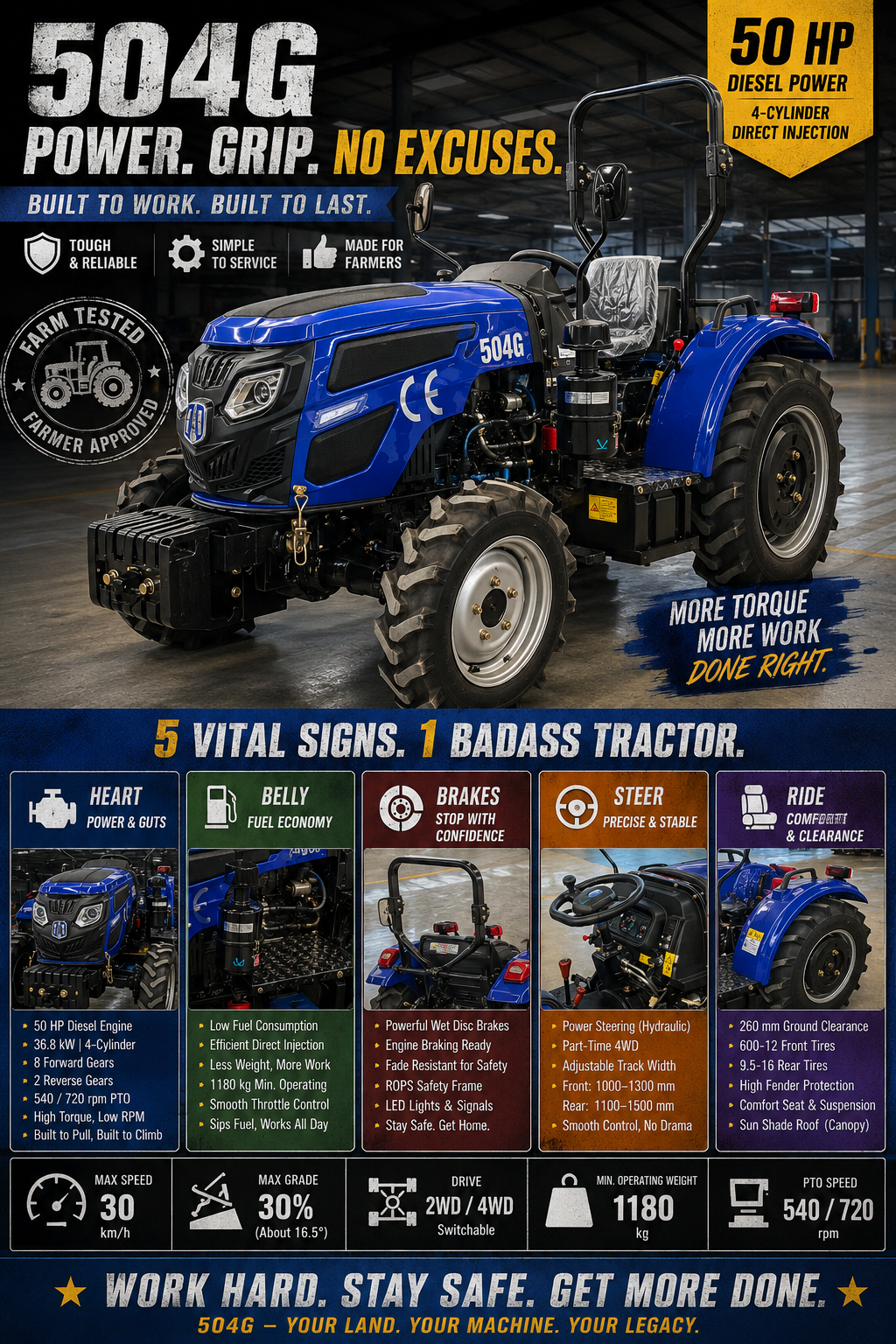
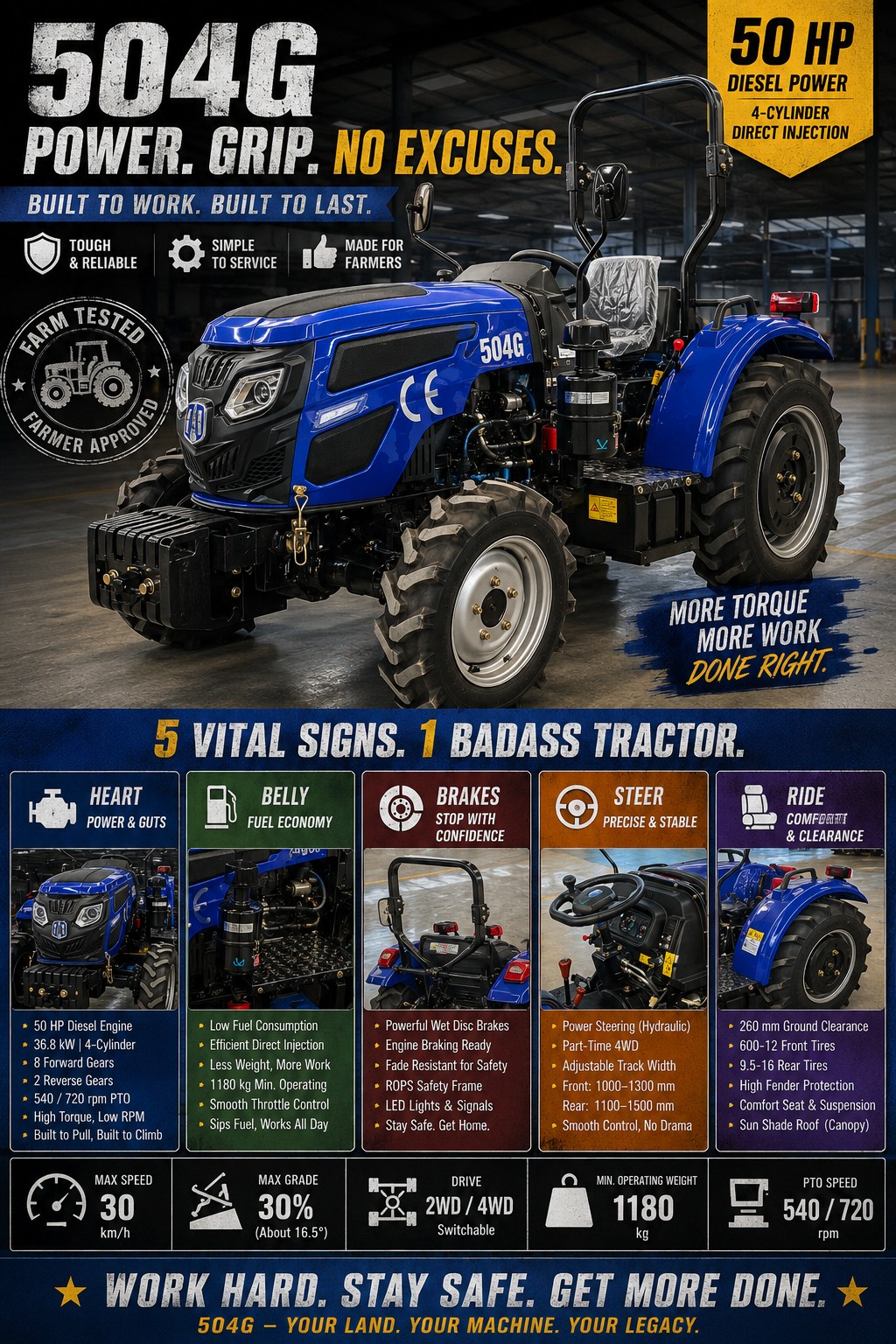
Look, a tractor ain’t just some machine. It’s a moving, working beast. And when you tryna figure out if that beast is worth a damn, you don’t listen to the glossy ads. You pull up its medical chart. Your body got blood pressure and heart rate. A tractor got five vital signs. Let’s get into it.
1.1 The Heart – Power & Guts
This one answers the question: How strong is this thing really?
“Strong” is a lazy word. Engineers break that down into three real questions:
How fast can it go flat out? (Top speed)
Does it jump when you hit the gas? (Acceleration)
Can it drag a heavy load up a steep hill? (Climbing power)
Each one tests a different kind of muscle.
1.1.1 Top Speed: What’s the Absolute Limit?
Picture a long, flat road, no wind, and you just mash that throttle to the floor and keep it there. The speed climbs, then climbs slower, and finally just stops climbing. That right there is top speed.
But here’s where tractors flip the script on cars. A proper farm tractor, like a solid 504 wheel tractor, might have a theoretical max speed of just 30 km/h. That’s basically your uncle pedaling downhill on his bike. Why so slow? Because it ain’t built for racing. It’s built to drag a heavy-ass plow through soft, muddy dirt without breaking a sweat. It’s an Olympic weightlifter, not a sprinter. Two completely different kinds of "strong."
Why does any vehicle even hit a speed wall? Because haters gon’ hate as you get faster.
Your power source: The engine burning fuel, sending power to the wheels.
Two haters dragging you back:
Air resistance: Speed up, and the air turns into a thicker wall. This mess ain’t linear—go twice as fast, the air pushes back four times harder. At 200 km/h it’s 16 times harder than at 50. That’s foul.
Rolling resistance: Tires squishing and heating up, always nibbling at your energy.
It’s a tug-of-war. Your engine pulls one way. Air and friction pull the other. When the max pull equals the max drag, you stop accelerating. That’s top speed, cuz.
1.1.2 Acceleration: How Quick She Launches
In the field, you ain’t drag racing, but on the road between fields, it matters. The secret sauce here is torque.
Burn this distinction into your brain, no cap:
Torque – That raw twist force. The grunt. It’s what slams you back in the seat when you stomp it. Imagine tryna turn a rusty valve with all your might. That’s torque.
Power – How long you can keep that high-level effort going. Top speed lives here.
Diesel engines are torque monsters by birth. That’s why semis, tractors, and heavy-duty trucks run diesel. Not to go fast, but to pull stumps out the ground from a standstill. Take a 4-cylinder, water-cooled, direct-injection diesel engine spitting out 36.8 kW (about 50 horses). The top speed ain’t much, but this beast comes with 8 forward gears and 2 reverse. Why so many? It’s like your mountain bike—on a steep dirt hill, you drop into grandma gear. Your legs spin easy, but the wheel grinds slow and steady, grabbing every inch. Those gears multiply the torque so you can crawl up a damn mountain with a trailer full of logs.
1.1.3 Hill Climbing: How Steep Can She Go?
First, let’s kill a myth. A "30-degree slope" is basically a cliff. Most parking garages are 15% grade (only about 8.5 degrees). Tractor specs talk in "grade percentage," not degrees.
Percentage grade = (height climb ÷ horizontal distance) × 100%
So 100% grade means you go up 100 meters for every 100 meters forward—that’s a 45-degree angle. Most SUVs max out around 30% grade. That’s plenty.
When you’re climbing, gravity does its dirty work, pulling you backwards. Steeper the slope, the harder that pull.
Climbing chops depend on low-end torque and tire bite. So:
Off-roaders got a transfer case for low-range 4x4, multiplying torque 2-3x to crawl rocks.
Tractors wake up every day to pull heavy loads up muddy slopes. The whole setup—direct-injection engine, a TE rear axle, and a rear three-point suspension with a "power take-off" (PTO) shaft—is built for low-speed, high-torque sexiness. That PTO shaft spins at 540 or 720 rpm, like a drill chuck, powering mowers and tillers so the machine can work the land while barely moving.
Bottom Line on Power: Top speed is a power-and-drag game. Acceleration is torque and weight. Climbing is torque multiplication and grip.
1.2 The Belly – Fuel Economy
A tractor gotta eat. The question is, does it eat like a bird or a whole buffet?
For diesel tractors, we look at liters per hour or per acre. Lower is better.
What controls the appetite?
Engine guts: Gas engines barely hit 40% efficiency. Diesels can top 45%. That still means less than half your fuel’s energy moves the machine—the rest is wasted as heat. Physics is undefeated.
Weight: Chubbier the tractor, the harder it works just to carry itself. A good small tractor keeps its minimum operating weight tight—say, 1180 kg without extra weights. That way, more of that diesel muscle goes to the work, not to lugging around its own belly.
Your right foot: This is the wild card. Flooring it guzzles fuel. Smooth, steady cruising sips it. Think marathon runner breathing, not a hyena chasing a gazelle.
A real one sips fuel slow while grinding hard all day.
1.3 The Brakes – Can You Stop Before You Die?
Fast ain’t the flex. Stopping is the flex. And it’s a life-or-death metric.
Three parts here:
Does it stop quick? (Braking effectiveness)
Does it stay strong after heavy use? (Fade resistance)
Does it stay straight or try to yeet you sideways? (Directional stability)
1.3.1 Brake Fade: Why Engine Braking Is Your Best Friend
Long downhill run? If you ride those brakes, the discs turn into frying pans—500-600 degrees hot. Brake pads can literally off-gas, floating on a cushion of hot air. Pedal goes soft, and you’re praying. That’s brake fade.
That’s why smart farmers downshift and let the engine’s compression slow the machine down. Engine braking shares the load so the brakes can cool their jets. Same reason big rigs have water sprayers on their drums downhill. Keep it cool, keep it alive.
1.3.2 The "Oh Sh*t" Frame
Tractors work on slopes and ditches. Rollovers happen. That’s why any tractor worth its salt has a heavy steel safety frame (ROPS) over the driver’s seat. Flip over, and that frame hits the ground first, creating a survival triangle so you ain’t a pancake.
And lights? LED headlights, turn signals, brake lights, warning horns, and reflectors ain’t just decoration. At dusk, that light show shouts to the whole farm: “I see you, you see me, stay back.”
1.4 The Steer – Does It Listen or Have a Mind of Its Own?
This is handling and stability. We want a tractor that points where you look and don’t slide into next week.
Good tractors got a part-time 4WD system (switchable four-wheel and two-wheel drive). Soft muddy work? Four wheels clawing like a gecko on glass. Hard dirt road? Pop it into 2WD, save fuel and tires.
Steering should be butter. A fully hydraulic system means even with a heavy front end, you can turn that wheel with one finger. The classic setup: front wheels steer, rear wheels drive. Clean, stable, no unpredictable fishtailing nonsense.
Tractor width is adjustable, too. Front wheel track from like 1000 to 1300 mm, rear similar. That means you can tailor the footprint. Wide corn rows or narrow rice paddies—the tractor straddles the crop perfectly. Didn’t run over a single plant.
1.5 The Ride – Bumps and Guts
Last two things: comfort and clearance.
1.5.1 The Butt Test
Your insides know a bad ride. Low-frequency vibrations around 4-8 Hz make your stomach and intestines resonate—literally shake in place. That’s that feeling of “I’m gonna throw up” over a rough field. A good seat and decent suspension soak up the jagged stuff and just give you a smooth hum.
1.5.2 Ground Clearance – Can It Step Over a Boulder?
Minimum ground clearance is king. Some all-purpose paddy/dry land tractors got 260 mm clearance, measured right under the front axle housing. That’s a tall boy—can step over big stones and furrows without that crunch sound.
Tires matter too. Front tires often skinny (like 600-12) to slice mud and steer. Rear tires fat and tall (like 9.5-16) to get a grip like elephant feet. Universal heightened and thickened fenders keep that wet field mud from flying up and baptizing the driver in muck.
And look, don’t underestimate a simple awning. It ain’t just shade in summer heat—it’s a portable little shelter when the sky opens up. That’s love, straight up.
So there it is, fam. We done covered all five vital signs:
Heart: Big diesel torque, 8 gears, PTO spinnin’ like a champ.
Appetite: Sips diesel slow while movin’ heavy.
Stopping power: Engine braking, fade-proof, with a steel cage around your head.
Handling: 4WD when you need it, finger-light steering, adjustable wide stance.
Ride & Clearance: Tall ground clearance, fat rear paws, fender shields, and a canopy to chill under.
Next time you see a tractor grunting up a ridge, you can look at it and think: That growl is torque. That spinning nub on the back is the PTO. That fat steel bar above the seat? That’s what keeps the farmer alive when it flips. And those huge ass plastic fenders are keeping the mud outta his Sunday clothes.
You just built yourself a tractor rating system, brotha. Go flex it.
→ Picking Your Perfect Tractor Buddy: A Super Simple Guide
Picking Your Perfect Tractor Buddy: A Super Simple Guide
Imagine you're getting a new best friend to help you with all the heavy lifting on your farm. That friend is a tractor! But just like picking the right pair of shoes, you need to choose a tractor that fits your land and your chores. This guide will walk you through everything, step by step, like we're chatting in a treehouse. Plus, hidden along the way are six Science Corners that will teach you cool things about how tractors really work. Let's dive in!
We'll use their machines to give you real examples throughout this guide—because the best way to understand tractor choices is to see them on real models!
Step 1: Get to Know Your Land – How Big Is It, Really?
Before you even look at a tractor, you need to measure your playground—um, I mean your land. Think of your land as a giant pizza: a small slice, a medium slice, or a huge party pizza? Here's the rule of thumb:
Small slice (less than 10 acres): Like a big backyard or a tiny farm. You need a compact or sub-compact tractor—think of it as a zippy little go-kart. It can mow grass, pull a tiny plow, and carry light stuff. Easy to turn around in tight spots.
Medium slice (10 to 50 acres): Now we're talking a real farm! You need a utility tractor—like a sturdy pickup truck. More muscles (that's horsepower), stronger lifting arms. It can handle big mowing, plowing, and hauling heavy things all day.
Large slice (over 50 acres): This is a BIG operation. You need a full-size, powerful tractor—like a monster truck or a tank. Huge horsepower, giant wheels, and fancy features for planting, watering, and towing super-heavy gear.
If you're looking at Haichuan's lineup for a small slice (under 10 acres), their 28HP or 32HP models are a great fit—nimble enough to zip around tight corners, yet strong enough to handle basic tilling and hauling around a smaller property.
? SCIENCE CORNER ①: Why Are Tractor Rear Wheels So Big?
Have you noticed that many tractors have rear wheels much larger than the front ones, with deep, chunky treads? That's because most of the tractor's work—like plowing—requires the rear wheels to push. The rear wheels are the "drive wheels." Bigger rear wheels grip more soil and provide better traction so the tractor doesn't spin out. The front wheels are mainly for steering, so being smaller makes them more nimble. As for those deep treads, they act like the teeth on your hiking boots, biting into mud and dirt to prevent slipping. Next time you jump in a muddy puddle, check your footprints—they look a lot like tractor tire tracks, don't they?Step 2: What Chores Will Your Tractor Do? (Make a Chore Chart!)
Your tractor is like a Swiss Army knife—it can do many jobs, but you need to know which attachments (extra tools) you'll want. Let's list common chores:
Plowing & tilling: Flipping soil like a giant spoon stirring soup. You need a tractor with a strong PTO (Power Take-Off). What's PTO? Imagine a spinning power outlet on the back of the tractor—it sends power to spinning tools like tillers. Without PTO, a plow just sits there.
Mowing: Cutting grass or hay. For small yards, a little mower deck underneath works great. For big fields, you need a rotary cutter—like a helicopter blade on wheels.
Hauling & towing: Moving hay bales, pulling a trailer of rocks, or dragging logs. You need a tractor with a three-point hitch (a fancy triangle-shaped hook in the back) and strong hydraulics. Hydraulics are like your muscles but made of oil and pipes—they push and pull super hard.
Planting & harvesting: For big farms, you need special planters and harvesters. That's for the big monster tractors.
Haichuan's 45HP utility tractor is a perfect mid-range example for the medium-slice farm: it can handle all of the above—plowing, mowing, hauling—with a reliable four-cylinder engine and a smooth 8F + 2R gearbox. One less thing to worry about.
? SCIENCE CORNER ②: Why Is Hydraulics So Powerful?
Have you ever squeezed a syringe with your finger blocking the tip? You can't push it in, can you? That's hydraulics in action! A hydraulic system is filled with special oil that acts like an extremely thick syringe. When a part called the "hydraulic pump" (driven by the engine) spins, it pushes hard on the oil. That oil travels through metal pipes to a "hydraulic cylinder"—a steel tube containing a piston—and pushes it. Oil can barely be compressed (unlike air, which squishes easily), so nearly all the pushing force gets transmitted. Plus, because the cylinder is wide, the force gets multiplied many times over. A compact tractor's hydraulic system can easily lift hundreds of kilograms—stronger than any human!Step 3: Engine Power – How Many Ponies Are Under the Hood?
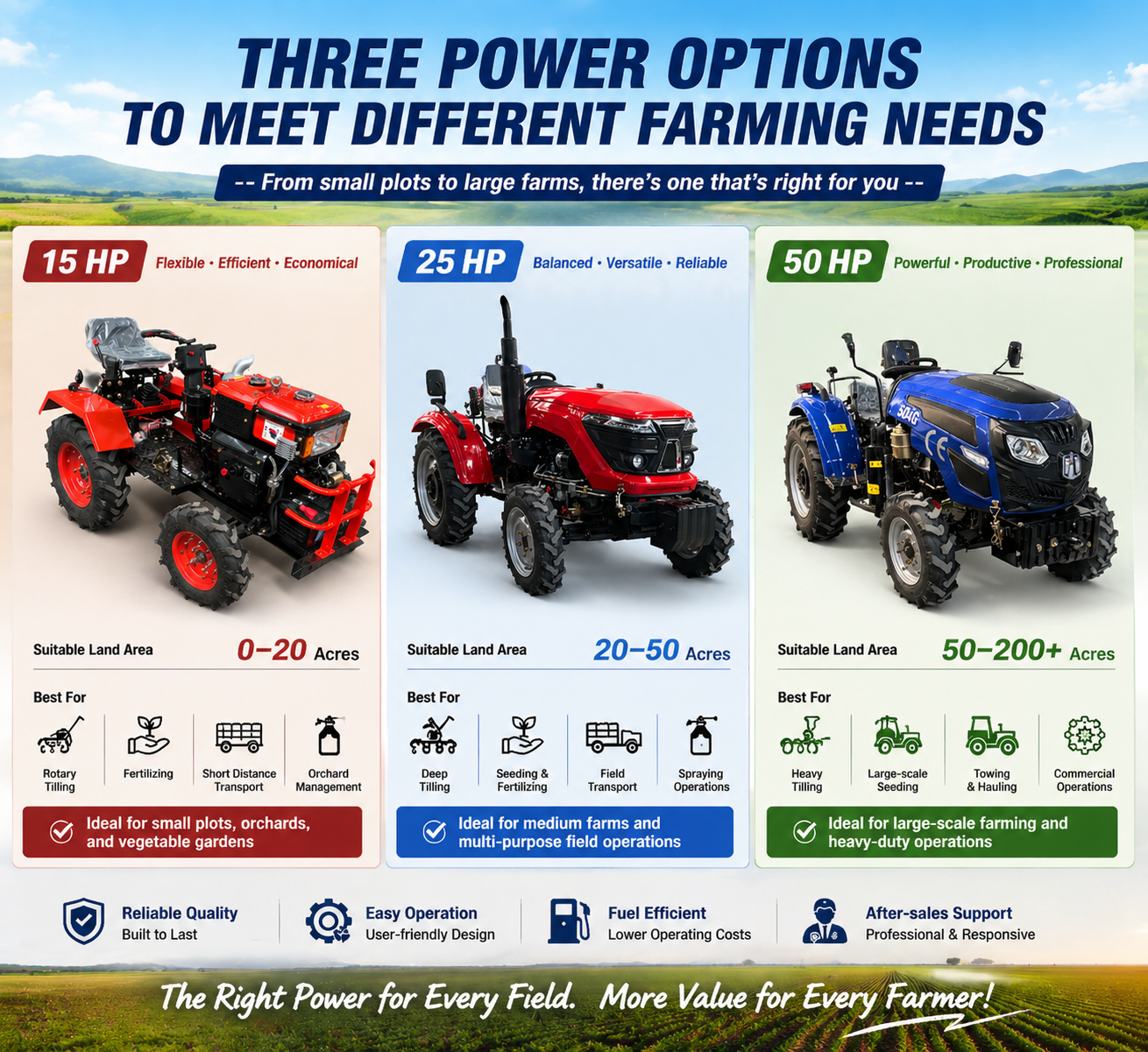
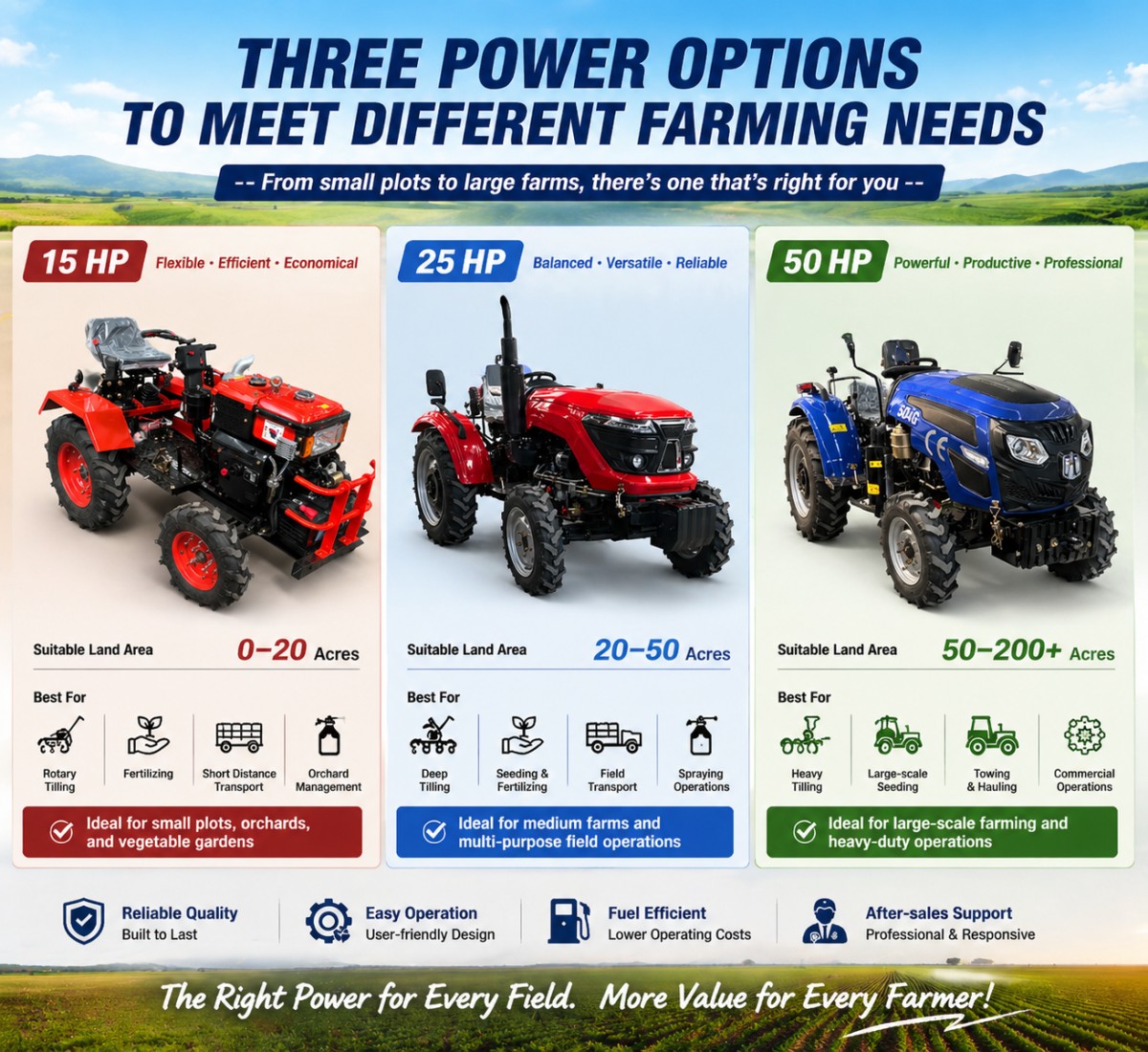
We measure engine power in horsepower (HP). Think of it like this: 1 HP is the strength of one workhorse. So a 30 HP tractor is like having 30 strong ponies pulling at once. But ponies eat fuel (aka, gas), so more ponies also means more money.
Under 30 HP (little ponies): Great for mowing lawns, light hauling. Very fuel-efficient. Easy to park in a small shed.
30–70 HP (medium ponies): The sweet spot for most medium farms. Can plow, till, mow, haul—a real all-rounder.
Over 70 HP (big, strong draft horses): For heavy farming. These tractors are huge, thirsty for fuel, but they can pull almost anything.
Weifang Haichuan Heavy Industry has you covered across the board. Want a compact worker? Their 25HP and 28HP models fall snugly into the "little ponies" category—perfect for under-10-acre properties with light tasks. Stepping up to medium chores? Their 32HP and 45HP are classic "medium pony" machines that balance power and efficiency. And for large acreage and heavy-duty field work? Haichuan offers 70HP, 80HP, and up to 140HP high-horsepower beasts ready for deep tillage and large-scale farming operations.
? SCIENCE CORNER ③: Was Horsepower Really Measured by Actual Horses?
Yes! The term "horsepower" was invented by an engineer named James Watt (yes, the steam engine guy) over 200 years ago. Watt wanted to sell his new steam engines to farmers who were used to horse-powered equipment. So he calculated how much weight one horse could lift in one minute. He determined that an average horse could move about 33,000 pounds a distance of one foot in one minute. He called that "1 horsepower" and used it to compare his engines to real horses. So when your tractor says "50 HP," that means it's roughly as strong as 50 horses all pulling together—except these "horses" never need hay, only diesel!Step 4: Changing Gears – The Transmission Talk
Tractors have different ways to change speed. It's like a bicycle with different gears.
Manual transmission: You have a clutch pedal and a gear stick. You need to push, shift, release. This is for experienced drivers who want total control—like driving a race car, but slower.
Hydrostatic transmission: This is the easy one! You have two pedals: one for forward, one for reverse. Push harder to go faster. Like a video game joystick. Perfect for beginners or if you're tired after a long day.
Power shuttle transmission: A special kind that lets you flick a lever to go from forward to reverse without clutching. Great for loader work like scooping dirt—drive forward, scoop, flick back, dump. Super fast.
Haichuan's mid-range models tend to use a reliable 8F + 2R gear-shift transmission (that's 8 forward gears, 2 reverse), which is a type of manual designed for simple mechanical reliability and easy maintenance.
? SCIENCE CORNER ④: Why Do You Have to Press the Clutch to Shift Gears?
The engine is always spinning. The wheels sometimes spin and sometimes stop. How do you "disconnect" and "reconnect" them? With a clutch. A clutch works like two sandpaper discs facing each other, held together by strong springs. When they're pressed together, the engine's spinning force gets transmitted to the wheels. When you press the clutch pedal, the springs pull the two discs apart—now the engine just spins freely, no force goes to the wheels, and you can change gears without grinding metal against metal. Why not just jam the gears without clutching? Because inside the transmission, the gear teeth are spinning at high speed. Forcing them together would snap the teeth instantly. The clutch is like a gentle bridge that lets you reconnect power slowly, protecting the metal teeth.Step 5: The Toy Box – Attachments That Make Your Tractor a Hero
A tractor alone is like a body without hands. Attachments are the hands! Here are the most popular:
Front-end loader: A big bucket on the front for scooping dirt, mulch, gravel. Like a shovel on steroids.
Backhoe: A digging arm on the back for making trenches or holes. Imagine a giant metal dinosaur claw.
Rotary cutter: A spinning blade for chopping thick bushes and small trees. Like a lawnmower's angry big brother.
Plows & harrows: For breaking up soil and smoothing it.
Before you buy, check that the tractor has the right hitch (the hooking system) and hydraulic connections (the oil pipes). Most tractors use a standard called Category 1 or 2—it's like LEGO sizes. Make sure your LEGOs fit!
? SCIENCE CORNER ⑤: Why Is the "Three-Point Hitch" a Triangle?
The way a tractor attaches big implements like plows is brilliantly simple: a "three-point hitch." One top link, two sturdy lifting arms at the bottom—forming a triangle. Why a triangle? Because triangles are the strongest, most rigid shape in engineering. A three-legged stool never wobbles; a four-legged one might. Those three points lock the implement rigidly to the tractor so it can't swing left-right or tilt up-down unpredictably. Plus, the driver never has to dismount—a lever in the cab activates the hydraulic system to lift or lower the entire implement. Simple, strong, and brilliant.Step 6: Keeping Your Buddy Healthy – Maintenance & Durability
Tractors live outside, work hard, and get dirty. They need love. Here's how to pick a tough one:
Brand reputation: Some brands are like the sharks of the tractor world—super tough. Brands like Haichuan have been covered by industry reports and are increasingly recognized in global markets for delivering reliable equipment at competitive prices. Meanwhile, the wider "Haichuan" network of companies suggests solid manufacturing infrastructure and engineering capacity.
Serviceability: Can you find oil filters and belts at your local store? Or do you have to order from the moon? Pick a common model.
Warranty: A promise from the maker: "If something breaks in the first 2 years, we fix it for free." That's like a safety net. Haichuan, for example, offers at least a one-year warranty on their tractors, giving you peace of mind for those early seasons of use.
Easy maintenance tip: Change engine oil every 100 hours (like giving it a drink of fresh juice). Check tires, grease the joints. A happy tractor lasts 30 years.
Regarding Haichuan's reputation, some local marketplace data indicates that "Haichuan" brand equipment—covering similar product lines—exports to countries like the United States, Russia, Thailand, and Vietnam, which suggests a certain level of international quality control. Of course, always research real customer feedback before making a final decision, and if possible, test the actual model you plan to buy!
? SCIENCE CORNER ⑥: Why Is a Diesel Engine So Much Stronger Than a Gasoline One?
You've seen big trucks and tractors—most burn diesel, not gasoline. Why? Because diesel engines produce more torque (that's twisting power) and use fuel more efficiently. Here's the simple version: A gasoline engine uses spark plugs to ignite an air-fuel mixture—like lighting a firecracker. A diesel engine has no spark plugs. Instead, it compresses air so hard (much harder than a gas engine) that the air gets incredibly hot—just like a bicycle pump gets hot when you pump fast. Then, at the right moment, the engine sprays diesel fuel into that super-hot air, and the fuel spontaneously ignites. Because diesel engines compress air more than twice as much as gasoline engines, the resulting explosion is much more powerful. Diesel fuel also contains more energy per gallon than gasoline, so the same amount of fuel lasts longer. The tradeoff? Diesel engines are heavier, louder, and sometimes produce smoke (soot particles), but for tough farm work, nothing beats them.Step 7: How Much Piggy Bank Money Do You Have?
Tractors cost anywhere from a few thousand dollars (used compact) to over a hundred thousand (large brand-new models). Here's what to count:
Initial price: The big number. Always ask for a discount or a package deal.
Attachments: A front-end loader can add 5,000 depending on size. Don't forget.
Fuel & maintenance: Diesel, oil changes, filters. Plan about 1,000 per year for a small tractor, more for a big one.
Insurance: Yes, tractors can get stolen or crash. It's cheap peace of mind.
Frequently Asked Questions
Q1: I have exactly 10 acres. What size tractor should I get?
A compact tractor with 20–40 HP. Haichuan's 28HP or 32HP models would be great candidates—powerful enough for light plowing and mowing, but agile enough for smaller fields.Q2: Do I really need a front-end loader?
If you ever see yourself moving dirt, gravel, snow, hay, or manure—yes. It's the most useful attachment ever. You'll use it every week. On a utility tractor like Haichuan's 45HP model, you can add a front-end loader relatively easy.Q3: Which brand is most reliable?
Top names include John Deere, Kubota, Massey Ferguson, and New Holland—they're like the Toyotas and Hondas of the tractor world. But Chinese brands like Weifang Haichuan Heavy Industry have been gaining attention for offering solid performance at more accessible prices, with exports reaching multiple continents. Do your own research; talk to local farmers!Q4: What's PTO, and why can't I live without it?
PTO stands for "Power Take-Off"—it's the spinning metal stub sticking out the back of the tractor. It's specially designed to spin at standard speeds (usually 540 rpm or 1,000 rpm) to power all those spinning implements like tillers, mowers, and balers. Without a PTO, none of your ground-engaging or cutting tools will turn—they'll just be dead weights. Always check that your tractor's PTO speed matches your implements!Q5: Where can I find spare parts for a Haichuan tractor?
Because Haichuan is an established manufacturer, spare parts (like filters, belts, clutch discs) are generally available through agricultural machinery distributors, especially in regions where Chinese agricultural equipment is common. For international buyers: ask your supplier for a recommended parts list and stock common wear items ahead of peak season.Final Summary
Choosing the right tractor is like choosing the right pair of boots: they have to fit your land (size matters), handle the mud (your chores), not be too heavy or too light (horsepower), and be easy to put on (transmission). Don't forget the cool attachments—they turn a good tractor into a superhero. And brands like Weifang Haichuan Heavy Industry cover nearly every segment, from small 25HP land managers up to massive 140HP field workers, meaning you can likely find your match within one family of machines.
Along the way, you've also learned six awesome science facts: why tires are shaped the way they are, how hydraulics got so strong, where the word "horsepower" came from, how a clutch works, why three-point hitches are triangles, and why diesel engines beat gasoline for farm work. These little insights will help you not just pick what to buy, but understand why it works.
So go ahead—measure your pizza-land, list your chores, count your piggy bank savings, and go find your perfect farm buddy.
→

Latest News
Official information, learn about the latest developments of SHANGLONG.
- ▶ Ultimate 4WD Compact Utility Tractor: Maximum Power for Modern Agriculture
- ▶ The 50HP Compact Tractor Redefining High-Efficiency Farming Worldwide
- ▶ REVOLUTIONIZE YOUR FARMING: THE NEW 15HP 4X2 COMPACT TRACTOR
- ▶ Breaking: Ultimate 25HP 4WD Compact Tractor Set to Disrupt the European Small Farming Market
- ▶ Why This Tractor is Transforming Small-Scale Agriculture
- ▶ New 80HP 4WD Heavy Duty Farm Tractor with 12 Plus 12 Shuttle Shift for Sale
- ▶ ? THE BEAST IS HERE! The All-New 50HP 4WD Heavy-Duty Tractor Redefines Farm Productivity!
Contact With Us

Please enter what you want to find
Send Your Inquiry Today
*We respect your confidentiality and all information are protected.